E-Paper



SC, Centre mustn’t find faults, need balance: CJI
Chief Justice of India (CJI) Dhananjaya Y Chandrachud said the two institutions cannot keep finding fault with each other in matters of judicial appointments, at a time when the Centre continues sitting on several recommendations by the Supreme Court collegium to appoint judges.

 Prefer HTon Google


Chief Justice of India (CJI) Dhananjaya Y Chandrachud on Friday stressed on the need of “constitutional statesmanship” between the Union government and the apex court, saying the two institutions cannot keep finding fault with each other in matters of judicial appointments, at a time when the Centre continues sitting on several recommendations by the Supreme Court collegium to appoint judges.
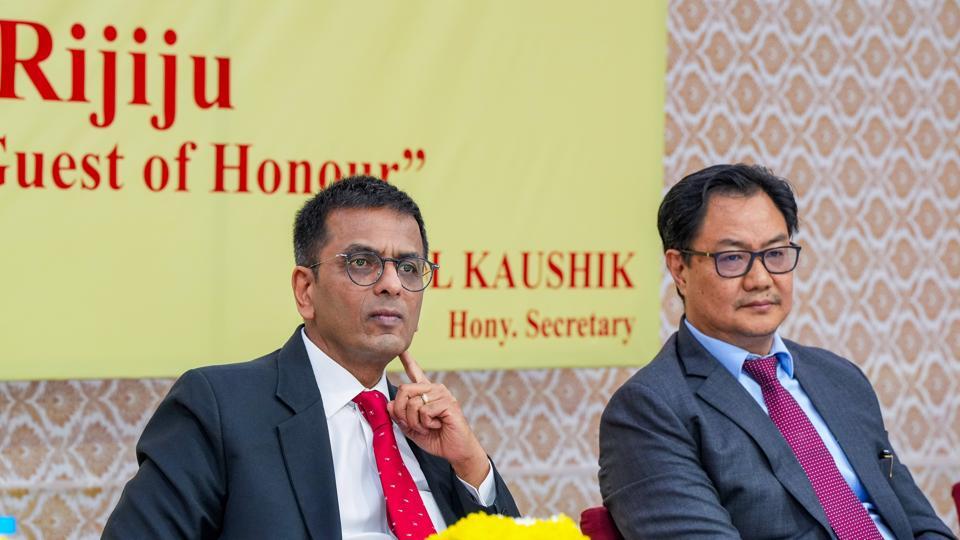
With Union law minister Kiren Rijiju in attendance at a function organised to celebrate Law Day, the CJI called for “harmony” and “balance” as he was emphatic that the collegium does a lot of homework before names are sent to the government for notifying appointments, and therefore the two institutions need to work as constitutional statesman to finding just conclusions.
Also Read | Must reconsider strict dress code for lawyers: CJI Chandrachud
“So much of the work of the collegium takes place when an agenda is circulated, but so much of the work of the collegium takes place much earlier and much thereafter when we leave over a cup of coffee or when we share the thought over a cup of coffee. So, you must also understand that there is something called a soft culture within the judiciary as well,” said justice Chandrachud.
“We, as judges are not here only to only follow the letter of the law by following the processes of the collegium, but for the purpose of ensuring that the soft culture, that sense of constitutional statesmanship between the government and the Supreme Court continue to be in harmony to find the right balance in the selection of judges. We can’t be constitutional statesmen if we are only at a point where we are finding fault with each other,” he said.
The CJI’s statements at the event organised by the Supreme Court Bar Association (SCBA) come days after the law minister’s strong and consistent criticism of the apex court’s model of selecting judges through the collegium system. At various instances during the last one month, Rijiju commented that the Supreme Court collegium appoints people who are known to the judges; called the collegium system “opaque”; and described the Indian selection system as the only one where judges appoint judges.
Also Read | Institution’s sanctity must as live-stream provides access: CJI
Justice Chandrachud, in his address, acknowledged the criticism of the collegium system, saying no institution democracy or in a constitutional democracy is perfect. “But we work within the existing framework of the Constitution, as it is interpreted and given to us. All the judges of the collegium, including me, are faithful soldiers who implement the Constitution. When we talk of imperfections, our solution is to work our way within the existing system,” he underlined.
Speaking at the same event, Rijiju, said that the government is committed to ensuring that the independence of the judiciary is “untouched”, adding the judiciary and the executive are the children of the same parent — the Constitution of India. “Aapas me ladna jhagadna theek nahi hai. Hum log mil kar kaam karenge aur desh ko majboot banayenge (There is no use in fighting with each other. We will work together to strengthen the nation),” said the law minister. He said that the government, under the leadership of Prime Minister Narendra Modi, has done nothing in the last eight and half years to undermine the authority of the Indian judiciary.
The delay on the part of the government in clearing the names recommended by the collegium was on November 11 taken up by a Supreme Court bench led by justice Sanjay Kishan Kaul on the judicial side. Saying that the endless hold-up by the Centre in clearing names is “not acceptable”, this bench demanded explanations from two top law ministry officials, and fixed the matter for hearing next on November 28.
Apart from 21 names recommended for the appointment as high court judges, the justice Kaul-led bench during the November 11 proceedings also took note of a complaint by senior advocate and SCBA president, Vikas Singh, that the government is yet to clear the elevation of Bombay high court chief justice Dipankar Dutta as a judge of the Supreme Court though the collegium’s resolution was dated September 26.
On Friday, Singh raised the issue again while speaking at the function, and said that the government’s act of not clearing collegium’s recommendations is a “complete negation of the rule of law”.
“In view of the Supreme Court’s judgments, the recommendations of the collegium have to be honoured. It is unfortunate that the government is disobeying the rule of law by even not making those appointments which have been reiterated by the collegium...the government cannot pick and choose that we will appoint this person but not another,” emphasised Singh. He added that the government can come up with a new law and a new system for appointment of judges but till the time that does not happen, they are duty-bound to follow the law of the land as enunciated by the Supreme Court judgments.
The subject was also raised by SCBA vice-president Pradeep Rai who requested the law minister to accept the collegium’s recommendations. “This issue has been settled by the pronouncements of this court. If you (government) have any doubt, I would advise you to consult the judgments of the Supreme Court,” he said.
Rai added that Rijiju, being the senior most person in the law ministry, should not make statements that can embarrass anyone. “Because the honourable judges don’t have medium to say anything but the bar will certainly respond to it,” said the senior lawyer.
Attorney general R Venkataramani, on his part said: “Mr Rai has proposed certain things. I second him. That’s a good way of seconding before the law minister.”
Under the memorandum of procedure (MoP), which guides the appointment of judges in the higher judiciary, the government can only object once if it does not agree with the collegium’s recommendations, but is bound by the decision after the names are reiterated. The MoP, however, does not prescribe a deadline for the government to notify appointments.
In 2014, the government passed the National Judicial Appointment Commission Act, setting up an alternative system for appointment of judges to constitutional courts, but in 2015, the Supreme Court ruled that the law was unconstitutional.
In the November 11 hearing mentioned above, the court had noted that some recommendations have remained pending with the Centre for at least a year — the oldest of which dated back to September 2021. Besides, there were 10 other names pending with the government, which have been reiterated by the Supreme Court.