E-Paper



SC delivers split verdict on sanction for graft probes against public servants
The verdict came in a batch of petitions, challenging the dilution of the anti-corruption framework


The Supreme Court on Tuesday delivered a split verdict on the constitutional validity of Section 17A of the Prevention of Corruption (PC) Act, 1988, a provision inserted through the 2018 amendments mandating prior government approval before initiating any inquiry or investigation against public servants for decisions taken in the discharge of official duties.
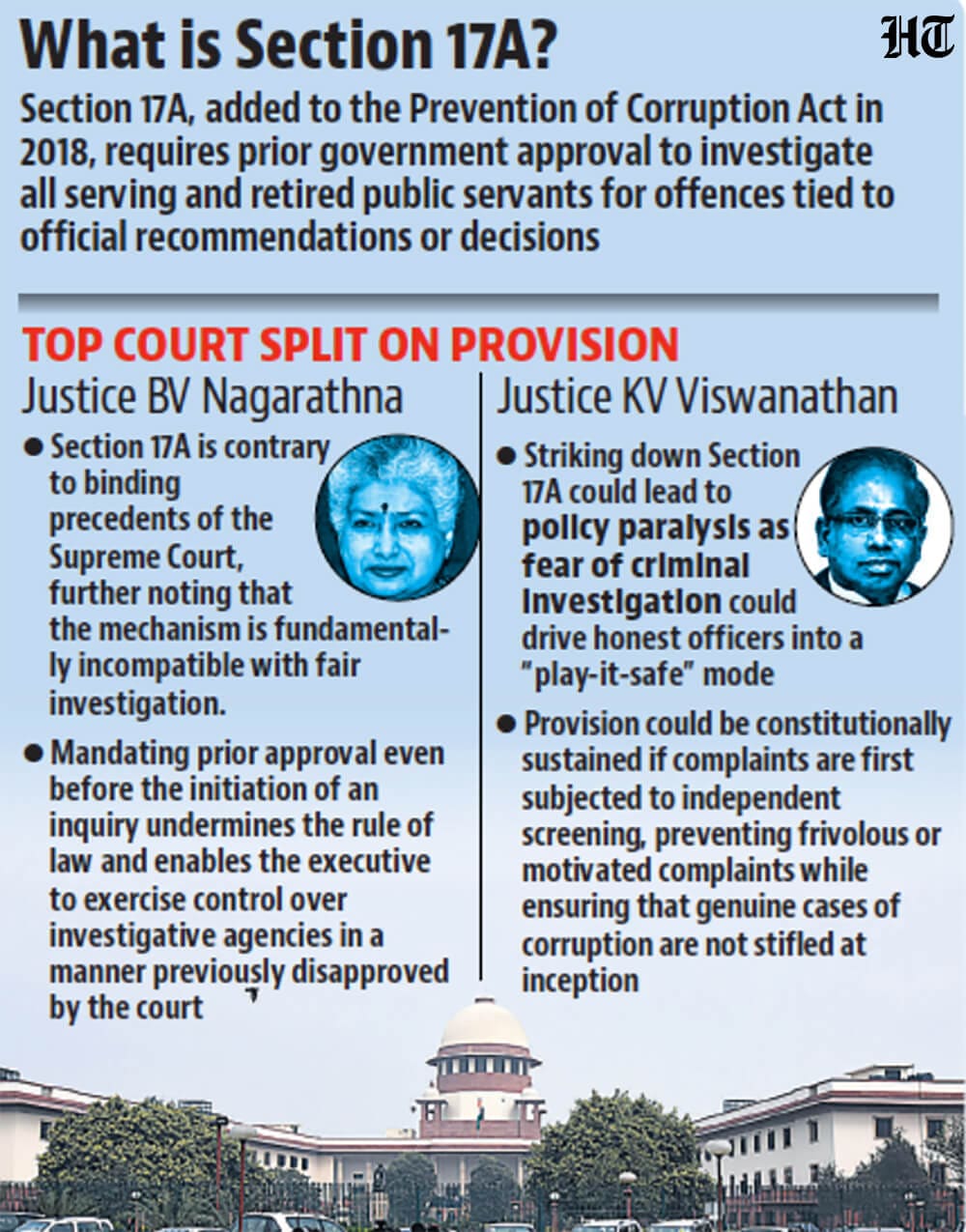
A bench comprising justices BV Nagarathna and KV Viswanathan differed on whether the provision could withstand constitutional scrutiny. Justice Nagarathna struck it down as unconstitutional. Justice Viswanathan upheld it subject to safeguards. In view of the divergence, the matter will now be placed before the Chief Justice of India for the Constitution of a larger bench.
The verdict came in a batch of petitions, led by one filed by the Centre for Public Interest Litigation (CPIL), challenging the dilution of the anti-corruption framework through the 2018 amendments to the PC Act. The bench had reserved its judgment on August 6, 2025, after extensive arguments from the Union government and the petitioners.
In her opinion, Justice Nagarathna held that Section 17A is contrary to binding precedents of the Supreme Court and impermissibly stifles corruption inquiries at the threshold. She ruled that the provision violates earlier judgments of the apex court, including Vineet Narain Vs Union of India (1997) and Subramanian Swamy Vs Director, CBI (2014), which had emphasised the need for independent and unhindered investigation into allegations of corruption involving public servants.
Justice Nagarathna found that mandating prior approval even before the initiation of an inquiry undermines the rule of law and enables the executive to exercise control over investigative agencies in a manner previously disapproved by the court.
Justice Viswanathan took a different view, holding that Section 17A need not be struck down if it is applied in a manner consistent with constitutional principles. According to Justice Viswanathan, routing complaints against public servants to constitutional and statutory oversight bodies such as the Lokpal or Lokayuktas for preliminary inquiries could act as a safeguard against both frivolous complaints and executive interference. Such an approach, he held, could “save” the provision by ensuring screening through independent institutions rather than the political executive alone.
While recognising concerns about potential misuse of the sanction requirement, Justice Viswanathan held that the objective of protecting honest officers from vexatious complaints cannot be brushed aside, and that the provision could be harmonised with anti-corruption objectives through careful application.
In view of the split verdict, the bench directed that the matter be placed before the Chief Justice of India for appropriate orders on the Constitution of a larger bench to resolve the issue conclusively.
The reference ensures that the legality of Section 17A, which has remained under challenge since 2018, will now be examined authoritatively by a bench of three or more judges.
Section 17A was introduced into the PC Act with effect from July 26, 2018, extending protection from investigation without prior approval to all serving and retired public servants, provided the alleged offence relates to recommendations made or decisions taken in an official capacity. The provision removed the earlier distinction between senior and junior officials that existed under Section 6A of the Delhi Special Police Establishment Act, which had been struck down by the Supreme Court in 2014.
The provision bars the police from conducting any inquiry without prior approval of the competent authority, except in cases involving arrest on the spot for accepting or attempting to accept an undue advantage.
The CPIL petition contends that the amendment guts the heart of the anti-corruption law by allowing the executive to decide, at the threshold, whether allegations against public servants can even be examined. It also challenges the repeal of Section 13(1)(d) of the PC Act, which earlier criminalised abuse of official position to obtain undue advantage even in the absence of a bribe.
While successive Union governments have defended sanction requirements as essential to prevent “policy paralysis” and protect honest officers, critics argue that such provisions enable impunity and selective enforcement.
With Tuesday’s split verdict, the final word on the constitutionality of Section 17A will now rest with a larger bench of the Supreme Court.