E-Paper



SC orders removal of stray dogs from schools, hospitals, public transport hubs
The court said that permitting their return would “frustrate the very purpose” of securing such premises and addressing public safety concerns.

 Prefer HTon Google


The Supreme Court on Friday directed all states and Union territories (UTs) to ensure the removal of stray dogs from educational institutions, hospitals, sports complexes, bus depots and railway stations, and said such dogs cannot be released back into the same locations after sterilisation.
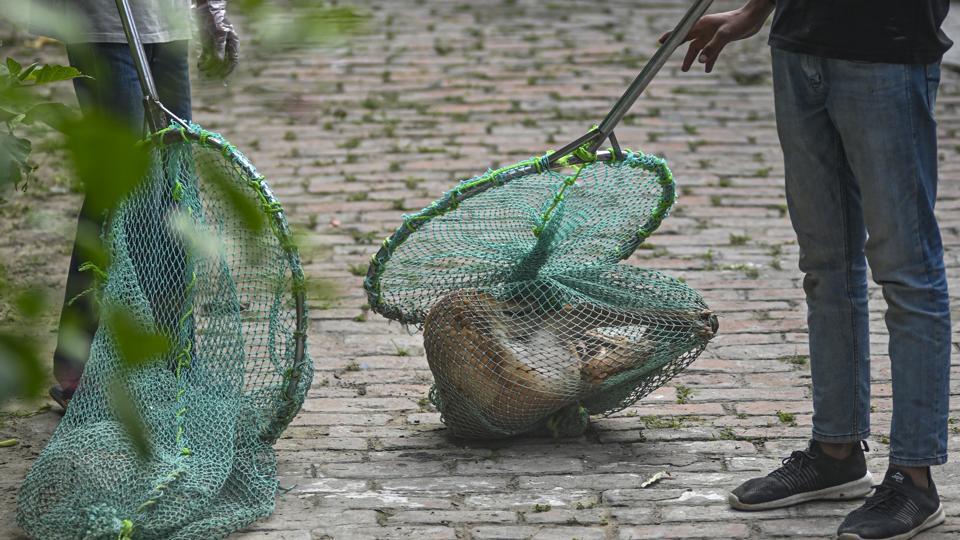
The court said that permitting their return would “frustrate the very purpose” of securing such premises and addressing public safety concerns.
A bench of justices Vikram Nath, Sandeep Mehta and NV Anjaria, which is monitoring stray dog-bite incidents through a suo motu proceeding, ordered that all stray dogs currently in these premises must be captured, sterilised and vaccinated.
“They will not be released back in the same area since releasing them back will frustrate the very purpose of the directive of the court,” Justice Mehta said while reading out the operative portion of the order. The detailed judgment is expected soon.
The bench also directed all states and UTs to, within two weeks, identify government and private schools, colleges, medical institutions, public transport hubs and sports facilities, and within eight weeks, ensure these areas are secured, preferably through boundary walls, to prevent the entry of stray dogs. A nodal officer must be appointed for the upkeep and surveillance of each such premises, and local municipal authorities and panchayats must carry out periodic inspections for at least three months and report back to the court.
Further, the court directed the National Highways Authority of India (NHAI) and other road-owning agencies to remove stray cattle and animals from national and state highways and ensure they are housed in shelters.
Suggestions placed before the court by senior advocate Gaurav Agrawal, who is assisting the bench as amicus curiae, will be incorporated in the order.
The order follows a series of hearings in recent weeks where the court criticised what it described as widespread non-compliance with its directions on stray dog management under the Animal Birth Control (ABC) Rules, 2023.
On November 3, the same bench had taken note of reports of government employees feeding stray dogs inside office and institutional premises, despite its earlier orders requiring designated feeding zones away from spaces of public movement. “We will be issuing directions with respect to government institutions and PSUs where employees are feeding and encouraging stray dogs,” the bench said at the time.
That hearing saw chief secretaries of most states and UTs appear personally before the court after the bench had issued summons over failure to file compliance affidavits. Only West Bengal, Telangana and the Municipal Corporation of Delhi had submitted reports as previously directed.
The suo motu case was initiated in July following reports of a spike in dog bite incidents, including attacks on children. While the court has repeatedly stressed the need to respect the humane framework under the ABC Rules, which mandate sterilisation and vaccination under the catch-neuter-vaccinate-release (CNVR) model, it has also said public safety cannot be compromised.
On October 31, the bench had refused requests from multiple states seeking exemption from the physical presence of their chief secretaries, stating that authorities had been “sleeping over” the court’s directives. “There is no respect for the court’s orders. Let them come and explain,” the bench had said.
The court had also recalled that despite three months’ time given in August to file status reports on ABC implementation, most states took no action, prompting the unprecedented step of summoning top bureaucrats.
In August, the bench had modified an earlier direction by a two-judge bench to permit release of sterilised dogs back to their localities in accordance with the ABC Rules, except in cases involving rabid or aggressive animals. However, with the latest order, the court has now carved out a clear exception for sensitive and public spaces with high footfall, such as schools, hospitals and transport nodes, where release back will no longer be permitted.
The court said the balance between humane animal management and public safety must be maintained, but noted that recent incidents showed institutional premises required stricter control measures.
The matter will be listed again after compliance reports are filed.