
 E-Paper



SC refuses stay on defamation summons against AAP MP Sanjay Singh
Singh approached the top court against an order passed by the Gujarat high court refusing to interfere with the summons issued by a Gujarat court in April last year.


The Supreme Court on Monday refused to stay summons issued to Aam Aadmi Party (AAP) member of Parliament Sanjay Singh in defamation proceedings against him for raising aspersions over Prime Minister Narendra Modi’s academic degree issued by Gujarat University.
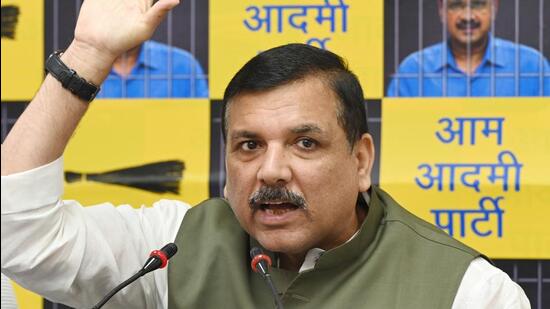
Singh approached the top court against an order passed by the Gujarat high court refusing to interfere with the summons issued by a Gujarat court in April last year. Both Singh and jailed Delhi chief minister Arvind Kejriwal are named as accused in the defamation complaint filed by Gujarat university registrar Piyush M Patel. Kejriwal did not approach the top court against the summons.
“At the stage of summons, only a prima facie case is required to be made out. This is not of the same standard while framing of charge. Before that, you will have your turn in trial,” a bench of justices BR Gavai and Sandeep Mehta said.
“The complainant still has a chance to say on what material he wishes to sustain the complaint... The single judge of the high court has held that all contentions of parties are kept open. The trial judge will not be influenced by any observations (in the high court order),” the bench added.
Singh was represented by senior advocates Abhishek Manu Singhvi and Rebecca John who argued that the complaint is not maintainable as there is no material to show that the university has been defamed in any manner.
The complaint against the two AAP leaders -- filed by Gujarat university registrar -- was based on a press conference conducted by them on April 2, 2023, days after the Gujarat high court on March 31, 2023 set aside an order passed by the chief information commissioner (CIC) directing Gujarat University to produce a copy of the postgraduate degree awarded to Modi to the applicant Arvind Kejriwal under the right to information (RTI) Act. The university claimed the degree was available on its website, which was contested by the AAP leaders at the press conference.
“The case of the complainant is that I uploaded the video of the press conference on my social media handle. My client has not uploaded any video,” senior advocate Rebecca John told the court. She further submitted, “The Gujarat University is not named by me. How is the university affected and how can a defamation proceeding be sustained by the university.”
Singhvi flagged jurisdictional issues in the case. According to him, the university comes within the meaning of “State” provided under Article 12 of the Constitution of India as the governor is the chancellor. He argued that the defamation complaint could only be moved by the public prosecutor in the present case, and not the registrar.
But the bench said, “All these issues must be seen during the trial. The complaint has to be read as a whole. Even the definition of state and state government is different.” Solicitor general Tushar Mehta, appearing for the university, claimed that Article 12 talks of State and this is the state government.
On December 28 last year, the Gujarat court sought the production of Singh in the trial. At that time, he was under arrest in the Delhi excise scam for alleged money laundering charges. The top court granted him bail in the excise case last week.
Meanwhile, in January this year, the Supreme Court stayed the defamation trial while directing the Gujarat high court to first consider Singh’s plea challenging the summons. The trial against Singh is pending before the court of additional chief metropolitan magistrate (ACMM) at Gheekata in Ahmedabad, and the Gujarat high court turned down his challenge against the summons in February this year.


