E-Paper



SC upholds Centre’s mining royalty calculation formula
The Supreme Court held that the measure adopted by the government was intended to curb under-invoicing and manipulation of mineral prices.

 Prefer HTon Google


The Supreme Court on Monday upheld the Centre’s methodology for calculating mining royalty, rejecting a challenge by Kirloskar Ferrous Industries Ltd to the existing formula on the ground that it results in “royalty on royalty” and imposes a cascading financial burden on mining leaseholders.
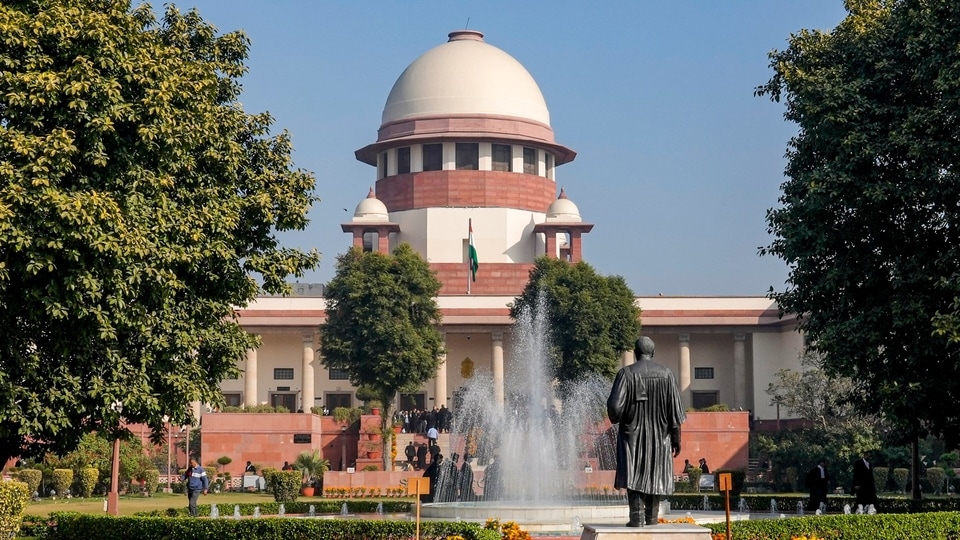
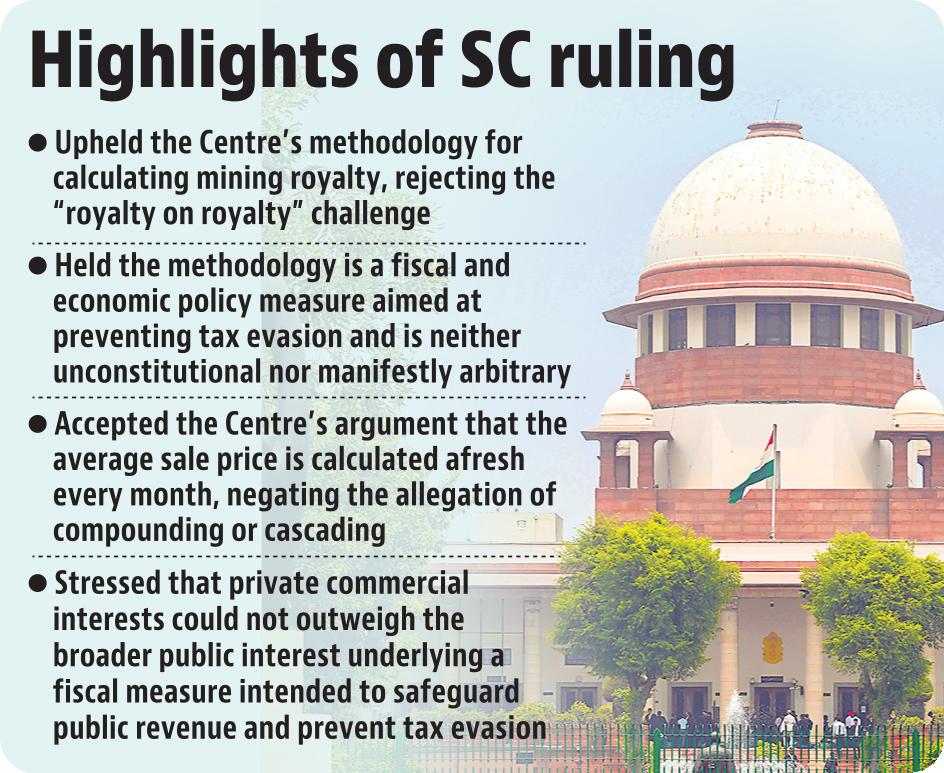
A bench of justices JB Pardiwala and KV Viswanathan declined to strike down the provisions governing computation of the average sale price (ASP) of minerals, holding that the methodology adopted by the Union government is a fiscal and economic policy measure aimed at preventing tax evasion and is neither unconstitutional nor manifestly arbitrary.
Also Read | SC accepts Centre's definition of Aravali Hills, bans grant of fresh mining leases
Ruling expected to bring certainty to mining sector
The ruling is expected to bring certainty to the mining sector by preserving the existing royalty framework. It also comes as a major relief to the Centre and mineral-rich states, as any change in the royalty computation methodology could have substantially affected royalty collections and auction premiums linked to mineral production.
Dismissing the writ petition, the court upheld the constitutional validity of the explanations appended to Rule 38 of the Minerals (Other than Atomic and Hydro Carbons Energy Minerals) Concession Rules, 2016 and Rule 45(8)(a) of the Mineral Conservation and Development Rules, 2017, which provide that royalty, contributions to the District Mineral Foundation (DMF) and the National Mineral Exploration Trust (NMET) are not excluded while computing the sale value used for determining the average sale price.
“We hold that the impugned Rules are not violative of Article 14 and Article 19(1)(g) of the Constitution. We further hold that the impugned provisions are not ultra vires Section 9 of the MMDR Act,” said the bench while dismissing the petition.
Kirloskar Ferrous and another petitioner had challenged the royalty regime, contending that because royalty, DMF and NMET payments are included in the sale value while calculating the average sale price, miners effectively end up paying “royalty on royalty”. They argued that the methodology artificially inflates the base value, leading to double payment of royalty-related levies, particularly in auctioned mines where the auction premium is also linked to the average sale price.
The petitioners further contended that while a similar anomaly in the computation of royalty for coal had been corrected in 2020 by excluding statutory levies from the sale value, no such correction had been made for iron ore and other minerals, rendering the rules arbitrary and violative of Articles 14 and 19(1)(g) of the Constitution.
Rejecting these submissions, the Supreme Court held that the measure adopted by the government was intended to curb under-invoicing and manipulation of mineral prices and therefore constituted a legitimate mechanism for determining royalty.
Also Read | HT Impact: SC seeks MP’s govt response over illegal mining at Chambal sanctuary
Court accepted centre's argument
The court accepted the Centre’s argument that the average sale price is calculated afresh every month based on market data submitted by miners and does not carry forward previous months’ royalty components, thereby negating the allegation of compounding or cascading. It also noted that the methodology was introduced to address attempts by some leaseholders to manipulate ex-mine prices and dispatch patterns to artificially depress the average sale price and reduce royalty and auction premium liabilities.
Emphasising judicial restraint in matters of economic policy, the bench underlined that legislatures and rule-making authorities enjoy considerable latitude in prescribing the manner of levy and the methodology for its computation.
“We find nothing manifestly arbitrary in the process adopted. There is nothing capricious or irrational about the measure,” said the court, adding that legitimate measures designed to check evasion can validly be adopted as the measure of levy. It also rejected the comparison with coal, observing that the royalty framework for coal operates on an entirely different mechanism and therefore cannot be equated with iron ore.
The bench further held that although royalty is a statutory levy, it is in the nature of contractual consideration paid by a mining lessee to the lessor for the right to extract minerals, and the legislature possesses wide discretion in prescribing the method for calculating such payments.
Notably, the judgment accepted the Centre’s submission that altering the royalty computation formula would have far-reaching fiscal consequences. The Centre had warned that over 585 mineral blocks have been auctioned under the existing framework and any change would fundamentally alter the basis on which bidders quoted auction premiums. According to the government, such a change could reduce state revenues by 15-17%, resulting in losses running into several lakh crore rupees over the life of mining leases, while conferring an unintended windfall on existing leaseholders.
Concluding that the petitioners had failed to demonstrate any constitutional infirmity in the impugned rules, the bench held that private commercial interests could not outweigh the broader public interest underlying a fiscal measure intended to safeguard public revenue and prevent tax evasion.