E-Paper



‘Shedding colonial mindset’: President Murmu unveils Rajagopalachari's statue in place of Lutyens' at Rashtrapati Bhavan
The bust of Chakravarti Rajagopalachari, situated at the Grand Open Staircase near Ashok Mandap in Rashtrapati Bhavan, replaces the bust of Edwin Lutyens.

 Prefer HTon Google


President Droupadi Murmu on Monday unveiled a bust of India's Indepenence hero Chakravarti Rajagopalachari, replacing that of architect Edwin Lutyens, at Rashtrapati Bhavan. President Murmu hailed it as an initiative towards “shedding colonial mindset.”
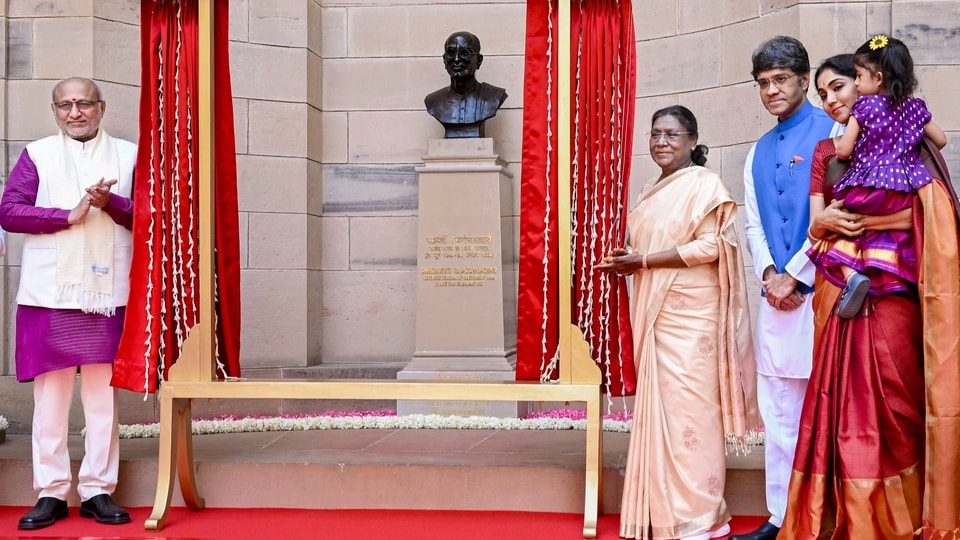
The newly unveiled bust of C Rajagopalachari has been placed near the Grand Open Staircase near Ashok Mandap.
Following the event, the President's official X handle posted, "This initiative is part of a series of steps being taken towards shedding the vestiges of the colonial mindset and embracing, with pride, the richness of India's culture, heritage, timeless traditions and honouring those who served Bharat Mata with their extraordinary contributions."
C Rajagopalachari was the first and last Indian Governor-General of independent India.
Several dignitaries were also present on the occasion, including Vice President of India CP Radhakrishnan and Union ministers JP Nadda, S Jaishankar, Dharmendra Pradhan, Gajendra Singh Shekhawat and family members of 'Rajaji'.
A day earlier, Prime Minister Narendra Modi announced the unveiling and celebrations of the 'Rajaji Festival'. During his monthly address ‘Mann Ki Baat,’ PM Modi said that the nation is leaving the symbols of slavery behind and beginning to relate to the Indian culture.
PM Modi calls it ‘commendable effort’
PM Modi also reacted to the event, calling it a commendable effort" to shed “colonial mindset.”
“Rajaji was a towering scholar, freedom fighter, thinker and administrator,” PM wrote in a post on X.
Born in December 1878, C Rajagopalachari was a lawyer and intellectual among many other things. He is remembered as an early political comrade of Mahatma Gandhi, who left his legal practice to join the Indian National Congress and later participated in various protests against the British Crown.
Most popularly, Rajagopalachari agitated against the Rowlatt Act, non-cooperation, and the Civil Disobedience movement.
He was elected to the Constituent Assembly from Madras on a Congress ticket. He was part of the sub-committee on minorities and was conferred with the Bharat Ratna in 1954.
Also read: Lutyens' statue removed: Why New Delhi's architect got on PM Modi's colonial purge list
Who was Edwin Lutyens
Edwin Lutyens was a British architect who, in collaboration with Sir Herbert Baker, designed several monumental buildings in New Delhi. He developed a hybrid Indo-European style, fusing Western neoclassicism with Mughal, Buddhist and Hindu motifs.
Among his architectural contributions are Viceroy's House (now Rashtrapati Bhavan), India Gate, North and South Block, the circular Connaught Place and the vast ceremonial axis then called Kingsway.
In recognition of his contribution, a part of New Delhi is also known as 'Lutyens' Delhi'.