
 E-Paper



Lutyens' bust gone: Why New Delhi's British architect ended up on Modi's anti-colonial purge list
"The country is leaving behind the symbols of slavery and has begun to value symbols related to Indian culture," Modi said in latest episode of Mann Ki Baat.

 Prefer HTon Google


A bronze bust stood in the central courtyard of Rashtrapati Bhavan for decades, by which millions must have filed by. Prime Minister Narendra Modi announced on Sunday, February 22, that it would no longer stand there. The statue of Edwin Lutyens — the British architect who designed some of New Delhi's most iconic structures — has been replaced by one of C Rajagopalachari, the first Indian Governor-General of independent India.
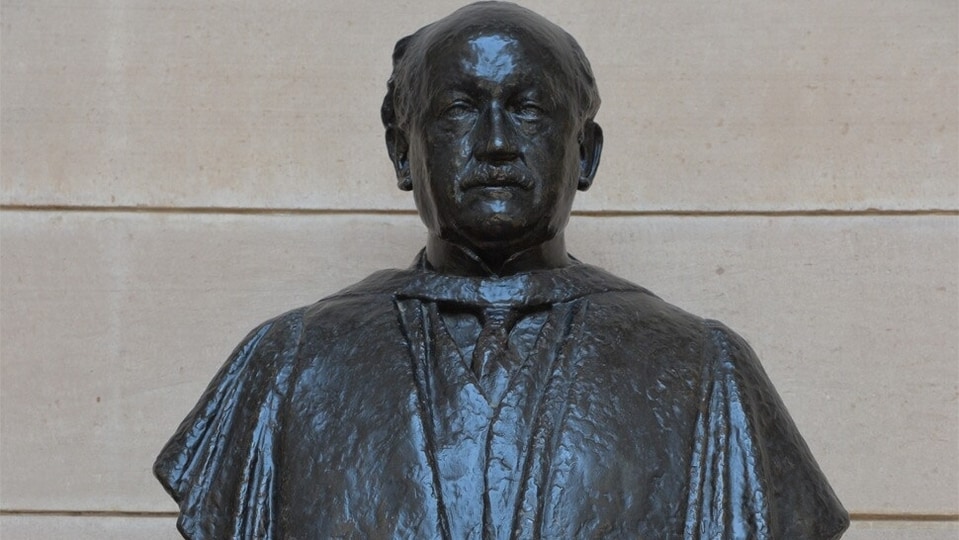
The announcement, made on the 131st episode of Modi’s monthly radio programme Mann Ki Baat, drew immediate attention not just for what it removed, but for what it represented.
"Today, the country is leaving behind the symbols of slavery and has begun to value symbols related to Indian culture," Modi told his listeners.
A new statue of Rajagopalachari or 'Rajaji', as he was affectionately known, was unveiled by President Droupadi Murmu on Monday as part of a newly coined 'Rajaji Utsav', with an accompanying exhibition running until March 1. The bust stands in an alcove on the grand open staircase inside Rashtrapati Bhavan.
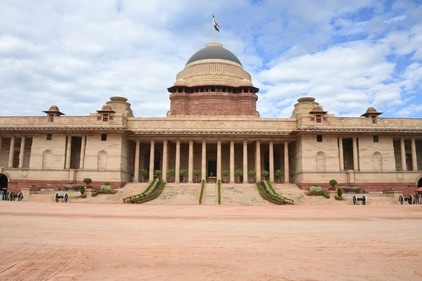
Lutyens had personally designed the building from which his bust is now removed.
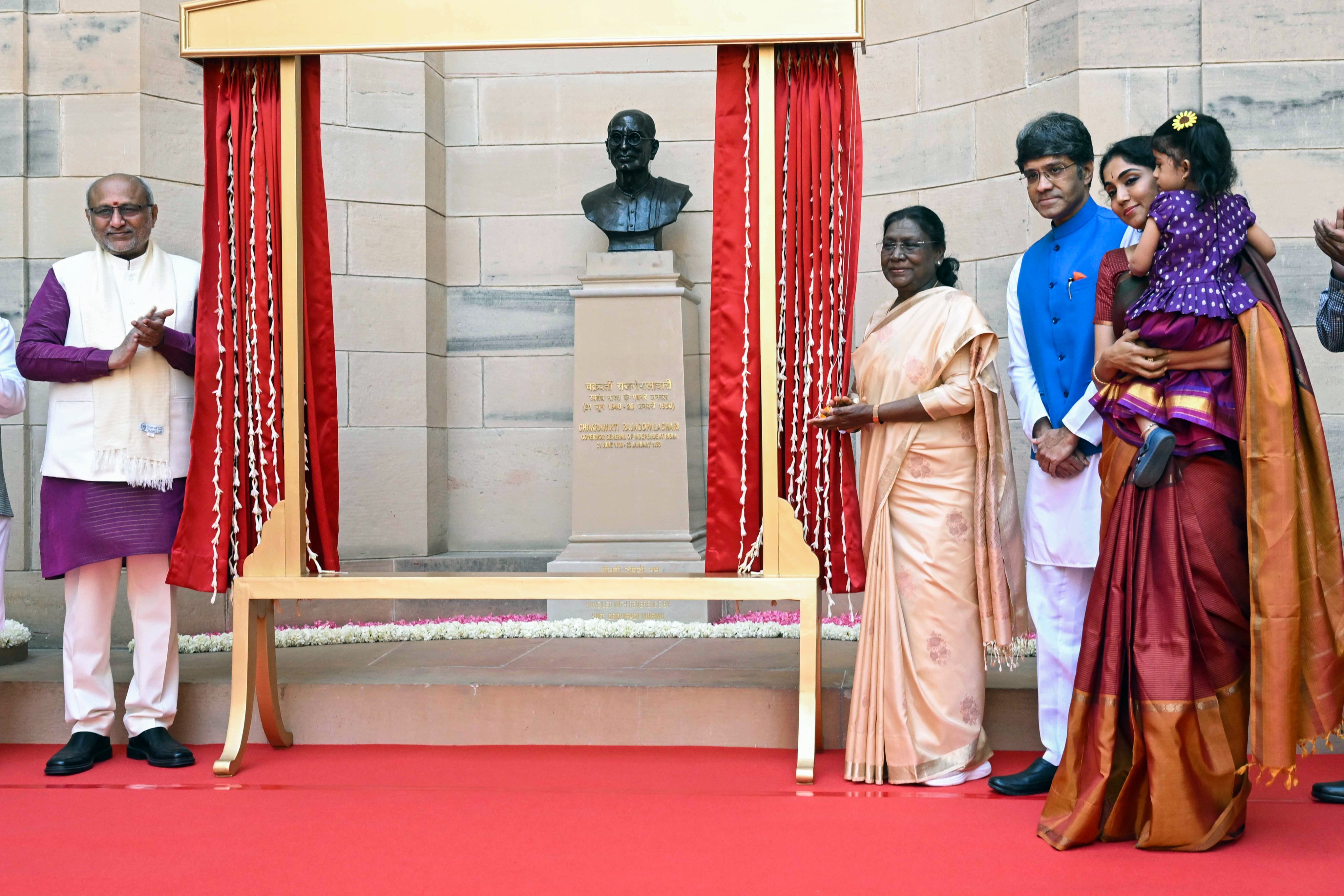
The initiative is part of a series of steps being taken towards shedding vestiges of colonial mindset, the President's secretariat said.
Architect who (re)designed an empire's capital
Edwin Lutyens' early life account comes from his daughter. In her writing published by the Lutyens Trust, a charity established to preserve his legacy, Mary Lutyens recorded that her father was "the tenth child and ninth boy in a family of thirteen, of Charles and Mary Lutyens of Onslow Square, London, and Thursley in Surrey”.
He was born on March 29, 1869, and named Edwin after a friend of his father, painter-sculptor Sir Edwin Landseer. Edwin Lutyens would go on to be knighted too, and become Sir. This detail matters: the family moved in artistic circles. His father, Captain Charles Augustus Henry Lutyens, was a soldier and a painter; mother Mary Theresa Gallwey was from Ireland and a homemaker.
Young Edwin, nicknamed Ned, was "so delicate as the result of rheumatic fever as a child that he was the only one of the boys not to go to public school or university," according to his daughter's account.
The education was a patchwork of a shared governess’s lessons, some schooling from an older brother. His daughter says his education happened also in long solitary hours in the Surrey countryside watching buildings go up. His daughter writes: "(Edwin Lutyens) told Osbert Sitwell, 'Any talent I may have was due to a long illness as a boy, which afforded me time to think, and subsequent ill-health, because I was not allowed to play games, and so had to teach myself, for my enjoyment, to use my eyes instead of my feet'."
He dropped out of the South Kensington School, later joined the office of some architects as an apprentice, and set up his own practice in 1888 at the age of 19. He went on to be compared to Sir Christopher Wren, an architect renowned for rebuilding parts of London after the 1666 Great Fire, including St Paul's Cathedral.
From country houses to the Capital of an Empire
Lutyens built a formidable reputation designing English country houses, in a professional partnership with the garden designer and landscaper Gertrude Jekyll. Many peers and architecture reviewers described Edwin Lutyens as "surely the greatest British architect of the twentieth — or of any other — century”.
But the New Delhi project was on a whole different scale. Following King George V's announcement at the 1911 Delhi Durbar that the imperial capital of British India would move from Calcutta to Delhi, Lutyens was appointed chief architect for the new city.
Working with fellow British architect Sir Herbert Baker, he developed a hybrid Indo-European style, fusing Western neoclassicism with Mughal, Buddhist and Hindu motifs. The grand project produced Viceroy's House (now Rashtrapati Bhavan), India Gate, North and South Block, the circular Connaught Place and the vast ceremonial axis then called Kingsway.
The partnership with Baker, however, was not without disagreements. Lutyens envisaged that the dome of Viceroy's House would remain continuously visible along the ceremonial axis as one approached Raisina Hill, the seat of power.
When Baker's inclined approach road obscured this view, Lutyens was furious. Mary Lutyens wrote that the friendship never fully recovered. Lutyens was knighted in 1918. He died on New Year's Day, 1944; his ashes rest in the crypt of St Paul's Cathedral.
Lutyens viewed his work on New Delhi as an enduring monument designed for imperial grandeur. He once remarked that while the Viceroy thought only of the next three years, "I am thinking of the next 300 years". He aimed for a style that was neither purely European nor just Indian or Mughal, but rather a hybrid that combined western traditions with subtle local elements.
Postal address to political insult
For what he built, the term Lutyens' Delhi began as a geographical description. It’s roughly a 26-square-kilometre zone of low-height and low-density bungalows, tree-lined avenues and ceremonial buildings that Lutyens and his collaborators designed between the 1920s and the 1940s. The zonewas listed among the World Monuments Fund's 100 Most Endangered Sites as recently as 2002, owing to development pressures.
Over decades, Lutyens' Delhi evolved into a political moniker for a particular type of people: English-speaking, Oxbridge-educated, Congress-aligned, allegedly sealed off from ordinary Indian life. When the perennial anti-Congress BJP came to power, PM Modi and his supporters deployed it as shorthand for all they stood against — in short, elitism. Modi as PM resides in the zone but has sought to reshape it. That’s where the removal of Lutyens’ statue also comes in.
Dismantling colonial markers
In September 2022, Modi renamed Rajpath, designed by Lutyens as an imperial ceremonial axis, to 'Kartavya Path', meaning "path of duty”. “Kingsway, or Rajpath, the symbol of slavery, has become a matter of history from today," Modi declared. In May 2023, Modi inaugurated a new triangular Parliament building beside the old circular one designed by Baker.
This month, February 2026, the Prime Minister's Office was relocated from the colonial-era South Block to a newly built complex named 'Seva Teerth', meaning “a sacred place of service”.
It’s all part of the Central Vista Redevelopment Project. PM Modi has been clear about the ideological direction. In his Independence Day speech of 2022 he articulated 'Panch Pran' or “five pledges, one of which was liberation from "the mentality of slavery”. He set a deadline of 2035 to remove what he calls the psychological residue of British rule.
In place of Lutyens’ statue now comes that of C Rajagopalachari or 'Rajaji', a lawyer and freedom fighter who was a close associate of Mahatma Gandhi. He remains the only Indian to serve as Governor-General, holding the role from one year after independence, from 1948, until India became a republic in 1950. He later founded a liberal political party, the Swatantra Party, in opposition to the first PM Jawaharlal Nehru's Congress. Modi has described him as someone who saw "power not as a position but as a service”.
Lutyens' physical imprint on Delhi remains at many places, though. For instance, the India Gate he designed to commemorate Indian soldiers who died in World War 1 has been absorbed into independent India's national memory.
P.S.: His great-grandson reacts
Matt Ridley, a great-grandson of Edwin Lutyens, said he was “sad to read that the bust of Lutyens (my great-grandfather) is to be removed from the presidential palace he designed in Delhi”, news agency PTI reported.
He posted a picture, too, with the since-removed bust.


