India carried out close to 27,000 Covid-19 tests on Wednesday and added 22 new labs in the last two days, ramping up efforts to speed up a process that is crucial to determine the extent of the outbreak but has suffered from long delays due to several bottlenecks.
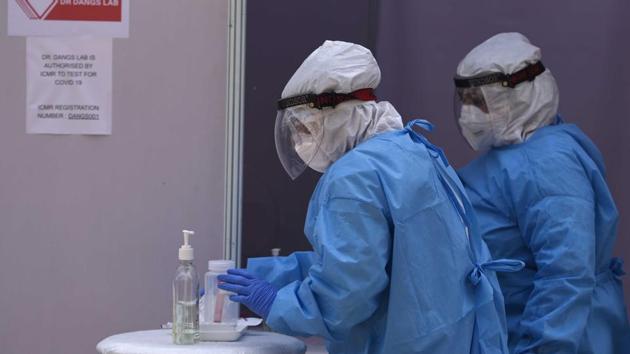
The 26,351 samples processed on Wednesday, according to data released by Indian Council of Medical Research (ICMR), represents a fivefold increase over the roughly 5,000 a day number at the beginning of the month. The total number of labs, including private ones, is now at 258.
“We have added more labs, and since sample collection and data entry were identified as bottlenecks, we have strengthened the system of sample collection and added trained human resources to ramp up testing in a big way,” said CK Mishra, secretary, ministry of environment, who co-chairs the PM’s high-level committee on preparedness for medical emergency.
Also read: Covid-19 cases breach 12,000-mark in India, death toll at 414
Almost as much as kits, capacity and protocols -- which have been areas of debate and concern for India right through the last month when Covid-19 cases began to rise -- speed of testing is a critical area where India may be falling behind, with a large backlog of tests awaiting results at the end of every working day.
{{/usCountry}}Almost as much as kits, capacity and protocols -- which have been areas of debate and concern for India right through the last month when Covid-19 cases began to rise -- speed of testing is a critical area where India may be falling behind, with a large backlog of tests awaiting results at the end of every working day.
{{/usCountry}}In Delhi, where 16,605 tests have been carried out, 956 are still pending.
India’s testing relies at the moment on the RT-PCR process, which is the most definitive diagnostic test for the Sars-Cov-2 virus that causes Covid-19. This involves swabbing a person for samples, which is then processed at a lab to if it matches the molecular signatures established with the virus.
The process is meant to take 7-8 hours. But collecting the sample and collation of results – including accounting for all negative results as well – leads to about 24-36 hours from when a person’s samples are collected to the result reflecting in the official tally. In some cases, as the number of tests grow and testing centres get backed up, it can take up to 2-3 days for a result to get reported in certain states.
Also read: Two firms begin production of antibody rapid test kits in India
When one considers that India’s cases are doubling at a rate of about six days, a lag of this nature leads to valuable time lost. “We will not know the full extent of the spread of Covid-19 unless we become more proactive in testing, instead of being reactive. Unless we test, we won’t know,” said Jacob John, professor emeritus and head of virology at Christian Medical College, Vellore, Tamil Nadu.
The number of confirmed coronavirus disease (Covid-19) cases crossed the 12,000 mark on Wednesday, rising by 851 through the day.
Quick testing is key to India’s containment strategy, according to experts, and will eventually determine when and what parts of the country are exempted from a lockdown that has halted economic activity and stranded hundreds of thousands of migrant workers.
In South Korea, which has largely been seen as one of few countries to have flattened its infection curve, officials carried out 15,000 tests a day. Germany followed a similar strategy, testing 12,000 people a day.
One way to speed up testing is using rapid test kits, which use a person’s blood to look for antibodies that can indicate an infection, are yet to be acquired or developed by Indian companies. Kits ordered from China have missed several deadlines after supplies were withheld due to quality checks, officials said.
Two of three Indian manufacturers have begun production of the antibody-based kits after the national regulatory body for pharmaceuticals and medical devices issued manufacturing licenses.
These can be deployed for pooling of samples, a batch testing strategy that can be used to do up to three times as many tests with the same number of kits.
Meanwhile, in order to speed up the RT-PCR tests, the Union health ministry has designated 14 “mentor institutions” such as the All India Institute of Medical Sciences (AIIMS) in Delhi and Post Graduate Institute of Medical Education & Research (PGI), Chandigarh, across states to handhold accredited labs in the region in carrying out the RT-PCR test.
The 14 are within 12 clusters and the mentor institutions will ensure the identified labs meet NABL’s quality- and infection-control standards, and ensure the machines are run to capacity with two shifts, according to officials.
The National Accreditation Board for Testing and Calibration Laboratories (NABL) provides accreditation to laboratories that meet the national accuracy, safety and quality standards.
The government is also acquiring RT-PCR machines with larger capacities. “Orders have been placed for 12 RT-PCR systems that can test 1,536 samples in a single run, with the delivery expected in the first week of May. Ten of these machines will go to ICMR labs, one to NCDC (National Centre for Disease Control) and one to AIIMS,” said an Indian Council of Medical Research (ICMR) official, asking not to be named.
Building on the National Health Mission, of which Mishra was the mission director in his earlier role in the health ministry, the ICMR has approved the use of machines that were used to drug-resistant tuberculosis to be paired with other RT-PCR devices to act as screening test for Covid-19. This pairing will be able to test up to 1,000 reactions per run.
The TB test device, Truenat, is a small battery-operated device that can be operated by health workers with basic training even at Primary Health Centres.
The other devices that it will be paired include Gene-Xpert, which is widely available across India.
“Gene-Xpert platform is already being used across country for sensitive multiple-drug resistant TB tests and gives foolproof results. What really works in its favour is it doesn’t need a sophisticated lab infrastructure or highly trained technicians, and it gives results in 60 minutes. The only shortcoming is it runs two to four tests in one go, depending on the machine, but it can really help reach underserved areas with low access to technology,” said Dr Navin Dang, consultant microbiologist and founder of Dr Dang’s Labs, which was among the first labs to get approved for Covid-19 testing in India.
At present, officials say there are adequate number of Covid-19 kits for RT-PCR tests. Most of the labs accredited at present have placed orders varying from several thousands to hundreds of thousands, and deliveries are expected in 5-7 days, according to an ICMR official.