
 E-Paper



Surya Grahan 2025: Can Solar Eclipse be watched with naked eye? What NASA said
Surya Grahan 2025: On March 29, a partial solar eclipse will take place, offering a double sunrise phenomenon in some regions. India, however, won't see it.

 Prefer HTon Google


Surya Grahan 2025: A solar eclipse or Surya Grahan is set to take place on Saturday, March 29, 2025. During this time, the Moon will pass between the Earth and the Sun, partially blocking its light.
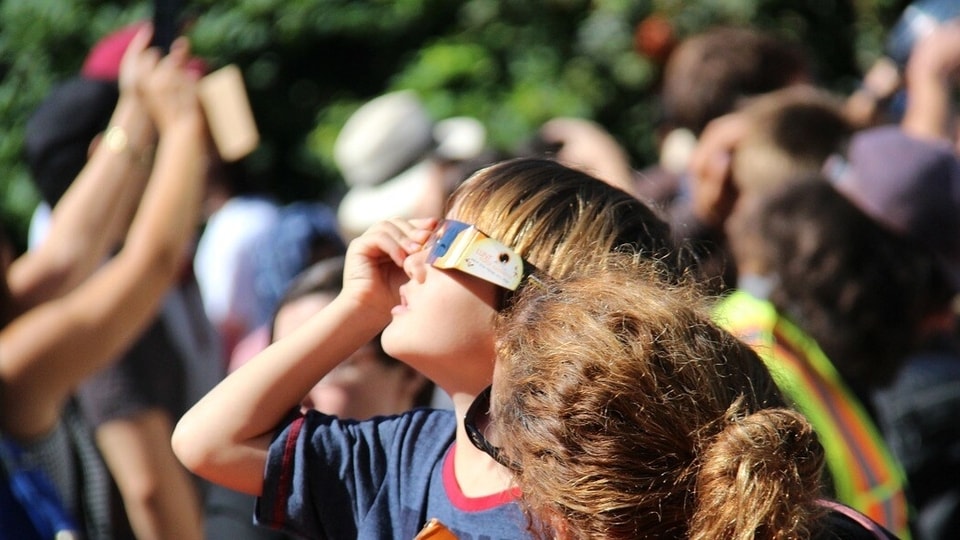
This one’s going to be a partial eclipse, meaning only a portion of the Sun will be covered. What makes it even more special is that it’s being called a double sunrise eclipse—a rare sight where the Sun appears to rise twice!
Also Read | Solar eclipse 2025: Will India see the March 29 ‘double sunrise’? Know here
Will it be visible from India?
Unfortunately, India won’t be able to view this eclipse. But if you are in parts of the US, Canada, Greenland, or Iceland, you are in luck!
How to watch solar eclipse?
If you are eager to catch the solar eclipse, you will either have to travel to a visible region or watch it live online from the comfort of your home.
Also Read | The New Moon Solar Eclipse on March 29, 2025, is here to shake things up, according to an expert
Here’s when it happens in Indian Standard Time:
- Starts at 2:20pm
- Peaks at 4:17pm
- Ends at 6:13pm
- Total duration is about four hours
Since the eclipse will already be in progress when the Sun rises in some places, it would create a fascinating illusion of two sunrises—one as the eclipsed Sun comes up, and another when the eclipse ends!
Who gets to see it?
The eclipse will stretch from eastern Canada to northern Russia, and potentially be visible in most of Europe and some areas of northeastern North America and northwest Africa, according to France's Paris Observatory. The eclipse will begin at 0850 GMT on Saturday and end at 1243 GMT.
The relatively rare celestial event occurs when the Sun, Moon and Earth all line up. A total solar eclipse is when the Moon totally blots out the Sun, creating an eerie twilight.
But this time, the Moon will cover at most 90 per cent of the Sun in some northern latitudes, turning the Sun's rays into "cold light", Paris Observatory astronomer Florent Deleflie told AFP.
The maximum amount of eclipse will be visible in northeastern Canada and Greenland at 1047 GMT.
It will be less spectacular in other areas. In France, for example, between 10 to 30 percent of the Sun's disc will be obscured, depending on the region.
Health safety during solar eclipse
Eye safety first: According to The National Aeronautics and Space Administration or NASA, one must use certified eclipse glasses or a handheld solar viewer at all times while looking at the Sun. Regular sunglasses won’t work—no matter how dark they are. Eclipse glasses are specially designed to be thousands of times darker and must meet ISO 12312-2 international safety standards.
Important precautions: Check your eclipse glasses before use – If they are scratched, torn, or damaged, throw them away.
Supervise children: Make sure they use eclipse glasses properly.
Never use eclipse glasses with telescopes, binoculars, or cameras: The intense sunlight can burn through the filter and damage your eyes.
When can you look at eclipse without glasses? The only time it’s safe to look at the Sun without protection is during totality—the brief moment when the Moon completely blocks the Sun. The second any part of the Sun reappears, put your eclipse glasses back on immediately!
Protect your skin
If you are outside for hours watching the eclipse, don’t forget:
- Wear sunscreen – You don’t want a sunburn ruining the experience.
- Put on a hat: Keep the Sun off your face.
- Cover up with protective clothing: Long sleeves can help prevent sun damage.


