
 E-Paper



Sri Lankan convicts released in Rajiv Gandhi assassination case to be sent back: Officials
Four convicts in the former prime minister Rajiv Gandhi assassination case, all Sri Lankan nationals, who were among the six people released from jail after the Supreme Court’s order on November 11, will be sent back to the neighbouring country, Tamil Nadu officials said on Monday.

 Prefer HTon Google


Four convicts in the former prime minister Rajiv Gandhi assassination case, all Sri Lankan nationals, who were among the six people released from jail after the Supreme Court’s order on November 11, will be sent back to the neighbouring country, Tamil Nadu officials said on Monday.
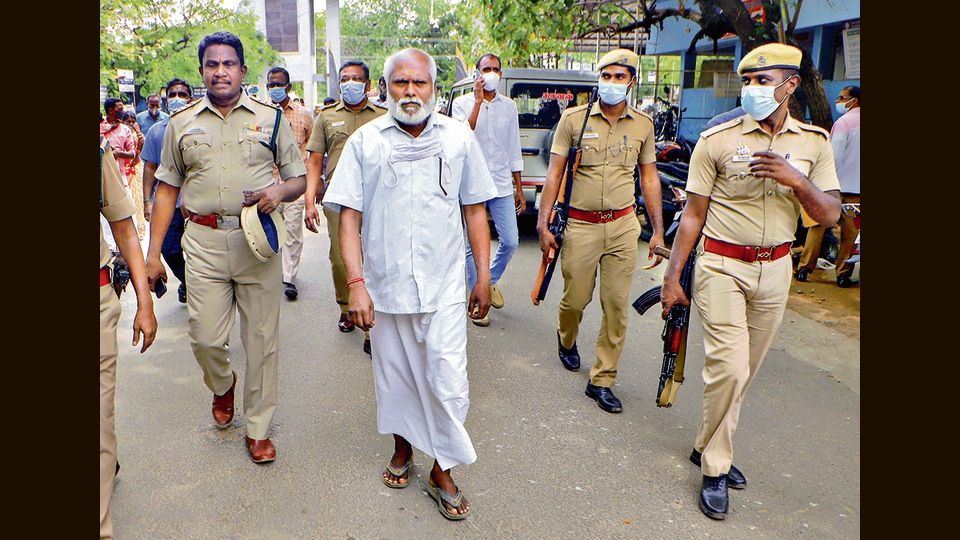
The four Sri Lankan nationals were taken to a special refugee camp in Trichy district on Saturday evening after their release from Vellore Jail on the direction of the Union government, said Trichy district collector Praveen Kumar.
“I’ve spoken to the FRRO (foreign regional registration offices) of the ministry of external affairs and they have already sent a communication to the Sri Lankan embassy, who will have to confirm their citizenship so that they can be granted landing permission,” Kumar told HT. “Hopefully, we will hear back soon.”
On November 11, the Supreme Court ordered the release of six convicts in the 1991 Rajiv Gandhi assassination case, after the Tamil Nadu government controversially recommended their remission in March 2016.
The release of the six convicts came months after the Supreme Court on May 18 ordered the release of AG Perarivalan, the first of the seven convicts in the case, on grounds of poor health and good conduct. The seven convicts – Perarivalan, Nalini Sriharan, Murugan alias Sriharan, Santhan, P Ravichandran, Robert Payas and S Jayakumar – were arrested in 1991. Four of them, including Nalini’s husband Sriharan, are Sri Lankan nationals.
On November 11, a bench of justices BR Gavai and BV Nagarathna directed the premature release of six convicts.
On Saturday, HT reported that of the four Sri Lankan nationals, only Santhan wanted to go back to the island nation, while Nalini’s husband Sriharan, also in Trichy, wanted to stay with their daughter in London, Payas wanted to go to his family in the Netherlands and Jayakumar expressed willingness to stay back in Chennai, where his wife and children live.
The collector said he has not received any information on where the four Sri Lankan nationals wanted to go to after their release. “I’ve told them if they have any reservations, they have to give it to us in writing, which I will forward to the (state) government,” said collector Kumar.
Legal experts said the case of these four was complicated.
“It’s a grey area in law and this is also ultimately in the hands of the Government of India and the courts,” said advocate Romiyo Roy, who has handled several cases of Sri Lankan refugees in the past.
If they do not want to be sent back to Sri Lanka, they can appeal to stay back in India on the basis of “principle of non-refoulement” under international human rights, refugee, humanitarian and customary law, claiming they are refugees, said the advocate. Then, the nation-state cannot send them back to their host country, Roy added.
“They have committed a crime and undergone over 30 years of punishment inside the prison. If the Union government makes considerations on humanitarian grounds, they can be allowed to stay back, given a second chance and allowed to mingle with the society,” said Roy. “But, for security reasons, the government can ask them to stay in the special refugee camp under Section 32E of the Foreigners Act which empowers the Government of India to detain any foreigner in a special camp.”
On some of them wanting to join their families in Europe, where there is a huge Sri Lankan Tamil diaspora, Roy said, “They don’t have to be necessarily sent back to Sri Lanka to go to European countries that are willing to invite them. The Indian government can give them an exit permit but since they were booked for a serious crime, we don’t know if that may happen.”
Meanwhile, Nalini visited her husband Sriharan alias Murugan in the Trichy camp on Monday and requested the state and Union governments to send the four men to the countries they wanted to go to.
“We have told them that steps are being taken for them to return to their homes and where they wish to go. So, they feel okay now,” Nalini told reporters outside the Trichy camp, while dispelling rumours that the four were on a hunger strike.
Nalini also urged the Trichy collector to let her husband go at the earliest so that they can be with their daughter, S Harithra. “We have to give petitions in the UK embassy. There is a lot of process...,” she said.
Former PM Rajiv Gandhi was assassinated in Sriperumbudur in Tamil Nadu by a suicide bomber, identified as Thenmozhi Rajarathinam, alias Dhanu, a member of militant outfit, Liberation Tigers of Tamil Eelam (LTTE). A total of 16 people, including the former PM and Dhanu, were killed in the blast and another 45 people were critically injured.


