E-Paper



District judiciary’s independence part of basic structure: Supreme Court
For most litigants in this country, the court added, the only physically accessible institution for accessing justice is the district judiciary

 Prefer HTon Google


The independence of the district judiciary is also a part of the basic structure of the Constitution, the Supreme Court declared on Friday, underlining that the access to justice would remain illusory without impartial and independent judges at the grassroots level.
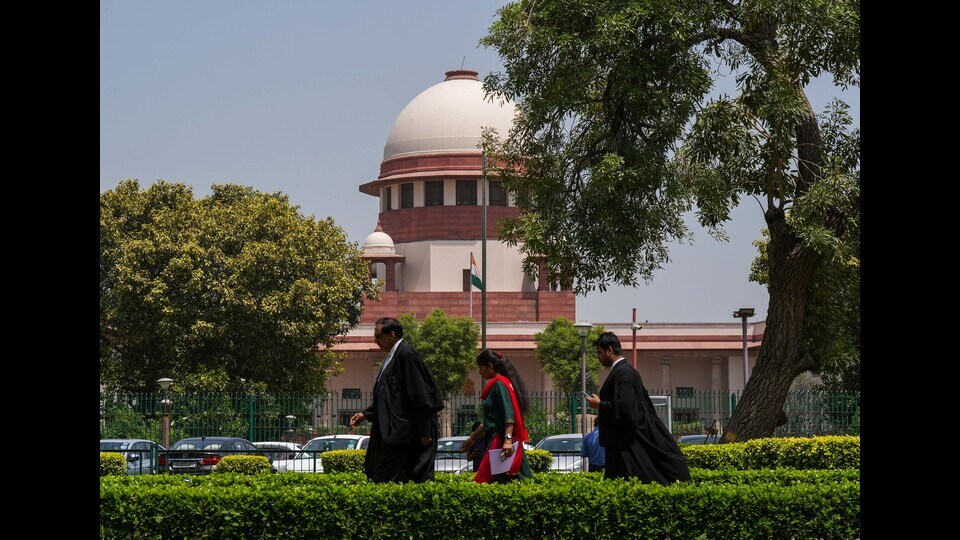
A bench, comprising Chief Justice of India (CJI) Dhananjaya Y Chandrachud and justices V Ramasubramanian and PS Narasimha, held that the declaration is imperative since all previous pronouncements by the apex court have been only in the context of the high court and the Supreme Court. The historic 1973 judgment in the Kesavananda Bharati case had ruled that independence of judiciary is a part of basic structure of the Constitution.
“The district judiciary performs an important role in upholding the rule of law. The independence of the district judiciary must also be equally a part of the basic structure of the Constitution. Without impartial and independent judges in the district judiciary, ‘Justice’, a preambular goal, would remain illusory,” said the judgment, authored by justice Narasimha.
It highlighted that the district judiciary is, in most cases, also the court which is most accessible to the litigant and handles 1.13 million cases every day. “It was seen that during the period of the pandemic as well that the district judiciary was efficient and undertook its functions to ensure that justice is delivered in a timely manner. It is thus important to recognise that the district judiciary is a vital part of the independent judicial system, which is, in turn, part of the basic structure of the Constitution,” it emphasised.
For most litigants in this country, the court added, the only physically accessible institution for accessing justice is the district judiciary, and therefore, the independence of district judiciary assumes even greater significance.
“The district judiciary is the backbone of the judicial system. Vital to the judicial system is the independence of the judicial officers serving in the district judiciary. To secure their impartiality, it is important to ensure their financial security and economic independence,” said the bench, as it issued slew of directions on implementation of the recommendations made by the Second National Judicial Pay Commission in its 2020 report.
As it accepted several recommendations of the committee and ordered enhanced salary and pension for the judicial officers, the bench underlined that the independence of the judiciary requires that pay of judicial officers must be stand-alone and not compared to that of staff of the political executive or the legislature.
“Efficient functioning necessarily requires judges of calibre and capacity to be provided with the right incentives and promotion opportunities to maintain the high level of functioning of the judiciary...The right of fair trial and access to justice, as contemplated by this court, is not limited to the physical access to a Court. The right must also include all the necessary prerequisites of a court, i.e., the infrastructure, and an unbiased, impartial, and independent judge,” it added.
The court pointed out that judicial officers have been working without a pay revision for nearly 15 years and hence, the submissions of the Union government and states regarding the paucity of funds must be rejected.
“Judicial officers cannot be left in the lurch for prolonged periods of time without a revision of pay on an alleged paucity of financial resources...One may go to the extent to state that the rights of “access to justice” and “fair trial” cannot be exercised by an individual without an independent judiciary. Further, without fair and speedy trial, the remaining rights, including fundamental and constitutional rights will not be enforced in a manner known to law. If these instrumental rights themselves are hindered, then all other rights within the Constitution would not be enforceable,” highlighted the court.
The judgment further maintained that no longer should the district judiciary be referred to as “subordinate judiciary”. “Not only is this a misnomer because the district judge is not per se subordinate to any other person in the exercise of her jurisdiction but also is disrespectful to the constitutional position of a district judge. Our Constitution recognises and protects a district judge as a vital cog in the judicial system. Respect ought to be accorded to this institution and its contribution to the country,” it said.