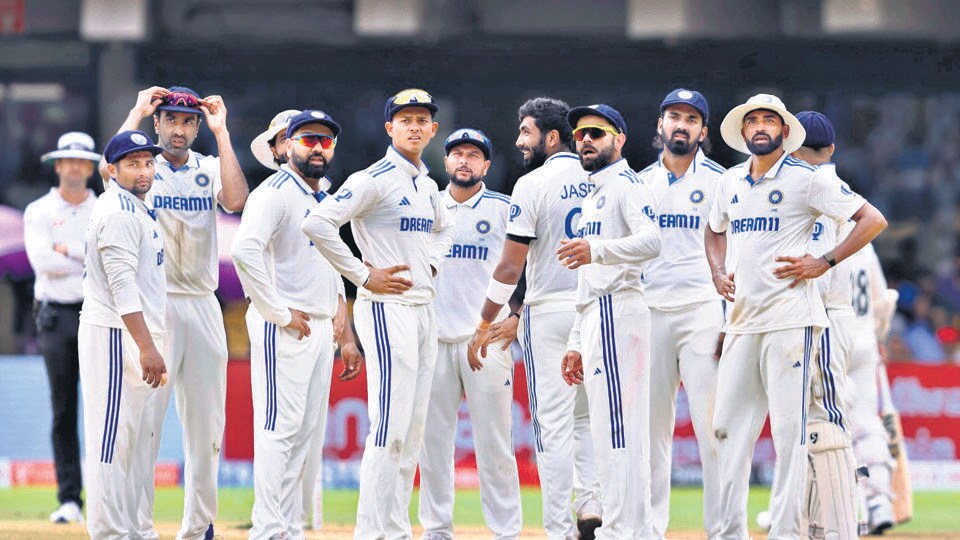
As is often asked politely and somewhat delusionally in press conferences, what’s the “positives” that can be drawn out of the first-ever 0-3 cleanout in a home Test series for India? The options are so feeble that the winning wildcard has to be this – okay, at least it’s New Zealand who are civilized and cultured around cricket. Imagine losing 0-3 to, say, England or Australia and having to put with the aftermath of preaching around “mental disintegration” and “fearless intent”.
India’s previous 3-0 home series defeat came at the hands of the West Indies but in a six-Test series in 1983. (Agencies)
Good attempt to dull the pain, but the horror and sting of what Indian cricket and its fans must grapple with this evening cannot be dulled by banalities. What we have just witnessed over the fortnight has been the worst batting performance by an Indian side in a series this millennium – and if you can bear the idea, possibly even going back even two decades before that. If anyone argues that India’s March 2000 innings totals – 225, 113, 158, 250 – in South Africa’s 2-0 series win are somehow worse than the string of scores from Bangalore (46, 462) Pune (156, 245) and Mumbai (263, 121) against New Zealand, please send them to a doctor.
India’s previous 3-0 home series defeat came at the hands of the West Indies but in a six-Test series in 1983, months after the Indians had upset them in the World Cup final. India’s scores from those matches – 207, 164, 464, 233, 241, 104, 241, 90, 451-8 decl – indicate that the series was fought over in many parts. This one? At one point during the Pant-Jadeja partnership on Sunday, commentator Ian Smith revelled over the tension and tightness of the “contest” but he was being kind.
At the end, India versus New Zealand was not a contest, it was a rout and Rohit Sharma and his team were comprehensively beaten by Tom Latham & Co. India only competed in stray patches over these three Tests: far less with the bat than should be acceptable to an Indian team and, with the ball, failing to respond swiftly to the Kiwis’ counter-punch. This defeat is fundamentally a failure of the top-order batting to provide their bowlers anything to play with. India’s first innings scores in this series read: 6-34, 4-70, 4-84. Another pointy pointer: this is the first time New Zealand have ever won three away Tests in a row. Their best away series scorelines so far have been 2-0 in two-Test series against Zimbabwe (twice) and Bangladesh. It is not being called New Zealand’s greatest-ever Test series win for nothing.
For India, the end-of-era feels that were nostalgically being recalled post-Pune (alongside the parallel disbelief of such a comprehensive defeat) must now meet their wake-up call. Mumbai produced no resistance, no fightback, no change to what had come before. After the shock of 46 all out, the Indian batting didn’t get better; on the face of the dismissals on offer in the two failed chases in fact, it can be argued that it got worse, hitting rock bottom during Sunday’s 121.
Over the last decade, the failure of Indian batters to counter spin adequately even at home has been repeatedly talked about, albeit quietly during their 18-series, 12-year winning streak. The drive to create wickets where the ball spun on day one from 2012 onwards was backed by the Indian middle order’s solid defensive skills and finely tuned shot selection radar on rank turners (prime exhibit: Cheteshwar Pujara). It was backed by the Ashwin-Jadeja spin combo’s discipline and ability working their way through opposition orders. Twelve years later, Ashwin and Jadeja are older and India’s batting finds itself with all the sparkle but no glue.
Of these last twelve years, let’s look at the sustained struggles of its two key batting protagonists over the last five. In these last five years, Rohit Sharma averages 37.82 in 34 Tests, Virat Kohli 32.9 in 36 Tests. The two have not formed a significant Test partnership with each other in all their Tests together either. In this time, India’s Test batting has in fact been propped up by sterling efforts from Rishabh Pant (India’s leading batter since his debut in 2018) and the lower order around him. Pant missed out an entire year due to his horrific accident and even then he’s averaging 44.06 in 27 Tests in the last five. It is what has given the bowlers enough runs on the board for the bowlers to work with. Against New Zealand, every lucky charm has worn off.
Rohit and Kohli are without doubt the last of an Indian generation that were brought up with “days-cricket” as the basic foundation of their game. The batters after them heading for Australia – whether KL Rahul/Jaiswal/Gill/Sarfaraz/back-up opener Abhimanyu Easwaran -- are post-IPL climbers, their game and minds hardwired with a white ball/Twenty20/ franchise cricket template. This is no matter how much or how little first-class cricket they may play. The same that could be said of the coach Gautam Gambhir who in his playing days was a Test cricketer through and through. As a coach though, he has only worked within the parameters of franchise cricket. Compared to which Test cricket is virtually a completely different sport. Coaching around it in its most stressful times, requires a completely different blueprint and an admission of inadequacies.
Former Australian captain Ian Chappell noticed India’s practice of the sweep and the reverse sweep in Mumbai and wrote, “Who is the insensitive coach who preached that the reverse sweep is safer to play in Test cricket rather than employing decisive footwork? The danger of the reverse sweep in Tests was adequately revealed with the senseless dismissal of Yashasvi Jaiswal in the Mumbai Test.”
In Australia, it is Rohit and Kohli as India’s senior-most batters who must find a way to lead their T20 tyros. Their methods in the series against New Zealand, with and without slices of luck, were not reflective of the basic tenet of two batters trying to find form. Spending time on the wicket, batting sessions, sensing and responding to tempo. And recognising when responding to Test match demands with T20 shotmaking is self-destructive.
Just as I was finishing this, a friend sent me a screenshot of a scoreboard of South Africa’s battle to save the 2015 Delhi Test. On a beastly Kotla wicket, South Africa scored 143 in 143 overs, eventually losing by 337 runs. And yet. In that mind-numbing 143-over breach was their middle-order of shotmakers and T20 beasts. Hashim Amla used up 244 balls to score 25. Faf Du Plessis’s 10 came off 97 balls. South Africa’s top score was 43 in 297 balls. From AB “Mr 360” DeVilliers. That’s what fight looks like and that’s what we didn’t see from India’s top batters against New Zealand. In six completed innings, only Jaiswal (308) batted more than 300 balls, Pant faced 292, Shubman Gill (253) and Sarfaraz 243 (195 in a single innings). Will Young faced 460 balls, with two batters facing 300-plus and two more at 299 and 258.
Losing and winning are two sides of cricket’s coin. We understand and very well played, New Zealand. Not fighting though in cricket teams belongs to a very dark place.

 E-Paper