Union finance minister Nirmala Sitharaman on Tuesday introduced the Taxation and Other Laws Amendment Bill, 2026 to make India a more attractive and predictable destination for global capital, strengthen domestic manufacturing and enhance ease of compliance with a range of tax incentives.
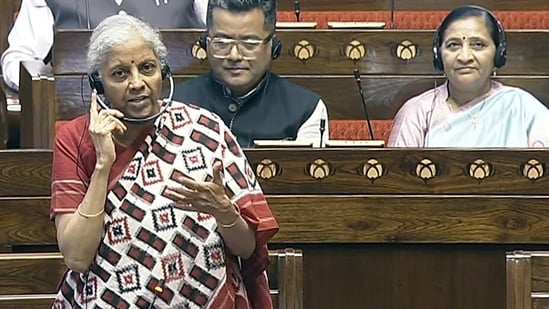
The finance minister introduced the bill in the Lok Sabha, seeking to amend three laws -- the Payment and Settlement Systems Act, 2007, the Income-tax Act, 2025, and the Finance Act, 2026. The bill also seeks to replace the Income-tax (Amendment) Ordinance, 2026.
“In recent months, on account of evolving geopolitical developments and related disruptions in international trade and supply chains, the global economic landscape has undergone considerable uncertainty. Hence, a need has arisen to undertake certain immediate taxation measures with a view to mitigate the impact of external economic shocks, ensure stability in the domestic economy, and support key sectors affected by the prevailing global conditions…,” Sitharaman said, referring to the June 5 ordinance in a statement accompanying the bill.
The ordinance that was promulgated by the President of India on June 5 and was effective retrospectively from April 1, gave tax exemptions to eligible foreign investors on government securities (G-Secs). The objectives were to attract global capital from foreign institutional investors (FIIs), foreign portfolio investors (FPIs) and the Bank for International Settlements (BIS); deepen sovereign debt market, and boost liquidity in G-Secs. While the enactment of the bill will repeal the ordinance, it will safeguard actions already taken under the provisions of the ordinance.
{{/usCountry}}The ordinance that was promulgated by the President of India on June 5 and was effective retrospectively from April 1, gave tax exemptions to eligible foreign investors on government securities (G-Secs). The objectives were to attract global capital from foreign institutional investors (FIIs), foreign portfolio investors (FPIs) and the Bank for International Settlements (BIS); deepen sovereign debt market, and boost liquidity in G-Secs. While the enactment of the bill will repeal the ordinance, it will safeguard actions already taken under the provisions of the ordinance.
{{/usCountry}}Also Read: A shorter tax statute is not always a simpler tax law
Speaking on the Taxation and Other Laws Amendment (TOLA) Bill, a finance ministry official said it revolves around three themes -- attracting foreign capital, encouraging Make in India and enhancing ease of doing business. Tax rules are being simplified so that foreign investment funds are not taxed merely for making India as their base, he added, requesting anonymity.
“India wants global investment funds, cloud businesses and infrastructure investors to route more of their activity through the country. The common thread is to provide reliable policy and process certainty. Overseas players are often unsure whether operating in or through India will create an unexpected tax exposure. These proposals give clear, stable and predictable tax treatment as well the process to get the desired tax treatment,” he said asking not to be named.
The TOLA bill proposes to allow Indian data centres to be run on a leased basis rather than only under direct ownership, he said. “The result is a much larger and more flexible ecosystem of Indian data centres serving global cloud players. This reform is expected to help India build large ‘AI data cities’ and attract significant investment into them.”
In order to encourage Make in India, especially for electronics (such as mobile phones, laptops, personal computers, tablets, servers and their key parts and accessories), the bill seeks to extend the period of tax benefit to the foreign companies supplying machinery and tooling to an Indian factory that makes electronics on its behalf from five years to 15 years, which is up to 2040-41.
Also Read: Trump's India tariff faces legal challenge from 25 Democratic Party-led states
The change will benefit companies such as Apple.
In order to attract the rough diamond trade to India, the bill proposes a 15-year exemption. Since 2016, foreign diamond miners have been allowed to display rough diamonds in special zones in Mumbai and Surat without being taxed merely for showing them. “To turn display into actual trade, the bill goes further and fully exempts the income of foreign diamond miners and the traders connected with them (i.e. sight holders, brokers, aggregators and auction houses), from selling rough diamonds in these zones, for a period of 15 years,” he said. The definition of rough diamonds is also widened. The aim is to shift a meaningful share of the global rough diamond trade to India and to build a financing ecosystem around it, he added.
The bill proposes to remove the existing 2% presumptive tax on foreign companies that store electronic components in Indian bonded warehouses for their local contract manufacturers, he said.
Meanwhile, the Appropriation Bill, 2026 was passed in Lok Sabha by Voice vote amid opposition protest over alleged theft of donation at the Ram Temple and other issues. Finance minister Nirmala Sitharaman introduced the Bill to replace an Ordinance which scraped income tax with regard to foreign investment in government securities. The Bill seeks to amend the Payment and Settlement Systems Act, 2007, the Income-tax Act, 2025, and the Finance Act, 2027.