E-Paper



The importance of Pokhran II, 25 years on
On May 11, 1998, five atomic tests propelled India into a group of nations with nuclear capabilities achieving self-reliance in developing nuclear weapons

 Prefer HTon Google


Between May 11 and 13, 1998, India conducted five atomic tests at the Indian Army’s Pokhran test range — a swathe of desert in Rajasthan — as the Atal Bihari Vajpayee-led government sought to build on the work done over several decades by previous administrations to give the country the nuclear option.
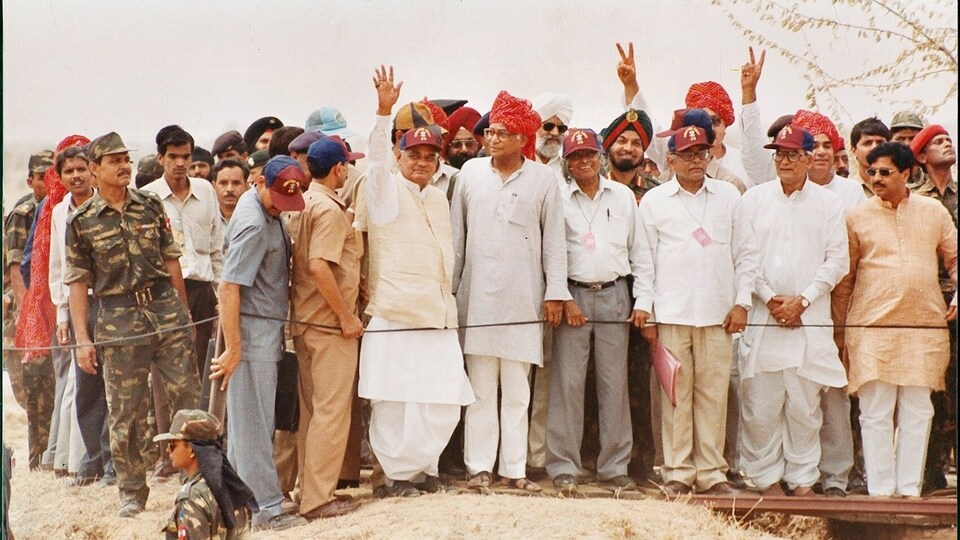
Speaking soon after the nuclear tests in 1998, Vajpayee had pointed out that the word “peaceful”, often used to characterise India’s first nuclear test in 1974 (Pokhran-I), had not figured in official statements issued after the five tests.
“Our intentions were, are and will always be peaceful. But we do not want to cover our action with a veil of needless ambiguity. India is now a nuclear weapons state. Ours will never be weapons of aggression,” the late PM had said at the time.
A statement of strength was necessary. Arrangements for nuclear tests had reached an advanced stage during the administration of late former premier PV Narasimha Rao, who came very close to carrying out the blasts in December 1995 but held off after United States satellites reportedly picked up signs of preparations at the testing range at Pokhran in Rajasthan.
Among the most ardent advocates for the testing of India’s nuclear devices were late APJ Abdul Kalam, who was chief scientific adviser to the prime minister and secretary of the Defence Research and Development Organisation (DRDO), and K Subrahmanyam, the father of external affairs minister S Jaishankar who was then convenor of the National Security Council Advisory Board.
At the time, leaders such as then defence minister George Fernandes had cited the challenge from China, which he described as “potential threat no 1”, as a key reason behind the nuclear blasts, which allowed defence scientists to calibrate the weapons and prepare better designs.
Self-reliance
The nuclear tests also came at a time when India was facing growing pressure from the US, with which it had strained relations, to sign on to the nuclear non-proliferation treaty (NPT) and Comprehensive Nuclear Test Ban Treaty (CTBT). India considered both pacts discriminatory and supporters of nuclear testing had argued that the tests would allow India to establish a credible nuclear deterrence and stand up to nuclear blackmail from the West.
The Pokhran-II tests in Rajasthan laid the foundation for achieving self-reliance in the development of nuclear weapons, and confirmed India’s capability to build more powerful weapons with higher yields, officials and experts said.
India has built on the gains from those tests, and 25 years on, the country is considered to have a fully operational nuclear triad of airborne, naval and land-based platforms that can deliver the weapons, said one of the officials cited above, speaking on the condition that he shouldn’t be named.
“We have modernised our nuclear arsenal over the years to deliver a prompt response, if required. The Pokhran-II tests paved the way for India developing enduring nuclear strike and counterstrike capabilities,” he said.
The landmark underground tests in the desert firmly established India’s capability for nuclear weapons development, the officials and experts said.
The 1998 tests were a clear demonstration that India would do whatever is required for its national interests and not be bound by unequal international treaties that hobble the country’s security, said strategic affairs expert and former Northern Army commander, Lt Gen (retired) DS Hooda.
India has been a responsible nuclear power with a clearly stated nuclear doctrine, he pointed out.
“With two nuclear-armed neighbours, India’s nuclear arsenal serves as an integral part of its military strategy to deter any adversary from using nuclear blackmail. We only have to see the example of Ukraine to understand that non-nuclear states will find it hard to deter a nuclear state that decides to use military force,” Hooda said.
A changed scenario
The nuclear tests received an angry response from countries around the world, particularly the US and its allies and Japan, and led to the imposition of sanctions. However, India mounted a worldwide campaign, sending senior officials, diplomats and academics to countries to explain the pressing reasons behind the blasts.
India’s nuclear doctrine, promulgated in 2003, commits the country to a “no first use” posture, with weapons to be used only in retaliation against a nuclear attack on Indian territory or Indian forces.
In a stand that reflects the capabilities India has built over the years, the doctrine further states that nuclear retaliation to a first strike will be massive and designed to inflict unacceptable damage.
The enunciation of India’s position also became necessary after Pakistan carried out a series of five retaliatory nuclear blasts on May 28, 1998. The neighbours coming into the open with their nuclear weapons has not prevented conflicts, with the Kargil border conflict showing there could be hostilities under a nuclear overhang.
Under India’s doctrine, retaliatory attacks can only be authorised by the civilian political leadership through the Nuclear Command Authority consisting of a political council and executive council. The prime minister chairs the political council, while the national security advisor chairs the executive council.
Former navy chief Admiral (retired) Arun Prakash said the Pokhran-II tests proved that Indian scientists had the competence to weaponise the country’s nuclear capability without any external help.
“The tests were conducted after a hiatus of 24 years. It was an encouraging development, and hopefully we have built on it over the past 25 years as we have two nuclear-armed neighbours who are expanding their nuclear arsenal,” he said.
Prakash made a strong case for tweaking India’s nuclear doctrine in view of changes taking place in the country’s neighbourhood.
“Our nuclear doctrine is sound, but it was promulgated two decades ago and much has changed since,” he said. “We need to make some adjustments to allow for the intentions of our neigbours, who are not only enhancing the quality and quality of their nuclear arsenals but perhaps also changing their doctrines.”
In recent years, experts have pointed to Pakistan’s tactic of developing battlefield or tactical nuclear weapons as a worrying development that should be factored into India’s nuclear stance and doctrine.
Prakash said India should look at enhancing the range, numbers, accuracy and yield of its nuclear weapons, factoring in changes taking place in China and Pakistan into its decision-making. “The nuclear doctrine should stay dynamic,” he said.
China has a stockpile of 350 nuclear warheads, Pakistan 165 and India 160, according to a 2022 yearbook on Armaments, Disarmament and International Security published by Swedish think tank Stockholm International Peace Research Institute (SIPRI).
China is in the middle of a substantial expansion of its nuclear arsenal, the Sipri yearbook said. This comes against the backdrop of India and China being locked in a military standoff in Ladakh sector of the Line of Actual Control (LAC) for more than three years.
The US believes China is modernising, diversifying and expanding its nuclear capabilities at a swift pace. In a report to the US Congress last year on military and security developments involving China, the Department of Defense said that if China continued the current pace of its nuclear expansion, it is likely to have a stockpile of 1,500 warheads by 2035.
While there is little official information in the public about India and Pakistan’s nuclear weapons programmes, the SIPRI yearbook said the two countries appear to be expanding their nuclear arsenals, and both introduced and continued to develop new types of nuclear delivery systems in 2021.