E-Paper



‘This is outrageous’: German ambassador on China’s claim on Arunachal Pradesh
German ambassador Philipp Ackermann described Russia’s invasion of Ukraine as an “Indian problem” as it too is a violation of the international order akin to China’s actions on the northern border

 Prefer HTon Google


NEW DELHI: China’s claim on Arunachal Pradesh is “outrageous” and its infringement on India’s northern border is unacceptable as it amounts to a violation of the international order, German ambassador Philipp Ackermann said on Tuesday.
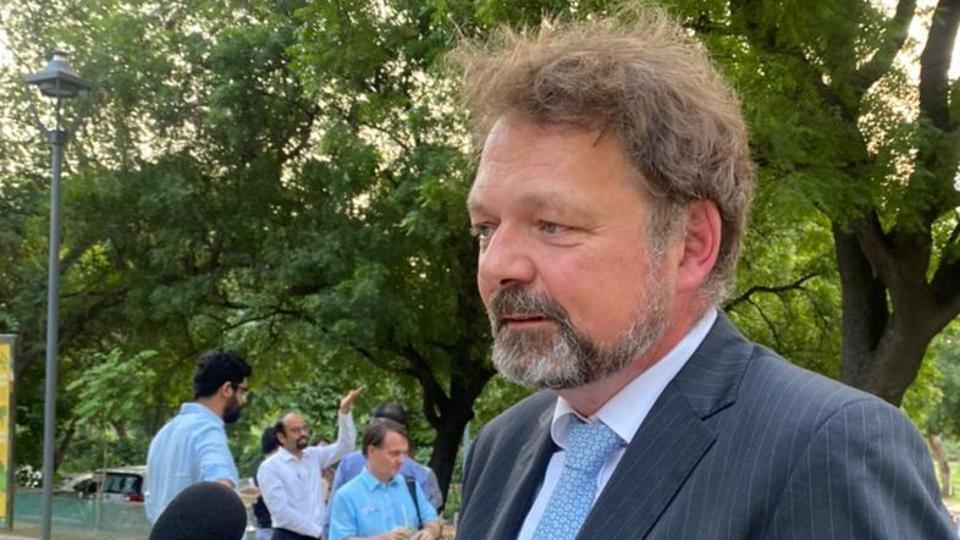
Ackermann, who was briefing reporters for the first time after taking up the position in New Delhi earlier this month, described Russia’s invasion of Ukraine as an “Indian problem” as it too is a violation of the international world akin to China’s actions on the northern border.
While acknowledging that India and Europe may not agree on all aspects of the Ukraine crisis, Ackermann noted that there has been “progress” in India’s position as it recently voted against Russia to allow the Ukrainian president to virtually address a meeting of the UN Security Council.
“We are very well aware of the Indian problems at the northern border. We should not forget that China claims that Arunachal Pradesh is an integral part of China. This is outrageous in a way. Therefore, we see very clearly that infringement at the border is extremely difficult and should not be accepted,” he said.
Ackerman likened Russia’s invasion of Ukraine to Germany’s invasion of Poland in 1939 – one of the events that triggered World War 2 – and said Moscow’s action amounted to a “blatant violation” of the international law built up over the past seven decades to allow small and big states to live with each other peacefully.
“I think that the Indian side very well recognises the problem of the violation of international law. Basically, it’s [the Ukraine crisis] also the Indian problem. You have it at your northern border. That’s something you have been experiencing every couple of years,” he said.
Germany has not shied away from raising the Ukraine crisis with India, including during Prime Minister Narendra Modi’s visit to Berlin in May and it is clear that “we would have wished at some stage that India…was more outspoken on some issues”, he remarked.
“We have seen now that the Indians voted for the first time against Russia. That was progress which we noted duly. It is also clear we might not agree on every single line when it comes to Ukraine,” Ackermann said, referring to India voting for a proposal to allow Ukrainian President Volodymyr Zelenskyy to address the UN Security Council last week.
India has refrained from publicly censuring Russia over the invasion of Ukraine, though it has repeatedly called for respecting the territorial integrity of all states. It has also sought an immediate end to hostilities and a return to the path of diplomacy and dialogue. European states such as Germany had opposed India’s decision to take up Russia’s offer of discounted crude, though New Delhi countered such criticism by pointing out that countries in Europe were themselves still buying Russian energy.
Ackermann said his interactions with Indian interlocutors had led him to believe that the Indian side understands the need to hold up and preserve the international order. “There is disagreement on some issues but I also understand that whilst we are not agreeing on methods or measures, on the abstract level there is an understanding,” he said.
At the same time, Ackermann called for differentiating what happens at the border with China from developments in Ukraine. “China doesn’t hold 20% of Indian territory, China is not destroying systematically every village, every town in the area that they hold,” he said.
Any transgression of borders is a violation of international law, and respecting boundaries is one of the “ground rules” of international law, he said.
Ackermann also pointed to Germany’s growing interest in the Indo-Pacific, including the situation in Taiwan. Germany’s deployment of a frigate last year the participation of its warplanes in Australia’s Pitch Black military exercise reflect both the renewed interest and the concerns in the region, he said.
The new German government of Chancellor Olaf Scholz has made a “clear shift” towards India and Modi’s two visits to Germany – in May for bilateral inter-governmental consultations and in June for the G7 Summit – reflect the importance attached to New Delhi’s role in bilateral relations and multilateral forums, he added.