E-Paper



To mine or not to mine? Decade later, Goa dilemma continues
On July 12, Sawant announced that the Goa government is “gearing up for auctioning of mining blocks on priority”.

 Prefer HTon Google


For 56-year-old James Fernandes, 2012 was a different world. A resident of Tilamol in Quepem, he lived right beside what was the busiest of Goa’s trucking routes, with ore-laden tippers rushing between open cast mines and a loading jetty where the ore was offloaded into riverine barges headed for the port.
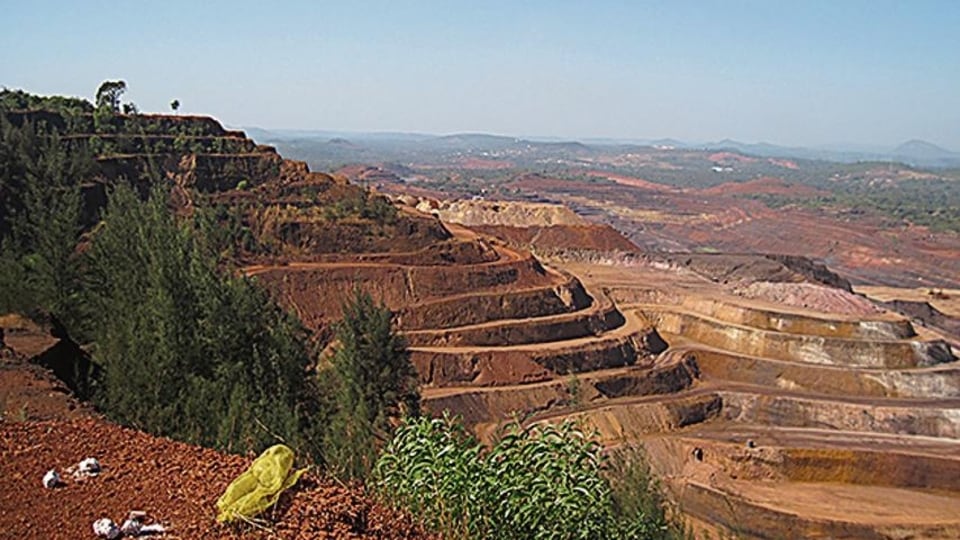
“The route used to carry around 2,000 trucks that made 4,000 trips per day. Trucks from various directions converged on jetties located along the banks of the River Zuari at Sanvordem,” Fernandes said.
Their homes and orchards full of soot and dust, James, along with fellow villagers, was in the thick of the action — protesting against the constant rumbling of the trucks, dust and the accidents on the roads as harried drivers rushed to complete as many trips as possible in a day. The demand was unequivocal: transport ore on alternate routes and not along village roads.
Then, it all stopped. Goa’s iron ore mining industry — then a ₹6,500 crore industry — ground to a halt after the state government in September 2012 ordered the suspension of all mining operations in the state, in response to the tabling of Justice MB Shah Commission report in Parliament that highlighted rampant illegal mining in the state. The order announced by then Goa chief minister Manohar Parrikar was “until further notice”.
Ten years later, there have been no convictions for illegal mining, only around ₹120 crore of the reported ₹35,000 crore loss to the exchequer has been recovered by the state, and Goa stares at uncertainty as the state government claims — without much conviction — that it will restart the once flourishing iron ore mining industry again.
The history
In a bid to shore up state finances, the colonial Portuguese regime via a decree of 1906 first granted mining rights in the state. The first mining concession was issued in 1929, and between 1930 and the 1960, 791 mining concessions were granted giving the holders rights to mine in perpetuity.
Mining took place in clusters — Mayem-Bicholim and Pissurlem in the north, Codli-Costi, Sigao, Tollem and Caurem-Sanguem in the south. In the absence of any other industry, mining soon occupied a lion’s share of Goa’s development narrative. As the industry mechanised and expanded operations, it gave rise to other ancillary industries such as ship building, helping business at Goa’s lone Mormugao Port.
According to figures compiled by the Goa Mineral Ore Exporters Association (GMOEA), between 1970 and 2012, iron ore production grew from 10 million tonnes annually to 54 million tonnes. This rise was particularly apparent during the years 2004-05 to 2010 when it grew from around 24 million tonnes to 45 million tonnes.
At its peak in 2010-11, a study by the National Council for Applied Economic Research (NCAER) estimated, the industry contributed roughly around ₹6500 crore or 16.94% to the state’s GSDP and employed 19,000 people directly, out of a total labour force of 582,000.
This however, came at a cost — to the environment, and to a way of life.
“Of the 150 acres of paddy fields that we have in our village around 50-acres or one third have been destroyed due to siltation or mud flowing in from the mines, burying the fields. We have also lost one of the two lakes in the village,” Sakharam Pednekar, a resident of Mayem village in North Goa who petitioned the high court to stop mining transportation without adequate safeguards, said.
Mayem’s situation is not unique, and is the story that residents of 40-odd villages narrate.
The shutdown
As protests among mining villages grew between 2007 and 2012, the Bharatiya Janata Party, then in opposition, joined in. Led by then opposition leader Manohar Parrikar, it accused chief minister Digambar Kamat of lording over a scam that caused loss to the state exchequer to the tune of ₹3,000 crore. In a separate letter to the President, the state BJP alleged that the mining scam was to the tune of ₹25,000 crore. The MB Shah Commission, constituted to inquire into illegal mining of iron ore and manganese in November 2010, pegged the loss to the exchequer at ₹35,000 crore.
But the last nail in the coffin for Goa’s mining industry came in February 2018, when the Supreme Court, hearing a plea filed by the Goa Foundation, an environmental NGO, ruled that “the maximum of 20 years renewal period of the deemed mining leases in Goa expired on 22.11.2007 and consequently mining by the lessees after 22.11.2007 was illegal.”
Concessions granted by the Portuguese “in perpetuity” were converted by the Union government into leases in 1987, whose maximum renewable period ended in 2007, the court ruled.
The return to non-mining life
Today, Sanvordem is back to being quiet and idyllic, the once brown-stained River Zuari placidly ebbing and flowing against the pier of unused loading jetties. On the road connecting Dharbandora and Sanvordem, traffic now passes smoothly, residents ambling across the road. The mining trucks that once occupied every inch of the road have now receded behind thickets, covered in tarpaulin, waiting for the situation to change. The tarpaulin is meant to keep out the elements, but a decade of disuse means that rust has claimed the bodies of many.
“The biggest change has been the improvement in the water quality of Goa’s rivers. For many years, siltation has been one of the biggest problems facing the main rivers that Goa relies on for drinking water. If mining was to continue I shudder to think of what the state of the river would be. Unfortunately the government has done very little to remedy the siltation of the river over the past ten years,” environmentalist Ramesh Gauns said.
“The Salaulim reservoir which supplies water to south Goa has been reporting high manganese content in the water despite meaning having stopped ten years ago, a testament to the lasting damage that mining has done,” Gauns added.
The quest to return to mining
But as days turned to weeks, months and years, those who had come to depend on the industry for their livelihoods became increasingly impatient with the lack of activity. On April 21, 2014, the Supreme Court lifted its ban on mining, saying that the state government could resume mining after granting leases subject to a maximum annual excavation of 20 million tonnes among other conditions. Since then, the state government has repeatedly made promises that it would restart mining, particularly prior to the 2017 state assembly elections and the 2019 Lok Sabha elections when the Prime Minister himself promised to restart mining. In an election rally on April 10, 2019, Narendra Modi said he would “leave no stone unturned to resolving the issue” and pledged to “work wholeheartedly to remove the obstacles in the way of mining resumption”.
More recently before the 2022 elections, chief minister Pramod Sawant made a similar promise. On November 24, 2021 Sawant promised that six to eight mining blocks would be auctioned.
“There have been 10 years of broken promises. It has now been reduced to an election issue,” Nilkanth Gauns, the president of the All Goa Mining Truckers Association, said.
“Mining had been the major economic activity contributing substantially to the GSDP to the State’s economy in the recent past which has dropped considerably. Mining is more focused in the midlands of Goa, while tourism is generally limited along the coastal belt of Goa. Over the past six decades, mining had metamorphosed into the backbone of Goa’s economy,” a Goa Mineral Ore Exporters Association statement said.
“Mining has been a major economic activity in the region. As it accounted for 20% of the GDP, more than 60,000 families and more than 25% of the state population is directly or indirectly dependent on mining,” the statement added.
“This entire scam seems fake to me. After 10 years no money has been recovered and not a single illegal miner has gone to jail. Instead, those who were poor and who had come to depend on mining for their sustenance have lost everything for no fault of theirs,” Gauns claimed.
The investigations into illegal mining
Sawant told the Goa assembly earlier this year that “a total of ₹120 crore has been recovered from the mining industry, while notices of ₹180 crore have been challenged by mining firms in the court”.
In August 2013, the Goa government set up a Special Investigation Team to probe allegations of illegal mining and started looking at irregularities in 127 mining leases. The SIT registered cases against several people including former Goa chief minister Digambar Kamat and Pratapsingh Rane, and his son Vishwajit Rane.
Charges were framed only in six cases, though. In two, where Digambar Kamat and Joaquim Alemao, a former Congress leader were accused, both were discharged. The case against Pratapsingh Rane and his son Vishwajit was closed on account of lack of evidence. Others are either under investigation or pending trial.
“Several cases are under investigation while others have reached the stage of trial. In cases where the accused have been discharged we have filed appeals before the high court and are pursuing the matters,” a police official who is part of the SIT, said.
The next step
On July 12, Sawant announced that the Goa government is “gearing up for auctioning of mining blocks on priority”.
“The state has entered into a MoU with Mineral Exploration Consultancy Limited (MECL), a government of India enterprise, for providing geological reports. The state has decided to engage the services of SBICAP Securities Limited for transaction advisory services. The state will also engage the MSTC auction platform for the conduct of the auctioning process. A high powered committee is being set up to monitor the auction process in a time bound manner,” Sawant said.
But it is a claim stakeholders are unwilling to buy. Despite setting up the Goa Mineral Development Corporation (GMDC) to oversee the process late last year, the Goa government is yet to appoint a board of directors or even staff it to ensure becomes operational. Director of mines Suresh Shanhbogue said there was “no update to offer”.
“If mining was to start like they said it would within a few months from elections, where is the movement? Instead nothing has happened,” Gauns said.
“Mining needs to be started in a way that it isn’t shutdown again and unless everyone including the earlier mine lease holders, who own surface rights on the land, are taken on board, they are unlikely to make way for a new operators,” Puti Gaonkar, who heads the Goa Mining Workers Front, said.
Some dread what fresh auctions might mean. “Our fear now is about what comes. Opening fresh areas is no remedy for old ills. There will definitely be protests if this is done,” said Ravindra Velip an activist, who believes mining can be done sustainably and profitably if left to a villagers cooperative.
The Goa Foundation, an environmental NGO, has demanded that the Goa government be transparent about its plans. “The government simply refuses to ensure transparency. The Supreme Court judgment required the grant of mining leases to be under a policy laid down by the Goa government. However, the Goa Grant of Mining Leases Policy, was withdrawn by notification on 13.4.2016 and none now exists. In the absence of a policy or a white paper on the subject, how do you grant mining leases in the state? The government set up GMDC, but rules are yet to be framed. Why has the Goa government not reserved the minerals for GMDC, which it has all the powers to do?” asked Claude Alvares, director of the Goa Foundation, in a letter to the Director of Mines.
Attention is now fixed on the corridors of the Goa secretariat where the future of the industry, and the state’s rivers and fields and forests, now lies.