E-Paper



Sub-inspector, three home guards among 16 electrocuted to death at riverbank in Uttarakhand's Chamoli
A sub-inspector, three home guards and one employee of Namami Gange plant died in the accident and among 11 injured, six were airlifted to AIIMS in Rishikesh.

 Prefer HTon Google


Sixteen people, including a police sub-inspector and three home guard jawans were killed, and eleven others were injured after they were electrocuted on the banks of the Alaknanda river at a Namami Gange project site in Chamoli district on Wednesday morning. Of the eleven injured, six people have been airlifted to the All India Institute of Medical Sciences in Rishikesh, while five others are being treated at the district hospital in Gopeshwar, 10 kilometres away from the accident site.
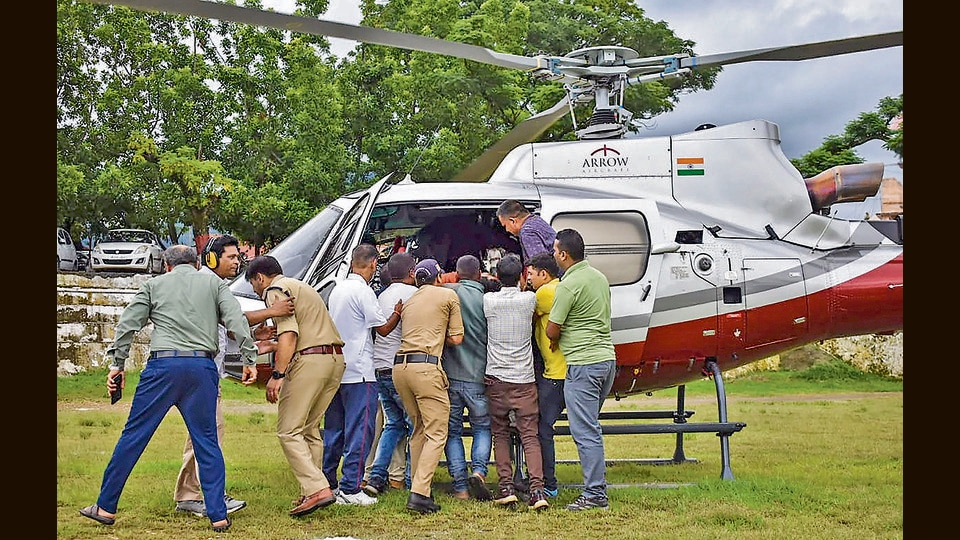
NK Joshi, district disaster management officer, said that the incident took place at 11.35am. “Of the 11 injured, the condition of two people is said to be critical while the rest are stable,” he said.
Also Read | 5 booked for using cobra to kill 30-yr-old Uttarakhand businessman: Cops
Senior police officials said that the body of a security guard, identified as Ganesh Lal, was found by locals and family members a little short of 9am on Wednesday. Officers said that Lal was likely electrocuted to death at night, as he had stopped responding to phone calls, which in turn led to family members and locals going looking for him. UPCL officials said that Lal’s death was likely caused by an electricity leak in the wiring of the Sewerage Treatment Plant (STP).
The Namami Gange plant, that treats the flow of waste from the town into the Alaknanda, is part of the national integrated conservation mission approved by the Union government in 2014, to prevent pollution at source, and the conservation and the rejuvenation of the Ganga. The Alaknanda and the Bhagirathi unite at Devprayag, 135 kilometres away from Chamoli to form the Ganga.
Also Read | Chamoli accident: Electrocution a regular issue at disaster site, say locals
By 9.30am, a crowd had collected near the spot where Lal’s body was discovered, that included locals, his family and security personnel. Two hours later, they were still there with the personnel holding inquest proceedings. “Around 11.30am, the police and the villagers that were at the site conducting the panchnama (an inquest report) were electrocuted when they touched the side railing,” said Chamoli circle officer Pramod Shah.
Among the fifteen that died in the incident, apart from Ganesh Lal who died in the morning, were a sub-inspector, three home guards, one employee of the Namami Gange plant, as well as Ganesh Lal’s brother Deepu Kumar (33) and father Mahendra Lal (48).
Eyewitnesses said that those who died were in contact with a steel railing that runs alongside the treatment plant and all of them received a huge shock. “There was pandemonium. People just collapsed and we thought people had fainted. We never imagined that so many people will die,” said Raghu Sharma, a Chamoli resident.
Another shaken eyewitness, who did not want to be named, said that people were screaming as they fainted. “Those that were outside the STP had to wait for some time for the electricity supply to be snapped even to go near the victims. Ambulances reached the spot in about 15 minutes, and took away the bodies,” the local said.
UPCL officials said that prima facie electricity was leaking through the internal wiring of the STP, coursing through the railing and other equipment and there was no transformer blast. Officials from the agency traded allegations with the Jal Sansthan, the department in charge of the STP, accusing them of not giving them information that an electrocution incident had taken place earlier in the morning. Officials of the Jal Sansthan however said that while they would hold an internal inquiry, it was the UPCL that should have known there was an electrical fault, particularly as Lal had been killed through a likely electric shock before the incident at 11.30am.
Within hours of the accident, chief minister Pushkar Singh Dhami ordered a magisterial inquiry. An official statement by district magistrate, Chamoli, Himanshu Khurana said, “According to the information received today on July 19, some people lost their lives due to electrocution at approximately 11.30am at the Namami Gange project in Chamoli. A magisterial inquiry is absolutely necessary, and I nominate Dr Abhishek Tripathi, additional district magistrate, Chamoli, to hold the magisterial investigation.”
Dhami, who attempted to reach the spot in Chamoli but was forced to return to Dehradun because inclement weather prevented his chopper from landing near the spot, condoled the loss of lives and said that the district administration, police and SDRF had been deployed. Dhami tweeted, “My condolences are with the bereaved families... in this hour of crisis our government stands firmly with the family members of the accident-affected people.”
Prime Minister Narendra Modi and Union home minister Amit Shah also expressed their grief over the loss of lives. The Prime Minister tweeted that he had been left saddened by the unfortunate incident and that he hoped the injured would recover soon. Shah said he had spoken to Dhami and tweeted, “Death of people due to electrocution in Chamoli, Uttarakhand is very sad. I talked to Chief Minister Pushkar Dhami ji and inquired about the incident. The administration is engaged in providing treatment to the injured. I express my condolences to the bereaved families and wish the injured a speedy recovery.”
State health minister Dhan Singh Rawat, who was on the ground in Chamoli and is the minister in charge of the district, said that he was coordinating between officials of multiple agencies. “Action will be taken against those found responsible for the incident after the inquiry report is received,” Rawat said. The state government meanwhile announced compensation of ₹5 lakh to the kin of the deceased and ₹1 lakh to those injured.
Congress leaders attacked the government for lapses that led to the deaths, and said that one of those killed, Sumit Atwal, was a member of the NSUI, the Congress student wing. Congress state president Karan Mahara said, “When a person has died of electrocution, the power supply should have been immediately stopped. At a time when heavy rains are lashing the state, strict security arrangements should have been made while working on such projects.”
Manveer Singh Chouhan, state BJP media in charge, said the Congress should extend support to the government at such a time of tragedy and not indulge in politicking. “When we came to know of the incident, party state president Mahendra Bhatt and Chief Minister Pushkar Singh Dhami left for the spot by helicopter but had to return due to bad weather…Whoever is guilty will not be spared,” he said.