
 E-Paper



Tri-services Missile Command on anvil as stand-off weapons era dawns
While work is on to conceptualize and prepare doctrine for the military theatre commands, the cyber, space and missile commands will be the first tri-services set-up and led the way towards ultimate creation of joint war commands.

 Prefer HTon Google


In the era of stand-off weapons, the Narendra Modi government is considering setting up of a tri-services missile/rocket command on the lines of the space and the cyber command as the first steps towards military theatre commands.
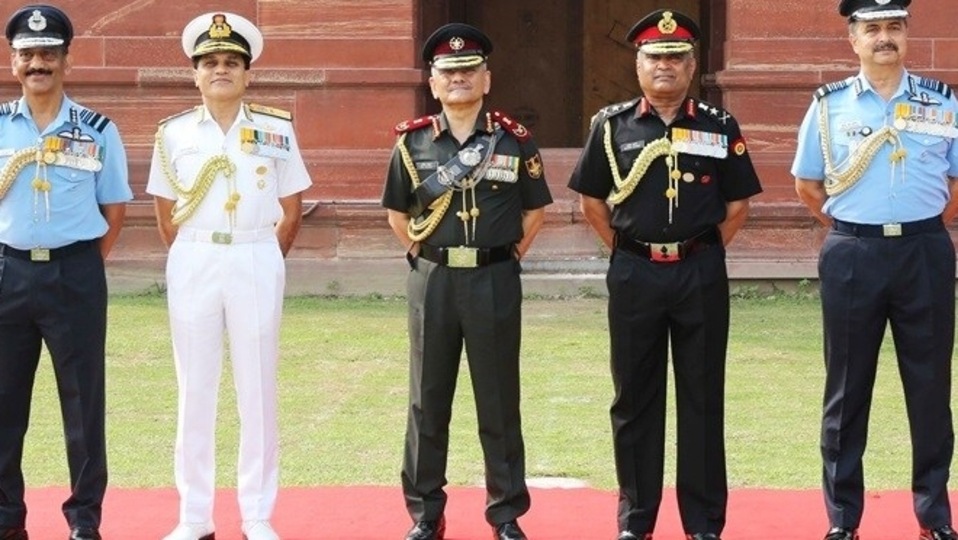
The proposed missile command will be responsible for deployment of missile and rocket regiments against any hostile adversary and will be manned by commanders of the three services in rotation. This means that conventional missiles like BrahMos and Akash as well as Pinaka rockets will be placed under one command for rapid deployment against any adversary. The proposal to set up a missile command has been moved in the aftermath of the May 2020 East Ladakh stand-off with the PLA and the use of rockets and missiles in the Ukraine theatre by the Red Army. The PLA has deployed rocket regiments in the depth areas of occupied Aksai Chin with missiles in the hinter in Tibet and Sinkiang region. The missile command will be on similar lines as the tri-services cyber command and the space command as the future wars will hardly have any contact between troops unless used for capturing enemy territory.
While the Modi government is moving towards military theatre commands, it does not want to take any military reform in a hurry and without proper conceptualization at the doctrine and commander level as well as integration at the lowest level of formations. Given that India has a land frontier of over 15,000 kilometers and coastline of over 7,000 km, the army will be the priority on land as Navy will be on sea.
For optimum operational results, India needs to rethink its offensive doctrines as the tri-services command has a role in taking the war to the enemy and not while defending its own territory. There is no point splitting up scarce military assets among various theatre commands if the threat is coming on India’s land frontiers or sea frontiers. The functioning of the tri-service command at Andamans and Nicobar Islands has sobered up the military reformists as the Navy has a spearhead role in India’s island territories and not the Army till such time India does not adopt the expeditionary forces concept. The Air Force cannot be limited to air defence of Indian airspace but also in launching offensive against the enemy by taking down or degrading its war machine.
Before embarking on the military theatre command charter, Indian national security planners will have to game war scenarios where the tri-services can be optimally utilized and best fit.
With Narendra Modi government appointing India’s second Chief of Defence Staff in Gen Anil Chauhan, his task will be to listen to the three armed forces chiefs on their views on theatre commands and rapidly operationalize the cyber and defence commands.
Gen Chauhan’s task also will be to wean the armed forces from its British Imperial Legacy, as exemplified in PM Modi’s Paanch Prans, as the Indian military is still human resource oriented and not tech oriented. Even today, a whole lot of money is spent on building new military messes and golf courses rather than developing counter-offensive capabilities in cyber-war or developing smarter missiles.


