E-Paper



Two churches and a volatile chasm on the Malabar coast
The December 3 verdict sparked tensions along the Malabar coast and prompted the top court to order status quo on December 17

 Prefer HTon Google


Morning has just broken over the gleaming white spire of the St Thomas Jacobite Syrian Cathedral in Mazhuvannoor, a canopy of trees obscuring the view of the horizon. Eliyamma K and AmminiPS, both in their 50s, are sitting on a wooden bench inside the imposing 150-year-old structure. Seemingly unaware of the early hour, the two middle-aged women are excitedly exchanging news about upcoming weddings or troubles in their village of Mazhuvannoor, settled on the eastern fringes of Ernakulam district in Kerala.
This is a common routine. This morning, they’ve assembled for the burial rituals of a 73-year-old acquaintance. “The funeral ritual is expected to begin at noon and will last around 15 minutes within the church. Then, the remains will be taken to the cemetery behind the church for burial,” Eliyamma said.
For the two women, the two-acre church compound serves as a spiritual and social sanctuary – from baptisms and weddings to funeral rituals, the church has hosted every important event in their lives. The most important days of the year for them are July 2-3, when they turn up with the rest of the parishioners to celebrate the annual “perunnal”, or festival, of the church. It has been this way since they can remember.
But now, Eliyamma fears her way of life might be under siege. On December 3, the Supreme Court ruled that the church, among six such shrines in Kerala administered by the Jacobite Syrian Christian Church, should be handed over to the rival Malankara Orthodox Syrian Church. The verdict was a reiteration of the top court’s ruling in 2017 in which it granted the Orthodox faction control over more than 1,100 parishes in the state by upholding the validity of the 1934 Constitution of the Malankara Church.
The December 3 verdict sparked tensions along the Malabar coast – three churches are in Ernakulam and three in Palakkad – and prompted the top court to order status quo on December 17 and explicitly state that it didn’t want any “untoward incidents”.
But now, the hearing ,to decide a dispute over the ownership and administration of over 1,000 churches and their associated properties, is coming up on January 29-30 and Eliyamma is anxious. “I cannot imagine losing the church (to the rival faction). The church was built entirely by the locals, who are all Jacobites. If we are forced to hand the church over, where will we go and pray? Where will we bury our dead?” she asked.
To be clear, there are no fundamental differences in liturgies, rituals, hymns or even the wardrobe of the clergy between the two factions. But in a milieu where the church is the node of everyday life and the focal point of every celebration and sorrow, the handover would force the 1,400parishioner families of Mazhuvannoor to join a rival denomination. “Accepting the authority of the Patriarch is part of our belief system. We cannot abandon it and join the rival faction,” Eliyamma said.
Paul Palathickal, a member of the Orthodox faction and a local councillor in Perumbavoor, said “both sides have their own arguments and truths.”
“Our ancestors used to be united and together at one point of time. But I don’t think the church can be one again,” said Paul, who goes to pray at a church recently taken over by the Orthodox group following the 2017 top court verdict.
Century-old disputeThe dispute at the heart of the row is more than a century old and involves St Thomas Christians, who consider themselves to be the descendants of the early Christian communities founded by St Thomas, one of Jesus Christ’s 12 apostles and from Galilee, who came in 52CE and set up seven churches in Kerala and evangelised several families.
The first signs of a disquiet came in the 16th century with the arrival of the Portuguese, who attempted to put the then autocephalous church under the Latin Church, causing a split. The entry of the Dutch and their triumph over the Portuguese in the 17th century further vitiated waters.
Things came to a head in 1912. That year, the Damascus-based Patriarch of Antioch, Ignatius Abded Aloho II, attempted to exert control over the Malankara Church and excommunicated Vattasseril Geevarghese Dionysius, the Malankara Metropolitan or the denominational head of the Malankara Church. In response, supporters of Dionysius said they’ll establish an independent Catholicate in India and invited Ignatius Abdul Masih II, a rival patriarch, to Malankara.
This split created two distinct groups – the Jacobite faction that considers the Damascus-based Patriarch of Antioch its supreme leader, and the Orthodox faction that acknowledges the native Malankara Metropolitan as its chief. Even as the number of churches they own is disputed, Jacobites accounted for 483,000 and Orthodox 499,400 followers, according to the 2011 census.
In 1934, the Malankara Church wrote a new constitution, asserting that the Malankara Metropolitan is the head of the church, with no claims from the Patriarch of Antioch over its temporal assets. This incensed the Jacobites who immediately went to court.
The groups briefly reunified in 1959, but the truce dissolved in 1972 after a group of priests went to Antioch, got ordained as bishops and returned to take control of churches, where their followers were in majority, reigniting disputes. In 1995, the Supreme Court ruled in favour of the Orthodox faction, reinforcing the 1934 Constitution. The decision meant that all churches were to be administered by the Malankara Metropolitan of Orthodox faction where the Antioch would have no spiritual authority.
Then, in 2017, the apex court’s LS Verghese verdict declared the 1934 constitution binding on all Malankara churches. While the judgment directly addressed the ownership of two churches, its implications extended to all churches under the Malankara Church, de-facto granting the Orthodox faction control over 1,100 churches in Kerala.
Widespread hostilities
Despite two big judgments, things moved at a snail’s pace on the ground. Sometimes, authorities would transfer ownership of a church but find that the parish is still dominated by members of the other denomination. This meant that while the Orthodox faction gained notional charge of some Jacobite churches, police were reluctant to push for full control. Authorities feared unrest in areas where Jacobites were numerically dominant, but not in control of their places of worship.
The hostilities were so widespread that even older women such as Eliyamma were swept into it. In July 2023, Eliyamma and over 200other people were told to “defend” her church when the district administration and the police arrived at its gates to hand over control over to the orthodox faction. Violent protests erupted and the Jacobite members mobilised inside the premises, locked the gates and waved the yellow flags of the faction. Eventually, the police, fearing major law and order issues, retreated.
Eliyamma said she “did her duty” and defended the church in those turbulent days. “We were adamant not to let the police in. If we had let them in, we knew we would be locked out of our own church,” she said.
Father Shibu Kurumolath, the Jacobite vicar of the church, said the apex court’s decision was “unbelievable”.
“In our parish, over 1,400 families are members of the Jacobite church. There are only five families, who were once Jacobite and have now defected to the rival faction. The faction has goaded these families to file the case over the church. So, should 1,400 families give way so that these five families can offer prayers? Where’s the logic?” the vicar asked.
“In an area, even if just one family belongs to the orthodox group, that family is persuaded to claim ownership over the Jacobite church there, using the ruling. It is clear that the orthodox faction is only interested in taking control of church real estate. Beliefs and faith don’t matter,” he said.
Ronny Varghese Abraham, a member of the managing committee of the Orthodox church, said the Jacobites’ claims were “baseless”. “The law as laid down by the SC multiple times says that the churches be governed as per the 1934 Constitution and where the Malankara Metropolitan’s decree will prevail. Their followers won’t be thrown out. They can always come to church. It’s just that the priests will belong to the Orthodox group,” said Abraham.
Despite the violence, police and administration pushed forward inch by inch. Of the 1,100 churches in question, only six now remain under dispute.
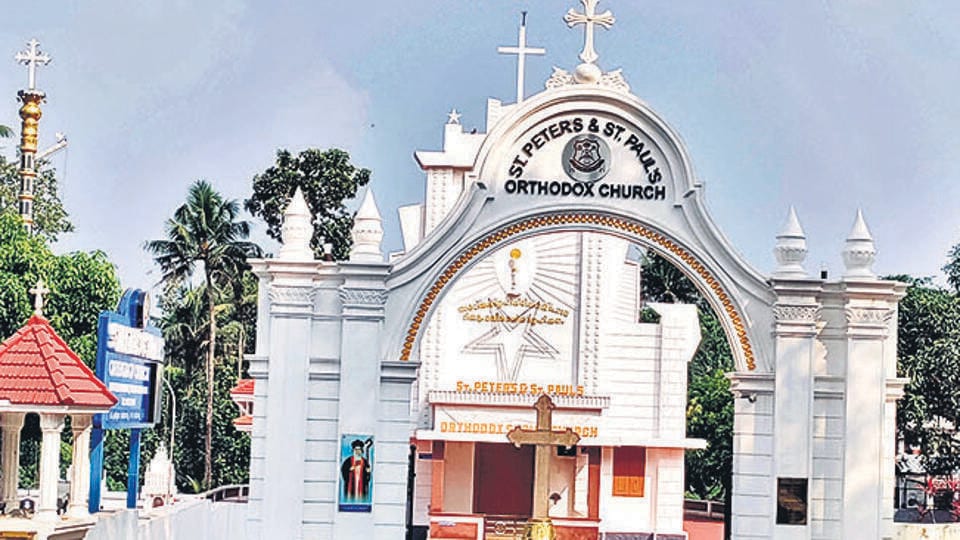
Scars of conflictFifteen kilometres from Mazhuvannur, Perumbavoor town bears the scars of the conflict. In the middle of town is the magnificent Bethel Suloko church, which was handed over from the Jacobite faction to the Orthodox group in 2019. On one side is a makeshift asbestos pandal. On weekends, the Jacobite faithful arrive in droves to attend prayers under the makeshift tent while the Orthodox members slip into the original church.
Things are calm now, but were not always so. In December, 2002, TM Varghese, a member of the Orthodox Church, was hacked to death in front of a car workshop by a gang of men, just days after N Binu, who belonged to the Jacobite faction, was run over by a vehicle in what were seen as tit-for-tat murders. In the Varghese murder case, in which a Jacobite priest was one of the accused, a CBI court in 2023 acquitted all the accused.
Biju John, a member of the Jacobite faction, said he was tired of the conflict.
“We go to church for peace of mind. But unfortunately, there’s no peace. There is only a small minority in both factions who want the conflict and fighting to continue. Most people want an end to the tension. But it looks unlikely,” he said.
Abraham said there was an easy solution to end the conflict – implement the apex court judgement.
“This is purely an administrative issue, not of faith or belief. The question is whether a foreigner or a native should rule over us. The Orthodox Church sees itself as ruled by a native Indian. There have been at least 20 judgments by various courts of the land in favour of us. The law must be respected and implemented,” he said.
He added that his faction was not in favour of permitting Jacobite priests for the last rites and burials of their members in the disputed churches. “Parish members, whether Jacobite or Orthodox, have the right for their bodies to be interred with their ancestors in the local church. But the vicar has the last word on the church and the cemetery. His approval has to be taken,” said Abraham.
These clouds of doubt hanging over death rituals are especially emotional triggers – in November 2018, a Jacobite member’s remains were kept in the mortuary for 10 days in Kayamkulam because of a stalemate between two churches.
Among ordinary people though, the appeal of the strident factionalism is waning.
“I have friends and family members on the other side and there is no reason for us to be torn apart. Even if we cannot unite again into one church, there must be a reconciliation that promises peace,” said Paul.
Ammini said she has faith in the court and solidarity among the local community. “We are more in number here and they [Orthodox] only have five families in the entire parish. Our belief and strength must be upheld by the court. The church is at the core of our daily lives,” she said.