E-Paper



Uttarakhand forest dept identifies 34 wild mushroom species, 14 of them edible
It was the first of its kind survey in Sal forests of Kumaon and lasted three months.

 Prefer HTon Google


Uttarakhand forest department’s research wing has identified 34 mushroom species that grow in the Sal forests of Kumaon region, of which 14 have been found to be edible.
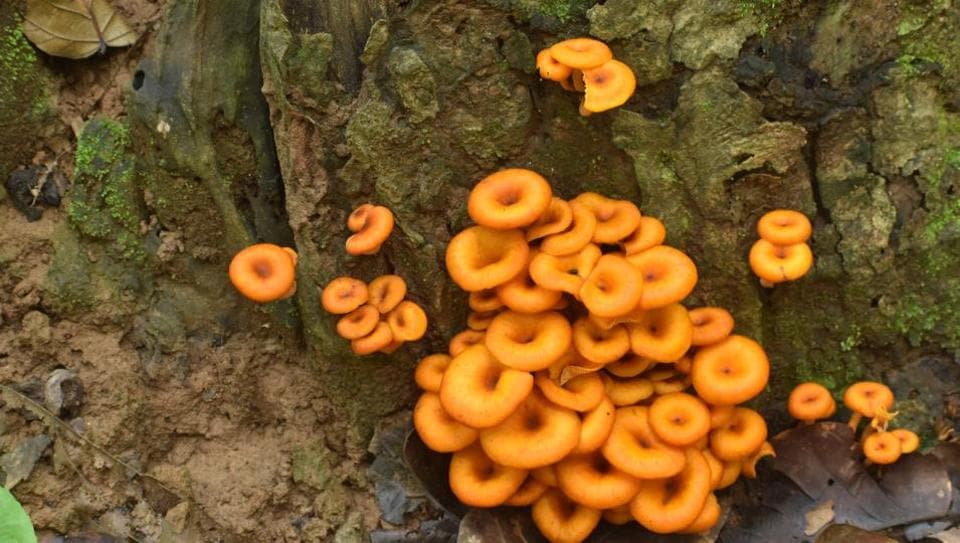
The study over the last three month was conducted in five different sites in the Sal forests of the Kumaon region. Out of the five sites, three were in Nainital district and two were in Udham Singh Nagar district.
According to the study conducted by the forest research wing’s junior research fellows Kiran Bisht, Tanuja Pandey, Jyoti Prakash, and Kanish Kumar (forest guard), a total of 34 different species of mushrooms or macrofungi were collected from Sal forests of Kumaon region).
“Out of the 34 wild mushroom species that have been identified, fourteen species are edible. The most common edible species collected from Sal forests included Termitomyces and Xylaria hypoxylon,” said Kiran Bisht.
“The local people have good knowledge of wild edible mushrooms which they have achieved through their experience and the knowledge passed on from generation to generation. Since these mushrooms are being sold in the markets during monsoon by the local people, this survey will further help people here and create more awareness about mushroom diversity”, said Jyoti Prakash
Wild mushrooms fetch local people good income as their price ranges between ₹150 to 200 per kg for common mushrooms like Button mushrooms to ₹20,000 to ₹40,000 per kg for morel mushrooms.
Tanuja Pandey said some of the edible mushrooms that they identified include Coprinellus disseminatus, Coprinus comatus, Hygrocybe Cantharellus, Rusulla brevipes, Macrolepiota procera, Ganoderma lucidum, Coprinellus micaceus and so on.
Sanjiv Chaturvedi, chief conservator of forests (CCF) and in-charge research wing said study of mushrooms in Sal forests hold significance as wild edible mushrooms are a source of food and income for the local people, who collect them mainly during the rainy season.
Chaturvedi said the Sal forest in Baggha area of Khatima in US Nagar showed maximum diversity of mushrooms followed by the Sal forest in Musabandar.
“This is the first kind of its survey in Sal forests here. On the basis of soil analysis, it was observed that the nitrogen content was the highest in the Baggha Sal forest followed by Sal forest near Nandhaur area However, the moisture content was almost equivalent in all the sites”, he said.
Talking about the importance of studying mushrooms, Chaturvedi said mushrooms are a major group of decomposers and as such essential for the survival of other organisms in the ecosystem as they contribute to the nutrient cycle and the maintenance of local ecology.
“Mushrooms play a significant role in soil formation, soil fertility, and improvement of the habitat where they grow. They are also indicators of good health of forests”, he said.