
 E-Paper



Voter turnout manipulation ‘an impossibility’: CEC Rajiv Kumar on changes in polling data post 5 pm
CEC Rajiv Kumar clarified that voter turnout increase from 5 pm is inbuilt in the process of aggregation and they lead to the final voter turnout percentage.

 Prefer HTon Google


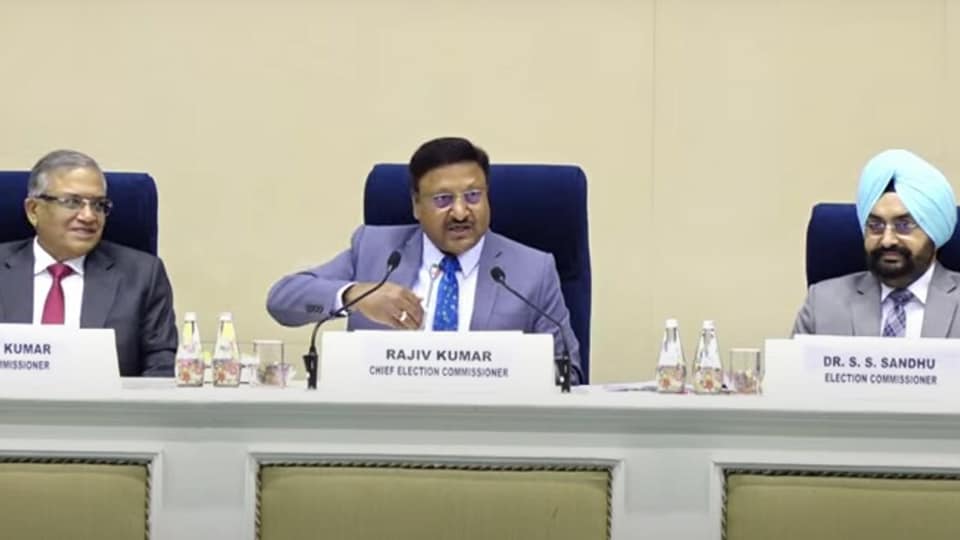
Chief Election Commissioner Rajiv Kumar, who addressed his last presser as the CEC on Tuesday, issued clarifications on the questions raised over tampering of voter turnout data and termed it to be an "impossible" feat. CEC Rajiv Kumar clarified that the narrative of voter turnout increasing after 5 pm is “misconceived”.
As per the poll schedule announced by the Election Commission of India, the Delhi assembly elections 2025 will take place on February 5 and the counting of votes is scheduled for February 8.
Kumar explained as to why it is incorrect and misleading to compare the final voter turnout with the 5 pm data and said that near the closing time, polling officials perform multiple functions. He said they update resume after submitting the electronic voting machines (EVMs) and noted that some polling parties report at midnight or the next day.
'No postal ballots on voter turnout app'
"The polling agents are given Form-17C at the close of poll at polling stations," the CEC added.
Additionally, he said that the voter turnout increase from 5 pm is inbuilt in the process of aggregation and lead to the final voter turnout percentage.
Kumar further noted that the voter turnout app does not have the postal ballots count. Some CUs are not counted because of "not deleting mock poll data and non-display of results by machine".
In this regard itself, the CEC also clarified that allegations of EVM tampering are "baseless". He cited that even courts have ruled on 42 occasions that EVMs are not hackable.
"There is no evidence of unreliability or any drawback in the EVM... There is no question of introducing a virus or bug in the EVM. There is no question of invalid votes in the EVM. No rigging is possible. High Courts and the Supreme Court are continuously saying this in different judgments... What else can be said? EVMs are foolproof devices for counting. Allegations of tempering are baseless. We are speaking now because we don't speak when elections are on," Kumar said.
The electronic voting machines are commissioned only seven to eight days before the polling day and candidates are kept informed through agents at every step of the process, the CEC added.
He said that political parties have full disclosure at each and every stage of the voter list preparation and they are also given opportunity to object.
"Right to question is inherent in democracy and it is our duty to clear all doubts," Kumar said at the press briefing.
However, he noted that rumours are being spread about wrongful additions or deletions in electoral rolls to target particular groups. "Stories are going around regarding electoral rolls, even now. Almost 70 steps are there...in which political parties and candidates remain with us... All the claims and objections that come up - are shared with all the political parties. No deletion can be done without Form 7," the CEC said.
In total, CEC Rajiv Kumar addressed a total of 6 prime concerns in relation to the conducting of elections.
(with ANI, PTI inputs)


