
 E-Paper



Water conservation in era where flooding, drought collide
Devanahalli, a town near Bengaluru, has been using treated wastewater blended with rainwater to supply 0.2 mld of water to households.

 Prefer HTon Google


New Delhi Just 10km from the Bengaluru International Airport, Devanahalli town, situated in a semi-arid zone, has faced persistent water shortage. In recent years, the local municipal corporation was forced to hire private water tankers as 32 of the town’s 130 borewells ran dry. But, for the last six months, the town has been using treated wastewater of Bengaluru blended with rainwater in two lakes to supply 0.2 mld (million litres per day) of water to households.
Read here: Provide food, water to pilgrims at Sabrimala halting points, says HC
Devanahalli’s existing demand, as estimated by the Karnataka water policy, is2.26 mld for its 38,000 residents. Once the second phase of this water treatment project is completed, more than 22% (0.6 mld) of its daily demand can be met by treated water alone, said S Vishwanath, a trustee at Biome Environmental Trust who is working with the town officials and the community to set up an integrated water treatment system using lakes, wells, and a water treatment plant.
But are residents willing to drink treated wastewater? Vishwanath vouches for the quality. “Apart from the water treatment plant, the system is equipped with a 130-micron disc filter, a multimedia filter with activated carbon, ultraviolet disinfection, and an online chlorinator to treat the wastewater before it is integrated into the water supply system. The WTP ensures compliance of treated water with BIS 10500 (drinking water) standards,” he said, adding that “the quality is such that residents may choose to drink it if they wish to”.
Not just in Devanahalli, borewells going dry is a common problem across urban India. With time, traditional means of conserving water using wells, stepwells, ponds, and wetlands have been forgotten. Most of these are lost to real estate or have become garbage dumps. Relentless pumping of water from bore wells, leading to drying up the groundwater reserves, has become the norm. Further, an increase in paved surfaces has meant less water percolates into the ground, affecting natural recharge.
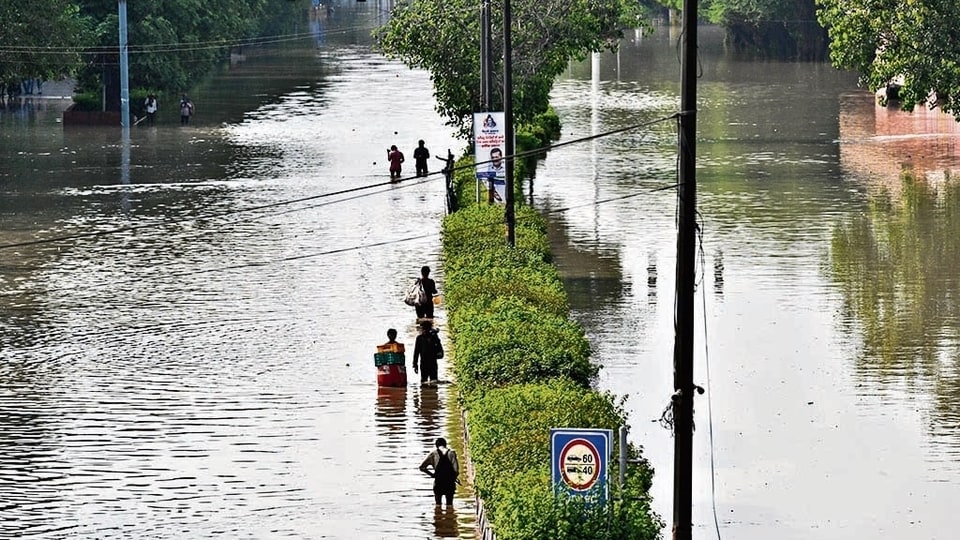
Saswat Bandyopadhyay, an academic working on climate resilient infrastructure, said the situation has worsened because of the climate crisis as rainfall has become erratic but intense. “We now have had times when we see 10-17 inches of rainfall within a day and due to lack of ponds, water bodies, and empty lands, the water cannot percolate. The water is wasted as run-off leading to urban floods and eventually gets flushed out of the city,” he explained. He added that globally, there is a rethink in city design to accommodate this excess water by creating new space for blue and green infrastructure following the concept of sponge cities.
Sustainability experts have for long stressed the need for efficient reuse of water to reduce demand for freshwater, a scarce resource. The Union government’s Swachh Bharat Mission and Atal Mission for Rejuvenation and Urban Transformation (Amrut) are especially focused on this approach, emphasising wastewater reuse to meet 20% of water needs in Indian cities.
D Thara, additional secretary at the Union ministry of housing and urban affairs said that under Amrut, ₹32,456 crore has been allocated to expand and upgrade wastewater treatment infrastructure, against which 232 projects worth ₹18,248 crore have been completed. These include the addition of 3,685 mld of sewage treatment capacity and another 2,546 mld treatment capacity, which is in the process of being added. “The reduction of untreated wastewater discharge into natural water bodies and systems constitutes a pivotal element in ensuring urban water security and preventing contamination of surface water sources,” she said. Under Amrut 2.0, launched in 2021, another 526 sewerage and septage management projects worth ₹50,537 crore have been approved.
HOPE FOR DELHI?
As early as 2012, Delhi considered using treated wastewater to augment its potable water supply. Although the project is yet to take off, some efforts to conserve groundwater have paid off. In March, the Central Ground Water Board found that the amount of water extracted was less than the recharge in the financial year 2021-22 for the first time in 10 years. Ankit Srivastava, a consultant with the Delhi Jal Board until recently, believes that the situation will improve considerably.
He said many projects — where treated water will be used for multiple purposes and, in turn, reduce groundwater use — are in their last phase. These include around eight lake rejuvenation projects, which will improve the water table of those areas. “Pappan Kalan Lake in Dwarka was commissioned around one and a half years back, but in this short period, the groundwater level has increased by 12 metres to 8 metres below the ground from 20 metres below the ground. Even the area surrounding the Rohini lake, fed treated water, has seen a major improvement with the groundwater available just two metres below the ground.”
He added that DJB has started laying pipelines to transport treated wastewater to farmhouses, parks, and other horticultural and industrial purposes. “Around 25% of the treated water is reused, but within the next one to two months, it will go up to around 35%.”
As in Devanahalli, Chennai has started to supply treated sewage blended with freshwater to households on a small scale this August. TG Vinay, managing director of Chennai Metropolitan Water Supply and Sewerage Board, said, “We release the treated sewage into Porur lake. Then the treated sewage of 3-4 mld mixed with rainwater is supplied to households after another round of treatment.” Experts from IIT-Madras are currently monitoring the water quality of this treated water.
Besides this, the water board supplies around 68 mld of treated sewage to industries. Another 20 mld of sewage treatment capacity will be added to the city in six months. The city will supply water to the Indian Railways and other private industrial players, another official said. He added: “By reusing this treated water, we are saving water that can now be used for domestic supply and reduce groundwater extraction.”
Currently, Chennai reuses less than 10% of its total treated sewage. However, wastewater reuse is much better in Surat, where more than 30% of the treated sewage is re-purposed for horticultural and industrial purposes.
Surat has 11 sewage treatment plants through which around 1,000 mld of treated sewage is released, of which 30% is being reused. “Out of the 330 mld, 115 is industrial-grade water for dying and other textile processing units. The rest of the water is used for gardens and agriculture,” said Bhairav B Desai, executive engineer at the Surat Municipal Corporation. He added that work is underway to increase the reuse of water further. He said the city and the state government are talking with private companies that partially need treated water to fund newer sewage treatment plants. “By 2035, we aim to utilise 100% of the treated sewage.”
Why does a relatively smaller city such as Surat or even a smaller town like Devanahalli fare better at water efficiency?
Veena Srinivasan, executive director at Water, Environment, Land and Livelihoods (WELL) Labs, thinks that the lack of coordination among government departments and the lack of incentive alignment is a major hindrance. “Often, the municipal body has no additional incentive to store the collected rainwater efficiently,” she pointed out while stating water utilities earn fees to distribute water to households. Still, there is no significant incentive to treat their sewage even though it is part of their mandate. “Often the only time there is an emphasis to treat sewage is when the National Green Tribunal takes notice and warns that they will be fined,” she added.
“This is why currently reuse of water is more successful where there is an active involvement of industries that can benefit from using the treated wastewater and they have no other water source,” she said.
The filled lakes in Devanahalli, other than ensuring piped water supply, also help recharge the shallow aquifers in the area, which will help the town meet its water needs through shallow aquifers rather than deep borewells. “Energy used in pumping is now considerably reduced by a factor of 7 per kilolitre of water, thus reducing the cost of water and reducing carbon emissions,” Vishwanath said.
Aquifers are water pockets below the ground that are often connected with other such formations and act as vital underground reservoirs storing rainwater and surface water run-off that percolate through the ground.
WIDESPREAD PROBLEM
Not just these cities, almost all urban settlements in India, big or small, have been facing water shortages for years with no offered remedy as the population rises every year. In March , the United Nations, in its ‘World Water Development Report 2023’ report, noted that Indian city dwellers will be the most severely affected as the global urban population facing water scarcity is projected to increase from 933 million in 2016 to 1.7–2.4 billion people in 2050.
However, the successful project in Devanahalli shows that managing and reviving shallow aquifers could help solve the existing water crisis in Indian cities. This is because not only does the cost of water become cheaper, but they can also be readily recharged with rainwater and surface water compared to deep-lying groundwater extracted through borewells.
To bring aquifer management to the forefront of policy dialogue, the ministry of housing and urban affairs is giving ₹20 lakh each to 10 Indian cities to implement projects that work as a model for mainstreaming recharging shallow aquifer management (SAM) under the Amrut 2.0 scheme. All these model projects will be realised by March 2024.
Pune is among the 10 cities chosen for the SAM pilot, where the watershed of the Harantale lake will be redeveloped to increase the groundwater recharge potential of the area artificially. For this, the lake will be de-silted to increase the water holding and percolation capacity. Among other proposed works a rainwater harvesting pond will be dug to capture around 2,000 cubic metres of rainwater by the side of the lake. Further, a plan is to create continuous contour trenches to arrest surface run-off and prevent solid contaminants from entering the lake body.
Read here: Delhi Jal Board warns of hit to water supply after ammonia levels rise
In Jaipur, one of the 10 SAM cities, an existing dilapidated stepwell — Juht Ki Bawdi — is set to be repaired and restored. At first, the site will be repaired, the existing structure restored, and then the current site will be disinfected after the currently lying water is thrown away. A barrier will also be placed to prevent solid waste from entering the step well before it is again used.
These are among the plans highlighted in a handbook compiled by the National Institute of Urban Affairs which will act as a guide to cities for taking up projects like this.


