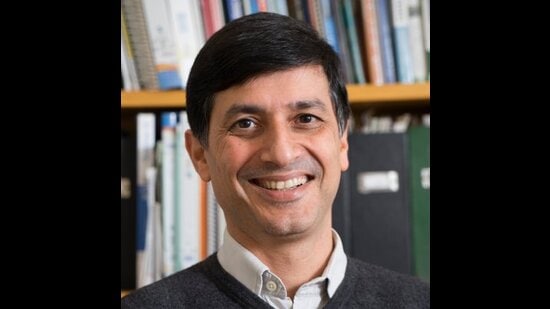
We aren’t on track for 1.5°C target: Navroz Dubash, IPCC report co-author
There are many more policies and laws in place around the world that have played a role in enhancing energy efficiency, lowering deforestation and accelerated deployment of renewable energy.
No single ministry alone may be able to deal with the climate crisis and government institutions and policies must be strengthened to help build a low carbon future, Navroz Dubash, professor at Centre for Policy Research and one of the coordinating lead authors of the IPCC report which was released on Monday told Hindustan Times in an interview. Edited excerpts:
Navroz Dubash, IPCC report co-author
Average annual greenhouse gas (GHG) emissions in the past decade were higher than any previous decade, according to the IPCC report. Does that mean most countries failed to deliver on their commitments to reduce emissions so far?
On an aggregate, we are not on track to achieve 1.5 degree C warming, and current policies will take us to between 2.2 and 3.5-degree C warming. That emissions have continued growing during the decade of the 2010s likely shows a combination of inadequate pledges by countries and a lack of implementation of existing pledges. As a result, we are indeed not on track to limit warming to 1.5 degree C. However, the key issue is to limit the warming as far as possible. And here, the IPCC report does note some signs of progress. There are many more policies and laws in place around the world that have played a role in enhancing energy efficiency, lowering deforestation and accelerated deployment of renewable energy. Countries can reduce emissions by 25% by 2030 at a cost of under USD 20 per ton of CO2 equivalent. The challenge now is to build faster and more urgently on these signs of progress.
The report has indicated more than once that keeping global warming under 1.5 degree C is unlikely. What can still be done to keep global warming under 1.5 degree C or should countries now focus on the 2 degree C goal?
The value of 1.5 degrees C is significant, but it is important to remember that the key is to work harder to limit warming to the extent possible – 1.5 is better than 1.6 degree C, but that is better than 1.7 or 1.8 degree C and so on. The important thing is to act, rather than focusing on specific numbers. And, it is very important that this action begins right away. Emissions have to decrease substantially by 2030, as much as 27% even to achieve 2 degree C. While there has been a lot of emphasis on achieving net zero carbon dioxide emissions globally by mid-century, this is not a substitute for early action. More than focusing on any particular number, the countries across the world need to stimulate domestic actions in their own nations as soon as possible.
This report is being expected to be a solutions-oriented one which can provide pathways to keep the dangerous global warming at bay. What are the most important solutions/policies that developing countries like India can consider?
The report provides a solution orientation across countries, since it is a global assessment. A few key steps: First, development decisions are also climate decisions and vice versa. Development choices on urban, energy and land systems can shift development pathways toward sustainability. So, it is useful to think about climate implications when making development choices. Second, strengthen government institutions for coordination, setting a strategy and building consensus on low carbon futures. Climate change cannot be outsourced to single ministries since it spans so many areas of economic activity and human endeavour. Third, focus on packages of policies rather than single instruments. This will allow balancing low carbon transitions, fostering innovation, and ensuring the poor and vulnerable are not left behind.
IPCC has flagged that continued installation of unabated fossil fuel infrastructure will ‘lock -in’ GHG emissions. What are the implications of this rapid mitigation for developing countries such as India?
In developing economies where emissions are still growing, there is an option to choose technologies that steer a country toward a low rather than high carbon future. Fossil fuel infrastructure versus renewable energy infrastructure is one such choice. The rapid cost reductions of renewable energy -- 85% reduction since 2010 for solar and batteries, and 55% for wind – make it easier to choose renewable energies. But in some cases, investing in low carbon futures requires additional investment. This is why it is worrying that the report finds that there is a significant gap in financial flows, on an average it is 3-6 times lesser than what is projected to be needed on any average globally by 2030 to limit warming to 1.5 or 2 degrees C. It would be wise to mobilise these funds to enable a transition to a low carbon world rather than locking into a high-carbon future.
Does the IPCC report reflect on equity in mitigation efforts? It does state, for example, that 10% of households with the highest per capita emissions contribute a disproportionately large share of global household GHG emissions. Does the IPCC recommend a differentiated approach in mitigation?
IPCC report does reflect on equity, both internationally and domestically. Internationally, it notes that equity remains important to the international climate regime, notwithstanding shifts in discussions about ‘differentiation’ – the idea that different groups of states should have different responsibilities – and challenges in deciding what is a fair division of labour or emissions. Domestically, it notes that because climate action can lead to not only economic opportunities but also disruption and distributional consequences, ensuring social cohesion and continued mitigation requires addressing underlying questions of justice. Many countries have explicitly created ‘Just Transition’ commissions to discuss and develop ways forward to mitigation that also take into account equity.
I write on the environment and climate crisis and I believe these are the most important stories of our times.
Follow India news real-time updates and the latest news covered on Hindustan Times, featuring today's critical updates on Sonam Wangchuk LIVE and more across India.
Home/India News/We Aren’t On Track For 1.5°C Target: Navroz Dubash, IPCC Report Co-author

 E-Paper