
 E-Paper



Scant rainfall triggers low yield fears in crucial states
A weak southwest monsoon in India has led to drought-like conditions in some major food-bowl states, causing decline in crop yields and water and power crisis.

 Prefer HTon Google


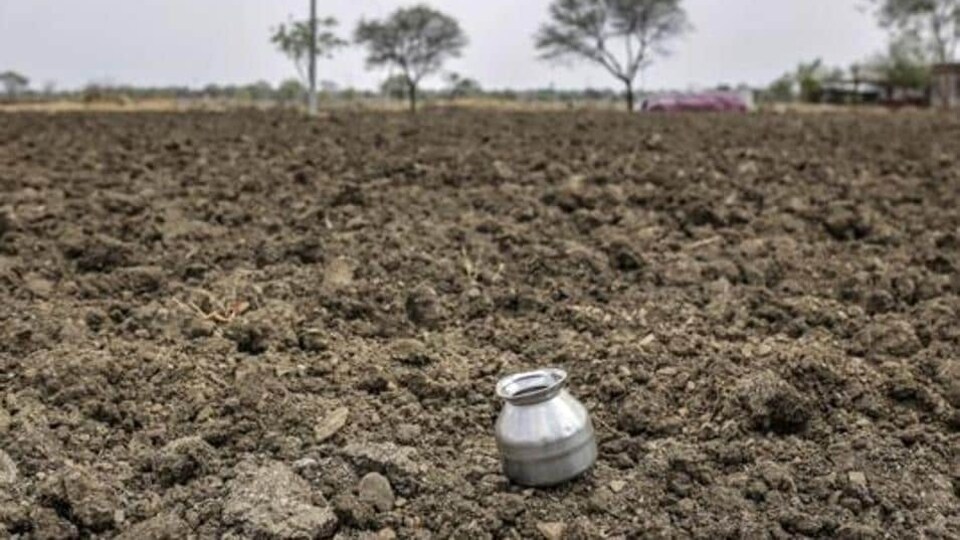
A weak and patchy southwest monsoon, vital for the world’s fifth-largest economy, has triggered drought-like conditions in some major food-bowl states, wilting crops and stoking water and power crises as farmers fear lower farm output due to poor yields.
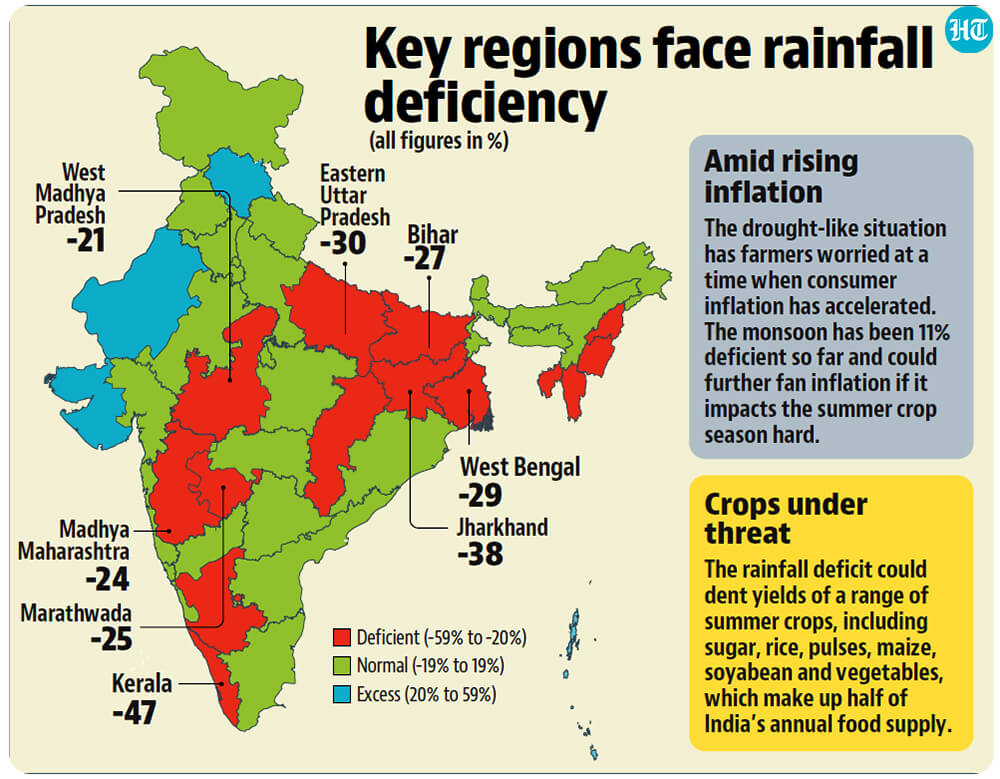
The worry among farmers comes at a time when consumer inflation has accelerated -- it was at a 15-month high of 7.44% in July -- with high food prices being among the primary drivers of the price rise. The monsoon has been 11% deficient so far and could further fan inflation if it impacts the summer crop season hard.
Soils have lost moisture and farmers are battling to save crops, but erratic power supply and depleted groundwater levels are proving to be hurdles, said cultivator and food aggregator Hitesh Chandak of Madhya Pradesh’s Itarsi over phone.
“Our region of Hoshangabad is mainly served by the Tawa dam but since water levels have gone down, irrigation canals are going dry,” Chandak said.
The Soyabean Processors’ Association of India (SOPA), an industry body, last week said that soy crops in Madhya Pradesh, Maharashtra and Rajasthan were under threat. “There has been unprecedented deficiency in rainfall in August and though the crops have held so far, rains are needed immediately,” said DN Pathak, executive director of the body.
Madhya Pradesh and Maharashtra are among several large states that produce nearly a two-thirds of the country’s summer food output. The others are Gujarat, eastern Uttar Pradesh, Rajasthan, Karnataka, Kerala, Manipur, Bihar and West Bengal and all of these regions have staggeringly high rainfall deficiency.
The rainfall deficit in these states could dent yields of a range of summer crops, including sugar, rice, pulses, maize, soyabean and vegetables, which make up half of India’s annual food supply.
Rainfall has been subpar in Maharashtra’s Marathwada and Madhya Maharashtra regions by 24% each. Gujarat has been battling a 16% shortfall, while rainfall has been 34% below normal in Madhya Pradesh, according to data from the India Meteorological Department, the national weather bureau. Kerala’s deficit stands at 47%.
Dams are running low on water in some of these regions too and the long heat spell has driven up power demand across sectors, leading to shortages in several states.
“Crops desperately need rains in September or else yields are sure to go down by 20-30%, especially of soyabean and maize,” said CP Gupta, the proprietor of Cheshta Food Enterprises in Kota, Rajasthan.
East Rajasthan, where most of the state’s food is grown, is battling a 9% deficiency. Unlike widely assumed, Rajasthan isn’t a barren desert state but a large grower of spices, pulses, onion, maize etc.
Maize is an important crop as it is a major source of poultry feed. Lower output could drive up chicken and egg prices.
Eastern India has been equally parched. Rainfall deficiency in Bihar, one of India’s largest maize growers, stands at 28%, while in Jharkhand, the shortfall has been around 38%. The monsoon in West Bengal, a large rice producer, has been nearly 30% below normal.
Bihar is a traditional maize-growing state and seven of its districts account for half of the state’s total acreage. According to the Met’s data, rainfall in all these districts, barring one, has been deficient till August 31: Begusarai (-38%), Khagaria (-14%), East Champaran (-24%), Bhagalpur (+2), Madhepura (-10), Saharsa (-51%) and Samastipur (-27%).
Analysts say soyabean, a source of edible oils, which India doesn’t produce enough to meet domestic demand, is in a particularly vulnerable state. Madhya Pradesh, the largest soyabean producer, is often called India’s Midwest because it accounts for almost 50% of the total soyabean production. Rains in many districts of the state’s Malwa region, the main soya belt, such as Indore and Dewas, have been below normal by 20-50%.
Overall, farmers this year have planted the leguminous crop in a total of 12.5 million hectares, marginally higher than last year’s 12.3 million hectares, but it’s the health of the soya crop that is concerning, Chandak said.
Good harvests not only boost farm incomes but spur overall demand in an economy where nearly half the population depends on an agriculture-based livelihood. Rural customers, for instance, account for nearly half of all motorcycles sold annually, according to industry data.
The monsoon brings nearly 70% of the country’s annual rainfall, waters nearly half of India’s net-sown area and replenishes reservoirs and aquifers, critical for irrigation, power-generation and drinking.
The weak monsoon is being attributed to the El Nino weather pattern, whose impacts ripple around the globe, from floods in Latin America to drought in India. “The impacts of El Nino are visible now,” said Mahesh Palawat, a meteorologist with Skymet Weather Services Ltd.
El Nino, an anomaly caused by warmer Pacific Ocean temperatures, is associated with drier summers in India. Although there is no one-on-one correlation between an El Nino event and droughts, most El Nino years have resulted in agricultural droughts.
India may need to import more pulses this year due to both lower acreage and poor rains, in states such as Rajasthan, Karnataka and Rajasthan and Maharashtra.
The world’s second-largest grower of sugarcane may be forced to ban sugar exports in the oncoming season beginning October, after limiting shipments to 6.1 million tonne in the current season, if yields are hit by poor rains in Maharashtra, Karnataka and Uttar Pradesh, the three largest producers.
Rainfall had been delayed and deficient in June, and then swung to a surplus in July, followed by a parched August. A pickup in the rains in July helped to expand kharif or summer sowing of paddy, the main staple, to 39.8 million hectares as on September 1, up from 36.7 million hectares last year.
Pulses, mostly rain-dependent, continue to be a pressure point, with sowing trailing normal levels. Total pulses sown till September 1 stood at 11.9 million hectares, a fall of nearly 9% over last year. Acreage of coarse cereals stand at 18.1 million hectares over last year’s 17.9 hectares. Total oilseeds have been sown in about 19 million hectares, the same as last year.
The IMD in a forecast on September 1 said it expected an increase in rainfall activity over east and east-central India from September 2, but the spells are likely to be short-lived.


