
 E-Paper



When a demolition drive destroys a village
The 30-year-old settlement built illegally on forest land at the Delhi-Haryana border had battled seven such drives before, and never been wiped out

 Prefer HTon Google


When bulldozers roared into Khori village last September to raze a cluster of illegally built brick houses, 40-year-old Lakshmi Devi rushed to salvage her belongings. A few weeks later, thanks to some borrowed money, she got her house restored to nearly its original self.
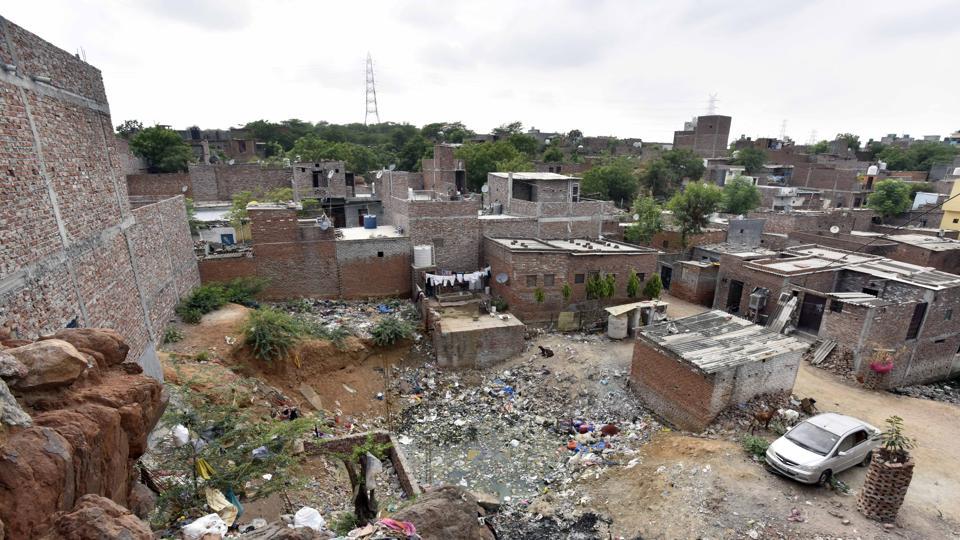
The story was similar for roughly 10,000 residents whose houses were demolished in that drive. The 30-year-old settlement built illegally on forest land at the Delhi-Haryana border had battled seven such drives before, and never been wiped out.
But when the bulldozers returned on April 2, they not only reduced the houses to a pile of bricks again but also dashed Devi’s hopes of a recovery. She was already neck-deep in debt but the Supreme Court (SC) order last month to demolish the entire village has left her in despair.
The court and the village
On June 7, the apex court ordered all encroachment on forest land in the area to be cleared within six weeks. A week later, 3,000 policemen arrived at the village. By June 12, electricity connections were cut and water tankers stopped from entering the village. And finally, on June 17, the apex court refused to review its decision.
Devi and her family of four now live in a tent next to their house. Some neighbours have tried to arrange bricks to build a semblance of a house. Only a handful are still trying to rebuild their homes. Most residents of Khori always knew they were residing illegally but, for the first time in three decades, there is a fear that their time is up.
“When plots were being divided and sold all these years, no one came to tell us that our homes would be demolished one day. This is how we poor people settle down anywhere in India,” said Devi.
Perched on the Aravalli hills on the southern fringes of the Capital, Khori is a village of dusty narrow streets sandwiched between upmarket neighbourhoods in Faridabad and the Okhla landfill. Similar unauthorised neighbourhoods of Sangam Vihar, Pul Prahladpur, Lal Kuan, Vishwakarma Colony and Prem Nagar ring the village where people started illegally clearing forest to settle down in the early 90s.
There is no official estimate of Khori’s population. The Supreme Court case mentioned 10,000 houses. Ishita Chatterjee, a PhD scholar studying the settlement, estimated 6,500 houses. Mohammad Mohsin, an active leader of the residents, pegged the population at 40,000.
But Yashpal Yadav, deputy commissioner of Faridabad, dismissed those figures as “gross exaggeration”. “A precise survey by drones show there are 5,100 residential structures here. There are less than 10,000 residents in the village at any particular time,” he said.
Since the apex court’s decision, most residents spend their days and evenings under the few remaining kikar, neem and sheesham trees. Most of the day goes in around arranging water. “People are willing to pay extra to buy water from me, but I am catering only to my regular customers,” said Kapil, a water supplier who managed to sneak in 4,000 litres of water for Khori village shops, which he sells to the parched residents.
The snapped power supply meant that local shopkeepers aren’t ordering perishable items like dairy anymore. “I am selling goods at prices lower than MRP. I am trying to limit my damages,” said Lal Singh, a shopkeeper. His 20-year-old daughter, Sandhya, said she is on the verge of giving up on her medical education.
Due to the uncertainty, many residents have stopped working. “What work? Saving our homes is our work right now,” said Irshad Ali, a painter.
Hope and hopelessness
Many residents of Khori are caught between hope and hopelessness. They believe that the government will not bulldoze thousands of homes, the SC order notwithstanding. “Who will snatch my home? Jaan jaaye, par ghar na jaaye (We may lose our lives, but not our homes),” said a resident, justifying his decision to buy a used refrigerator and some furniture at a time when power supply to the village is snapped and there is exodus from the village.
Others are defiant.
Kalpana Devi, a 32-year-old woman from Munger in Bihar, spent her life’s savings in buying a 30 square yard plot 12 years ago and constructed a one-room house four years ago. She doesn’t intend to leave. “My husband has not found work over the last year due to the pandemic. I have three young daughters. Where should I go? We are going nowhere. This uncertainty is like a death sentence, and I will die here,” said the woman.
Rumours fly in the village that four residents have died by suicide in recent weeks. “We have heard of four suicides so far. People are panicking as the demolition appears a reality,” said Dinesh, who works as a supervisor at a Delhi hospital. But police confirm only one incident, a 70-year-old man who died on June 15. “We have booked a builder who sold him a piece of land for ₹ 3 lakh,” said Sube Singh, spokesperson for Faridabad Police.
Another 22-year-old local woman fell to her death on June 16 from the second floor of a house in Delhi’s Sangam Vihar, a day after she moved from Khori with her husband under the shadow of the demolition.
The woman’s death confirmed what the police and district administration have been insisting — that residents are slowly vacating their homes.
Sube Singh said that by mid-June, 30-40% people left their homes. “The residents are going to lose their homes. We don’t want any confrontation, which only ends in injuries to the police and the public, and legal troubles for the public,” he added.
The deputy commissioner pegged the number of those who have left the village at 40%. “Those living on rent have left,” said Yadav. Local residents acknowledged the phenomena, which indicates their resistance is weakening, but insisted it was mostly limited to the tenants. “It is the tenants who are leaving. Some others are only shifting their expensive belongings,” says Sailesh Kumar, a painter who hails from Gorakhpur.
They also point out that moving out isn’t easy. “House owners in surrounding neighbourhoods know our desperation. Rooms worth ₹2,000 were being rented to me for ₹5,000. We are looked at with contempt,” said Lal Singh. A room in Khori village costs between ₹500 and 1,000 in rent.
Going back to their native villages, in Uttar Pradesh, Bihar or Bengal, is not an option because most families have sold their properties back home.
The environment-community debate
By various accounts, this portion of the Aravalli Range was the site for bauxite mining in the 1980s, and outstation labourers here first began occupying the land in the 1990s. According to government officials and activists, bauxite mining in the area stopped in the 1990s following court orders. According to Chatterjee, the village is spread over a 120-150 acre of forest land.
“By late 1990s, there were already a few hundred homes constructed on the forest land. Local strongmen facilitated this illegal sale of land,” said Jitender Bhadana, who runs an NGO, Save Aravalli Trust.
Sube Singh said that local property dealers were to blame for this illegal settlement. “They fooled people into buying the forest land. They handed the buyers some documents, making them believe they were buying legal property. More and more buyers followed after that and soon there was an entire settlement here,” said Singh.
“I worked in the mines in the 1980s and 1990s. In those times, someone could simply throw a stone and own the land up to the point where the stone fell,” said Mohd Saleem Khan, a village leader who was among those jailed recently for his role in an alleged violent protest.
Khan doesn’t believe that he hurt the environment by occupying the land but Bhadana contradicts him. “The extent of encroachment over the last 15 years can be seen by comparing the satellite images of the same place from the late 2000. The lungs of the national capital were being eaten day by day,” he said.
Some residents here have voter identity, ration and aadhaar cards but few houses are registered. Many residents accused builders of lying to them that the plot fell on the Delhi side of the border, a major draw for buyers. Until the SC order, a single storey house constructed on a 50 square yard in Khori could cost as high as ₹20 lakh, without any official property documents. Sube Singh said that some buyers were lured in with the promise of land under the power of attorney, but none of these sales were legal.
Few houses have a government electricity metre. Most are provided by private builders who usually charge upwards of ₹14 per unit.
The future
Mostly legally, and sometimes by their sheer population, villagers have been resisting the impending demolition since 2010. They have been petitioning the courts time and again, seeking repeated stay. While the first demolition happened in the 1990s itself because the authorities noticed forest being cleared to make residential plots, the villagers approached the court in 2010, igniting a 11-year legal battle.
Since the SC order, villagers have held protests, some of which turned violent, and even a mahapanchayat, prompting multiple police cases. The police have gone on to book over 550 known and unknown persons and arrested about 20 of them.
Many lawyers and activists have also reached the village. “We are not against the SC order. Our fight is for the rehabilitation of tens of thousands of people being displaced,” said Nirmal Gorana, general secretary of Bandhua Mukri Morcha.
Under Haryana law, displaced people are eligible for rehabilitation, but there is a catch. “The cut-off year for those eligible for rehabilitation is 2003, thus making most residents ineligible,” said Anupradha Singh, an advocate working for the Khori villagers.
Senior advocate Colin Gonsalves, who is representing the villagers in the SC, believes that the solution is “simple”. “These people are not squatters and land grabbers. Every resident paid for the land and they have no commercial gains from it. Every state has adequate urban land. The government can quickly solve the problem by identifying a land close by and settling these people,” said Gonsalves.
The administration says demolition is only a matter of time. “The demolition is a SC order and it will certainly be carried out. We are just giving the villagers time to move out so that their damage is limited,” said Yashpal Yadav. He added that almost no resident had evidence of living here before 2003.
Seema Trikha, the local MLA from Badhkal constituency, said that no one could interfere with the SC order. “Though the Khattar government is not responsible for the demolition exercise, we are forming committees to look into affordable housing for the displaced,” said Trikha.
For weeks now, residents have keenly followed each scrap of news related to Khori, hoping to understand what the future may hold. “Has the government really announced the regularisation of 1,200 illegal colonies? Will our village also be spared?” said an anxious young man to his friend, sitting on a street darkened by lack of electricity. “Our village falls on forest land,” was the stark reminder from his friend.


