The government on Thursday told the Supreme Court of India that the concept of a "creamy layer" cannot be extended for the reservation of the Scheduled Caste and Scheduled Tribes categories. The government argued that the doctrine has consistently been applied to Other Backward Classes (OBCs) only.
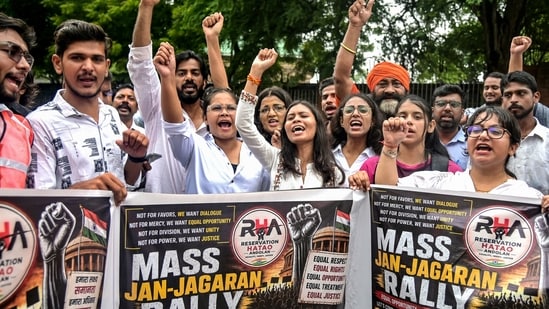
The government made the submissions while also opposing a plea seeking an income-based sub-quota within reserved categories.
The Centre told the top court that the reservation policy is "not solely based on economic status," but rather on historical and social criteria such as tribe, social backwardness and caste.
The government further stated that any modification, especially to introduce income-based preferences in reserved categories can be done only after “a holistic review and thorough empirical study, including socio-economic data of reserved category beneficiaries,” as per Bar and Bench.
Also Read | Govt opposes plea in Supreme Court on income-based quota for SC, ST and OBCs
Furthermore, in a reply on June 15, 2026, the Ministry of Social Justice and Empowerment said that only the Parliament can take a call on the question of extending the creamy layer principle to the SC and ST categories.
{{/usCountry}}Furthermore, in a reply on June 15, 2026, the Ministry of Social Justice and Empowerment said that only the Parliament can take a call on the question of extending the creamy layer principle to the SC and ST categories.
{{/usCountry}}The affidavit further called on the court to refrain from petitions which seek judicial directions to redesign the reservation policy of the country.
What is the concept of 'creamy layer'?
The creamy layer concept, introduced for the Other Backward Classes, refers to the wealthy and educated members in that category. Under this, those with a family income of ₹8 lakhs from sources other than agriculture, do not get reservation benefits.
The term was first introduced by the Sattanathan Commission in 1971, which directed that the "creamy layer" should be excluded from the reservations of civil posts. This concept was later also identified by the Justice Ram Nandan Committee in 1993.
However, no such extension was made for the SC and ST categories, allowing persons from these reserved categories to receive the benefits regardless of their family income.
Hence, when the Supreme Court called on states to identify and exclude the creamy layer within the SCs/STs from receiving reservation benefits in August 2024, the union government stated that the concept cannot be extended to these categories because, for the SC and ST categories, the discrimination against them is not based on economic conditions.
The government also submitted that the constitutional scheme governing the identification of Scheduled Castes under Article 341, Scheduled Tribes under Article 342 and socially and educationally backward classes under Article 342A does not permit alterations based solely on economic criteria.