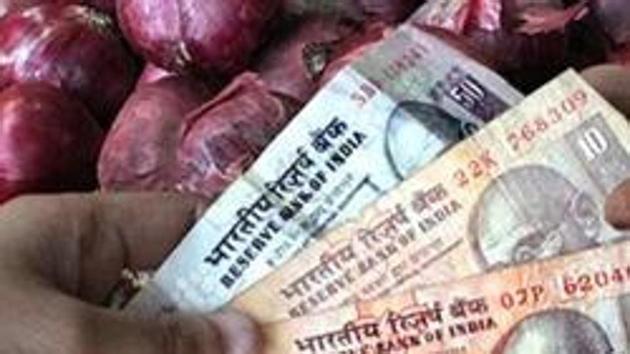
Onion prices are in the news once again. There’s good reason for that. In Delhi’s Azadpur fruit and vegetable market, one of the biggest in the country, it is cheaper to buy some varieties of apples than onions. The highest priced Red Gold apples from Himachal Pradesh were selling at around Rs 34/kg on September 25, 2019, while onions from Maharashtra and Madhya Pradesh were priced at Rs 41/kg and Rs 39/kg respectively. According to the Centre for Monitoring Indian Economy’s (CMIE) database, the average annual growth in wholesale onion prices in the past four weeks has been 67%. This figure suggests that there is more to the current price hike than just seasonality.
With crucial assembly elections due next month, the government has already moved in to control prices. Exports have been banned for now. The government also plans to offload its stocks to bring down prices (see https://bit.ly/2n5OdW1 for details). In a country where food items have a share of almost 50% in the retail inflation basket, sharp reactions to rise in prices of staple food items are not unexpected.
What about the farmers who cultivate onions, though? There is merit in the argument that by intervening to bring down prices, the government is unfairly denying them windfall profits. An HT analysis of retail and wholesale prices using CMIE’s database suggests that farmers who grow vegetables, such as onions and potatoes, always face greater risk than their peers growing cereals, such as rice and wheat. Not only are vegetable prices more volatile, their producers are also susceptible to predatory behaviour by buyers.
An analysis of wholesale onion prices and the retail-wholesale price mark-up — percentage difference between the two — shows that they almost move in opposite directions. When wholesale prices are down, mark-ups are higher, and when wholesale prices are higher, mark-ups go down. This means that when farmers are getting lower prices, the benefits are not passed on to the consumers, whereas when prices go up, farmers are seen as the culprits and attempts are made to bring down wholesale prices.
{{/usCountry}}An analysis of wholesale onion prices and the retail-wholesale price mark-up — percentage difference between the two — shows that they almost move in opposite directions. When wholesale prices are down, mark-ups are higher, and when wholesale prices are higher, mark-ups go down. This means that when farmers are getting lower prices, the benefits are not passed on to the consumers, whereas when prices go up, farmers are seen as the culprits and attempts are made to bring down wholesale prices.
{{/usCountry}} 
The behaviour of retail-wholesale mark-up for vegetables, such as onions and potatoes, is quite different from that of cereals, such as rice and wheat. The latter is mostly flat at around 10%.

To be sure, this pattern is not something completely unexpected. Unlike cereals, vegetables are perishable in nature and, therefore, farmers have less power to hold back their harvest when prices are lower. The government also provides Minimum Support Prices (MSPs) for rice and wheat, which provides some sort of floor for their prices. Such cushion is not available to farmers growing fruits and vegetables.
This, however, does not take away from the fact that farmers dealing in horticultural products face a much bigger risk than those who grow cereals. This reality is often buried in the outcry which follows short periods of price hikes for vegetables, such as onions.