E-Paper



Number Theory: Will ‘One Nation, One Election’ help the BJP?
A look at how the ‘One Nation, One Election’ move will play out for the BJP
Updated on: Sep 5, 2023, 04:37:07 IST

 Prefer HTon Google
Share via


Copy link

With the government forming a committee under the chairmanship of former president Ramnath Kovind, the “One Nation, One Election” debate is back. The constitutionality and logistics of the proposal aside, is there a purely political angle to the BJP’s push for the proposal? Here are four charts which answer this question.
The charts that matter
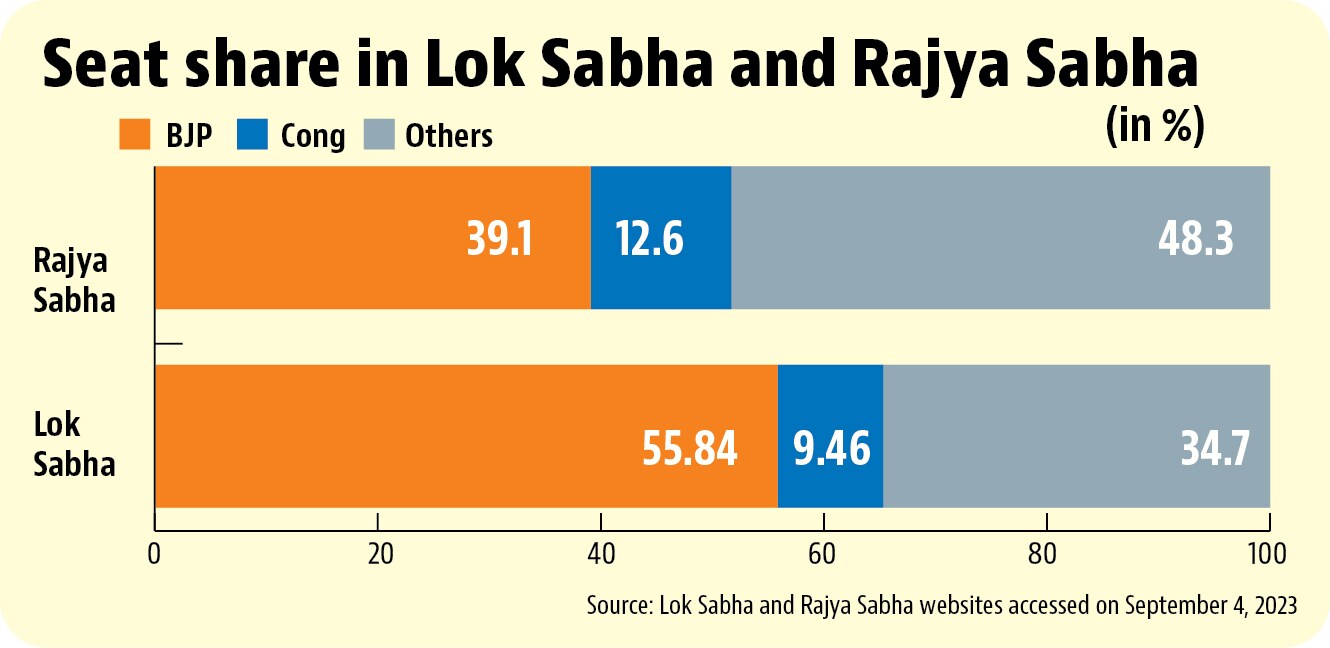
 State elections are the biggest roadblock to BJP’s complete parliamentary dominanceThe BJP’s politics, in the post-2014 phase, has been to portray itself as the only pan-India political party. While the BJP’s dominance in terms of number of Lok Sabha seats is well-established, with its back-to-back majorities in the 2014 and 2019 Lok Sabha elections – the Congress has not been able to get a parliamentary majority since 1984 – it has not been able to get a majority in the Rajya Sabha till date. Though this has not prevented the BJP from getting its key legislations enacted, it does make it dependent on the support of parties which are not even in the NDA fold.
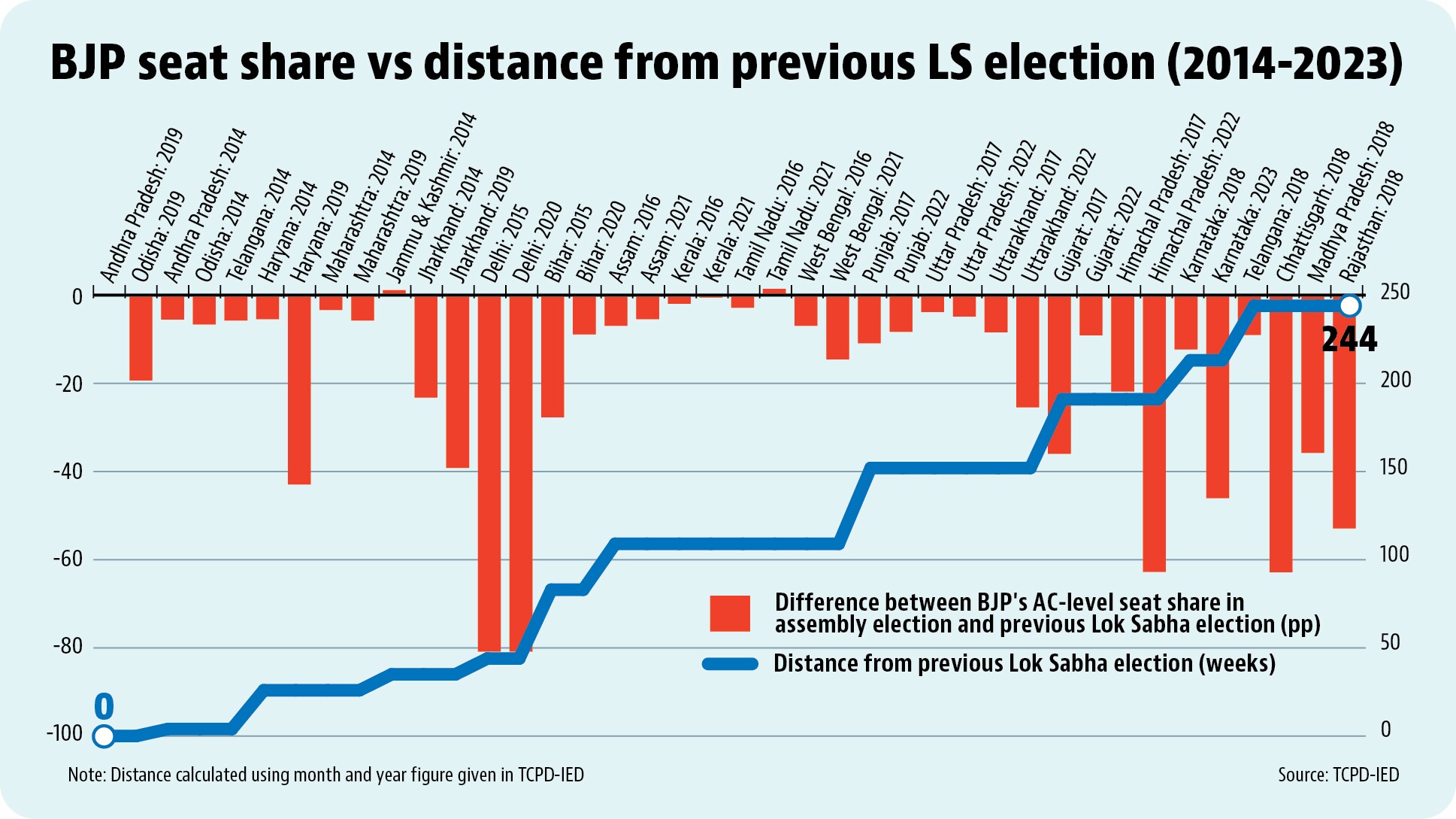
- Lack of majority in Rajya Sabha reflects BJP’s relatively subpar showing in state elections post-2014An HT analysis of assembly elections held with or after the 2014 Lok Sabha polls shows that the BJP or its allies have won only 49% of these. In fact, a detailed comparison of the results shows that the BJP’s Lok Sabha performance in most states is better than its performance in the subsequent assembly elections. This gap holds for both vote share and seat share. It will not be surprising if a section within the BJP believes that this deficit can be bridged, even if partially, if assembly and Lok Sabha elections were to be held together.
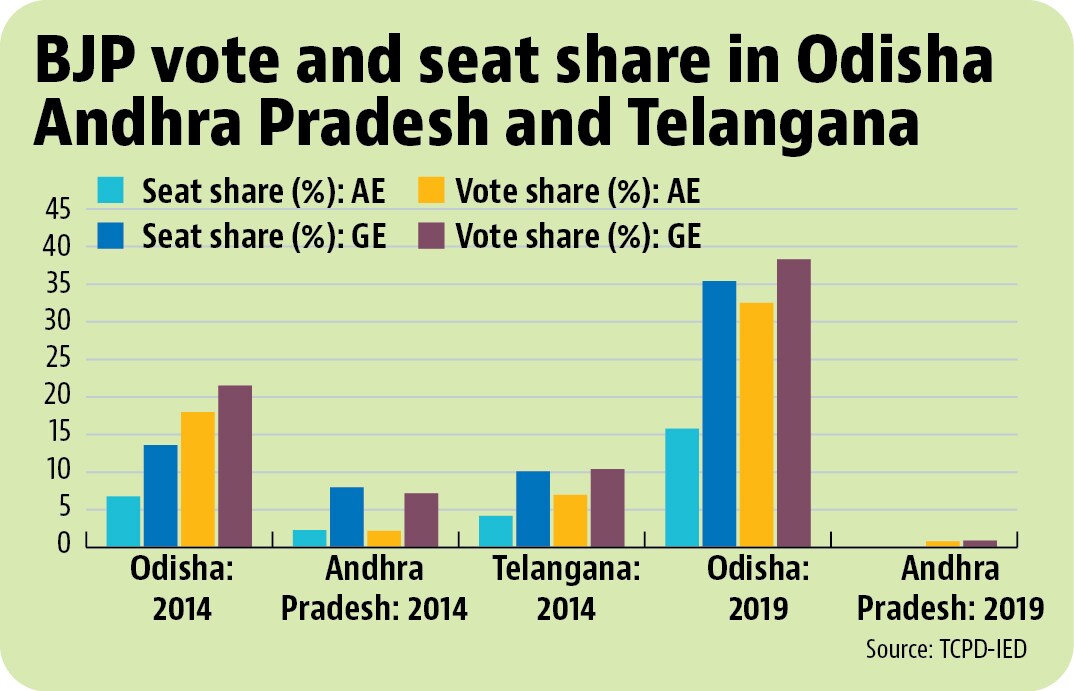
- But some states show split-ticket voting even when elections are held simultaneouslyAmong larger states, Odisha (2014 and 2019) Andhra Pradesh (2014 and 2019) and Telangana (2014) have had simultaneous elections for assembly and Lok Sabha in the post-2014 period. To be sure, Andhra Pradesh was divided into Andhra and Telangana only after the 2014 elections, but given the fact that it was a foregone conclusion, we have disaggregated the 2014 results to capture the states as they were after the elections. Even in these elections, especially in Odisha, where the BJP is a stronger force than it is in Andhra Pradesh or Telangana, it did not perform as well as it did in the Lok Sabha elections. Having said that, it is important to note that split-ticket voting – voters voting for different parties at the national and state level – only changed the magnitude and not the direction of the results. When elections are held separately, this pattern does not hold.
- BJP’s state losses seem to be happening despite high approval ratingsThe states which have had simultaneous Lok Sabha and assembly polls since 2014 had a regional party opponent for the BJP rather than the Congress. Does it mean that the BJP can hope to ride over state-specific anti-incumbency against the Congress if it were to hold national and state elections together? Psephological data does not seem to hold any useful insight here. For example, BJP state governments did not enjoy very different approval or disapproval ratings compared to the Narendra Modi government in states where it lost to the Congress.
- A potential X-factorOne factor where the post-2014 BJP is very different from its pre-2014 avatar is that it is increasingly letting go of strong state-level leaders in some of its strongest states. This trend is only likely to gain momentum in the forthcoming state elections cycle, with the central leadership of the party keeping alive the question of putting up incumbent or past chief ministers as their leadership faces in states such as Madhya Pradesh, Rajasthan and Chhattisgarh. Even in Karnataka, it is widely believed that replacing BS Yeddyurappa with a relatively lightweight chief minister in Basavaraj Bommai cost the BJP in the elections. It is here that the Congress has an advantage vis-a-vis the BJP in terms of still having stronger state-level leaders. At the same time, the lack of a leadership face that can compete with Narendra Modi’s popularity is the biggest disadvantage the Congress has at the national level. If the BJP’s centralisation is to continue, holding state polls separately will only add to its weakness in these elections. This might be the biggest political motivation for the BJP to club state polls with national elections.