
 E-Paper



EC rejects AAP’s request to tamper EVM circuitry at open challenge
Terming AAP’s request as ‘irrational’, the Election Commission said changing the motherboard or internal circuitry of the electronic voting machines would amount to introducing new machines in the polling system.


The election commission has turned down a request by the Aam Aadmi Party (AAP) to allow changing or tampering of electronic voting machine (EVM) circuitry during the upcoming open challenge, claiming that doing so would be “irrational and implausible”.
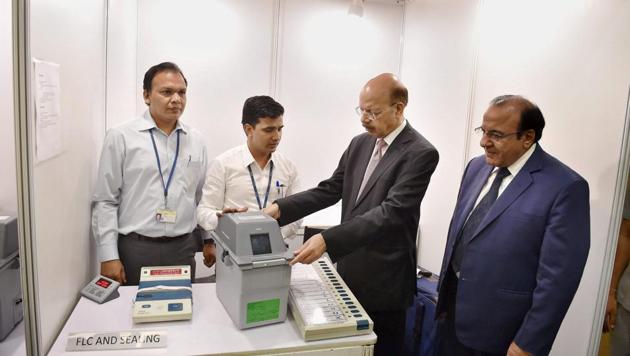
AAP has led Opposition parties in alleging that EVMs used in assembly elections held across five states earlier this year were manipulated in favour of the ruling Bharatiya Janata Party.
“It is the considered view of the commission that allowing any change of the motherboard or internal circuit of the EVM is like saying that anyone should be permitted to manufacture a new machine and introduce new EVMs in the ECI system, which is implausible and irrational,” the electoral body said in a letter to the AAP.
The letter comes ahead of the election commission’s open challenge on June 3, where all parties have been invited to send representatives to prove the tamperability of EVMs. None of the parties – including the AAP – have confirmed their participation in the event so far. The cut-off for doing so is 5 pm on Friday.
The AAP has asked the poll panel to give its experts unconditional access to both internal and external parts of EVMs during the challenge, dispensing of all rules and regulations.
Explaining the reason for turning down the AAP’s demand, the poll panel wrote: “Any person with basic common sense will be able to appreciate that a non-ECI EVM, or an EVM with a different internal circuit, is simply a different machine or – at best – a lookalike of the ECI EVM. Hence, it can never be guaranteed by the ECI to give correct results.”
It said the EVM challenge to prove the allegation of tampering are within the framework of the extant administrative and security protocols prescribed by the commission, which are strictly followed in the field with the active participation of political parties, candidates and representatives in “an absolutely open and transparent framework”.


