E-Paper



Zydus jab cleared for kids to cost govt ₹265
The price is a significant reduction from the ₹1,900 the company initially quoted for the regimen of the indigenously-developed Covid-19 vaccine that is the world’s first plasmid DNA-based one.

 Prefer HTon Google


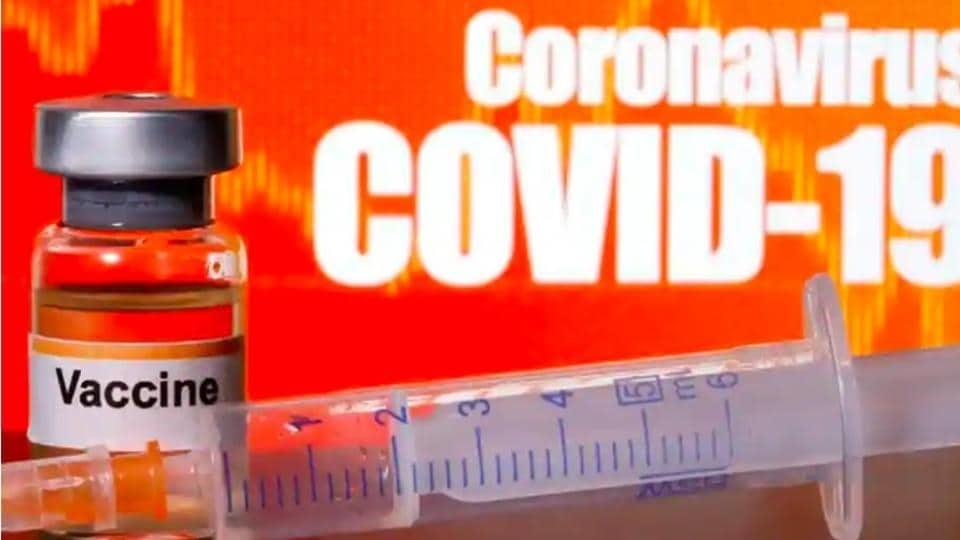
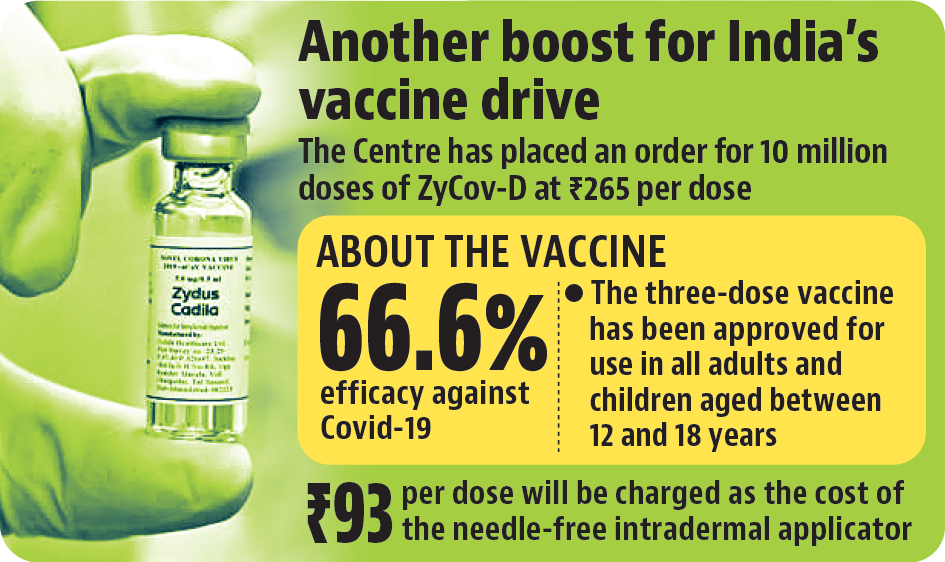
The Centre has placed an order for 10 million doses of ZyCov-D, Zydus Healthcare’s anti-coronavirus disease (Covid-19) vaccine, at ₹265 per dose (or ₹795 for the recommended three-dose regimen), according to people familiar with the matter, paving the way for India’s first Covid-19 vaccine for children between the ages 12 and 18 years that will soon be introduced into the national immunisation programme. There was no announcement on a likely date for the launch of vaccinations for children in this age group.
Additionally, ₹93 per dose will be charged as the cost of the needle-free intradermal applicator that is required to administer the shot.
The price ( ₹1,074 in all) is a significant reduction from the ₹1,900 the company initially quoted for the regimen of the indigenously-developed Covid-19 vaccine that is the world’s first plasmid DNA-based one.
The two other vaccines that are currently part of the government’s programme are priced at ₹225 a dose (for the two-dose Covaxin one) and ₹215 a dose (for the two-dose Covishield one).
“The Centre has placed an order for about 10 million doses. After hard bargaining by the government, the company agreed to bring down the cost. It is just a matter of time before this particular vaccine is used under the public immunisation programme,” said a person aware of the matter, on condition of anonymity.
It took months for both the parties to fix a price for each dose of the vaccine that was approved for emergency use on August 20. The company confirmed the development.
“…received an order to supply one crore (10 million) doses of ZyCoV-D, the world’s first Plasmid DNA Vaccine, to the Government of India at ₹265 per dose and the needle-free applicator being offered at ₹93 per dose, excluding GST. The pricing has been decided in consultation with the Government of India,” said the company in a statement on Monday.
Sharvil Patel, managing director of the company, said, “We are happy to support the Government’s vaccination programme with ZyCoV-D. The needle- free application of the vaccination, we hope, will motivate many more to vaccinate and safeguard themselves from COVID-19, especially children and young adults in the age group of 12 to 18 years.”
Till Monday night, India has fully vaccinated 348million people and partly vaccinated another 393 million. That works out to 78.8% of the adult population of 940 million that is currently eligible for Covid vaccines.
The vaccine works by instructing cells to produce the spike protein of the Sars-CoV-2 virus, which elicits an immune response. Results from the company’s phase 3 clinical trials showed the vaccine has an efficacy of 66.6%.
“Since this vaccine is administered differently using a needle-free applicator, vaccinators are being trained to give the shot,” said an official in the government aware of the matter, requesting anonymity.
The vaccine is to be given on Day zero, Day 28 and Day 56, as per the schedule shared by the company.
“ZyCoV-D has shown good stability at temperatures of around 25 degrees for at least three months. The thermostability of the vaccine will help in easy transportation and storage of the vaccine without any problems of fluctuations in temperature. For prolonged use, a temperature of 2-8 degrees is sufficient. Also being a DNA plasmid vaccine, ZyCoV-D doesn’t have any problem associated with vector based immunity. The DNA Plasmid platform allows generating new construct quickly to deal with mutations in the virus,” the company’s statement said.
ZyCoV-D was developed in partnership with the government’s Department of Biotechnology under Mission Covid Suraksha, which involved the pooling of resources by several Indian research institutions for development and clinical trials.
There are two vaccine candidates that have been tested among children in India; apart from the Zydus vaccine, subject expert committee of the Central Drugs Standard Control Organisation also recommended use of Bharat Biotech’s Covaxin for use in children between 2 and 18 years recently.
The National Technical Advisory Group on Immunisation is working on the protocol and framework for the inclusion of this vaccine in the programme as the vaccination in children is likely going to be introduced in phases with those at high risk (children with comorbidities) being given priority.
Government experts are at present working on a list of comorbidities.
“They will have to do it in a phased manner as if you look at the numbers there should be about 400 million children, and 1-2% of them likely to be at higher risk because of their medical condition and the kind of treatment they would be taking such as chemo, transplant medication, etc. It will be a huge challenge logistically; therefore, doing it in phases makes sense,” said Dr Anupam Sibal, senior paediatrician and group medical director, Apollo Hospitals. The 400 million number includes children in the 2-18 year age group.
Globally, at least 50 countries have begun giving doses to children. In most cases, children above the age of 12 are being inoculated. The shots being used for these ages are typically the Pfizer-BioNTech and Moderna vaccines.