E-Paper



Desecration of environment has made Uttarakhand prone to floods, landslides
Killer landslides and floods that leave thousands of pilgrims stranded are now common in Uttarakhand during the monsoon. The desecration of the environment is to blame.


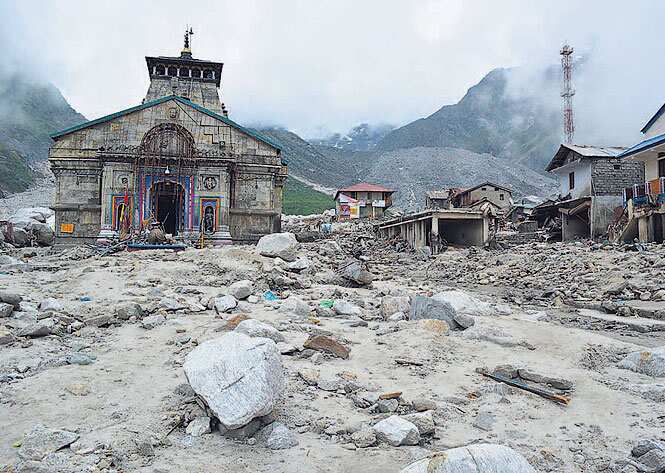
Since 2005, heavy monsoon floods have been causing havoc in Uttarakhand. This year, again, over 6,000 pilgrims were stranded forcing the government of the pristine north-western Himalayan state to suspend the Char Dham yatra.

It is clear that tampering with the state’s fragile ecology has led to the devastation. The India State of Forest Report (ISFR) 2013 shows how the new state’s eagerness to catch up with Himachal Pradesh, its better-off neighbour, in terms of development, has exposed it to nature’s fury.
Uttarakhand is the only state in the north-western Himalayas where the forest cover had declined. Between 2001 and 2013, the state lost about 500 sq kms of forest. During this period, the green cover increased in both Himachal Pradesh and in Jammu and Kashmir.
Much of the decline in Uttarakhand’s green cover has happened in Uttarkashi and Rudraparayag districts. This was the epicenter of the monsoon-induced flash floods last year and this year too.
PHOTOS:Rain fury returns to Uttarakhand
A closer reading of the report shows that even the quality of forest, which is essential to check the heavy flow of monsoon rains, has deteriorated. The tree density in the forests of Uttarakhand has dipped and the extent of very dense forest cover has also declined, the report states.
“A good forest retains a lot of water that comes during the monsoon, preventing devastation. As the forest quality goes down, its ability to retain water also reduces resulting in higher sand erosion,” said TS Shankar Raman, a biologist with Nature Conservation Foundation.
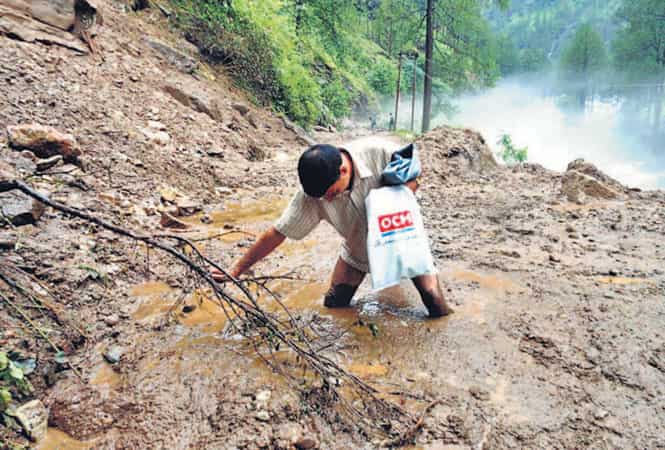
In addition to the loss in forest cover, the last decade also witnessed the development of a vast network of roads in the state’s ecologically sensitive interiors. Geological scientists, who should have played a key role in deciding the topography of the roads and should have advised on avoiding Uttarakhand’s highly active tectonic fault-lines, either neglected to do so or did and were ignored.
“Key attention needed to be paid that roads don’t block natural water ways intensifying the fury of flash floods. Most of the roads have been rebuilt on the old fault lines despite the caution,” said Professor KS Vaidya of Bangalore’s Jawaharlal Nehru Centre for Advanced Scientific Research, adding that the heavy loss of life in the deluge was the result of “criminal oversight” of the state’s geological features and water channels by the authorities over the decades.
It’s clear that Uttarakhand has side-stepped science and bowed to local political demands for roads. The impact of this can be seen every monsoon. This has happened despite the National Disaster Management Authority advising the state to ensure that the view of geologists is incorporated in road construction plans. A debate is also raging about the destructive contribution of the large number of hydel projects built in the state.
After the 2013 tragedy, a study of river water flow in Uttarakhand was carried out. However, its key recommendations that sought to slow down haphazard development in the state did not find any takers. This was because it would have resulted in the scrapping or downsizing of some major hydel projects that have been blamed for disturbing natural river flow, a reason for the high intensity of flash floods.
A ministerial committee headed by former cabinet secretary BK Chaturvedi to examine the impact of hydel projects on the state’s ecology had recommended a minimum water flow of 30% (50% during winters). The National Hydro Power Corporation officials dismiss claims of the hydel projects causing devastation as propaganda by anti-dam activists. Even environment minister Prakash Javadekar seems to support the view.
“The June 2013 tragedy should have been a wake-up call on stopping unplanned bumper-to-bumper hydel projects. Sadly, it had failed to wake them (the political class) up,” said Himanshu Thakkar of the Delhi-based advocacy group, South Asian Network for Rivers Dams and People.
Sadly, many of the ecological concerns of Uttarakhand, which is the source of the river Ganga, also fail to find a mention in the National Democratic Alliance government’s new Clean Ganga Mission.