
 E-Paper



Ganga cleaning begins; toxin sensors installed
The sensors will self-monitor the levels and nature of effluents and pollutants. They will send real-time data on discharges from factories to a central server and will automatically send alerts when effluents breach permissible limits.


The Modi government will over the next six months install high-tech sensors at critical points along the Ganga to monitor industrial runoff from about 700 units — the first steps towards the long and daunting task of cleaning the 2,510-km river.

The sensors will self-monitor the levels and nature of effluents and pollutants. They will send real-time data on discharges from factories to a central server and will automatically send alerts when effluents breach permissible limits. Non-compliant industries will face action.
The Ganga, India’s longest river and an icon of the Hindu faith, supports a third of the country’s 1.2 billion people living on its floodplains. Despite its cultural importance, it is dying a slow death due to filth, untreated sewage and industrial runoff. Only 45% of the 11 billion litres of sewage from 181 towns along the river is treated.
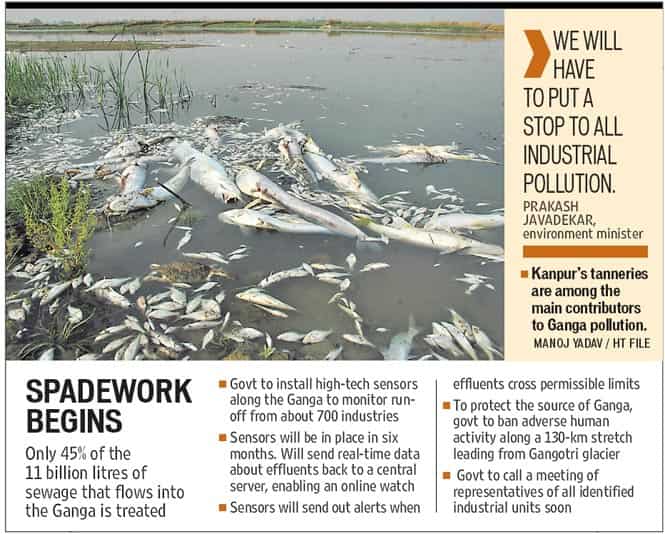
The city of Kanpur could face special scrutiny since it is the main source of waste in the northern Ganga. For example, of the 37 tanneries in the city, only 20 are legal.
The government will also enforce a strict ban on adverse human activities on a 130-km sensitive stretch beginning at Gomukh, the spurting water channel arising from the high Himalayan Gangotri glacier that feeds the Bhagirathi river, one of the principal sources of the Ganga.
Read:PM Modi heads superbody to drive Mission Ganga
“We will have to put a stop to all industrial pollution,” environment minister Prakash Javadekar, who also holds charge of information and broadcasting, said.
Earlier Thursday, Javadekar met water resources minister Uma Bharti.
To ensure compliance, a meeting of representatives of all identified industrial units is being called. The government will then turn to the next leg of its Mission Ganga, which will include issues such as sewage treatment.
According to scientists, pollution levels in a river depend upon the concentration of pollutants. The river’s health, in turn, is a measure of its ability to drain off and naturally discharge contaminants.
So, the clean-up plan would hinge on ensuring uninterrupted flow through scientific intervention —an aspect branded as “Aviral Ganga” (loosely translates to unceasing Ganga) by the Modi government.
Read:Centre sets 3-year target to rejuvenate Ganga River
The NDA’s policy to clean the river is likely to be administered by a powerful overarching entity, which will “coalesce” myriad activities scattered across departments.
Prime Minister Narendra Modi, who is expected to lead the “superbody”, had promised a clean Ganga in the run-up to the Lok Sabha polls.
A day after the BJP was swept to power, Modi visited Varanasi, which sent him to the Lok Sabha, and offered prayers on the banks of the river. “Need of the hour is to restore the glory of the Ganga. Today Maa Ganga is calling us, her children to make the river clean once again,” he had tweeted.
Read:Water conservationist cautions centre against Ganga project


