
 E-Paper



Govt likely to repeal 987 outdated laws
Modi government has put in motion a plan to repeal as many as 987 obsolete laws. The law ministry will bring a new bill in the winter session of Parliament to repeal 287 obsolete laws and junk about 700 Appropriation Acts that have lost relevance.


By his own admission, Prime Minister Narendra Modi is “happiest” showing the door to laws that are of no use.
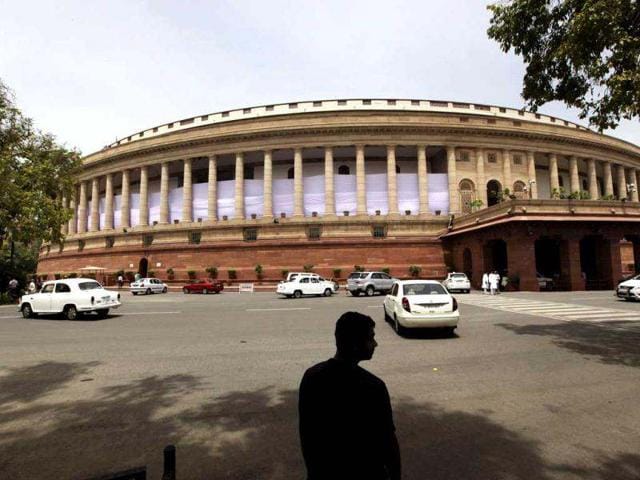
Accordingly, his government has put in motion a plan to repeal as many as 987 obsolete laws.
The law ministry will bring a new bill in the winter session of Parliament to repeal 287 obsolete laws and junk about 700 Appropriation Acts that have lost relevance.
An Appropriation Act is passed by Parliament during budget session to allow the government to withdraw money from the exchequer for a financial year. The law has no utility after the next budget when a new Appropriation Act gets passed.
But, all Appropriation Acts, including those passed decades ago, are still a part of statute books.
“We plan to bring a bill to repeal 287 obsolete laws,” law minister Ravi Shankar Prasad told reporters on Monday. He added they were consulting the finance ministry on the law commission’s recommendation to repeal 700 Appropriation Acts.
The ministry is examining the British system of junking Appropriation Acts after some years.
Many of the laws listed for repealing are from the British era and have lost relevance.
The government has made its plan known a day after Modi told Indian-Americans at Madison Square Garden, “Earlier Indian governments spoke of having made this law and that law, but I have started ending laws which are of no use. So many laws... If I end one law a day, I will be the happiest.”
Here are some laws that govt wants out:
Forfeited Deposits Act, Act 25 of 1850
Category: Land Laws
This Act was enacted for the forfeiture to the Government of deposits made on incomplete sales of land made under Regulation VIII, 1819 of the Bengal Code (the Bengal Patni Taluks Regulation, 1819).
Since tenure-holders or patnidars were taking fraudulent advantage of this Regulation, this Act was introduced to counter the situation. The Regulation allowed forfeited deposits at land sales to be applied as purchase-money.
The Act instead provided that forfeited deposits were to be used towards the cost of sales, and the rest to be forfeited to Government. This Act is of no relevance after 1947.
Foreign Recruiting Act, Act 4 of 1874
Category: International Relations
This Act empowered the Government to issue an order that prevented the recruitment of Indians by a foreign State.
The Act confers a wide discretion on the Government to specify the conditions under
which persons may be barred from being recruited by a foreign State. According to the Law Commission, in its 43rd Report on Offences against National Security (1971), such wide discretion might potentially violate the constitutional guarantee to freedom of occupation under Article 19.
The 2nd Administrative Reforms Commission Report of 2006 has also observed that this Act is outdated. This Act has been recommended for repeal by the PC Jain Commission in its Appendix A-1.
Elephants’ Preservation Act, Act 6 of 1879
Category: Environmental Law
The Act makes it an offence to kill, injure or capture wild elephants except in cases of self-defence, or in accordance with a licence granted under the Act.
However, the Act imposes only an insignificant fine of Rs 500 for its contravention, while a subsequent conviction attracts imprisonment for 6 months along with the fine.
The purpose of the Act is now subsumed by the Wildlife (Protection) Act, 1972 which has similar provisions on the prohibition of killing wild animals and on 26 procedures for licensing.
Elephants are included within the ambit of the 1972 Act, which also has more stringent penalties. Therefore the 1879 Act is redundant.
For full list visit:


