
 E-Paper



Modi govt gives breather to most-polluting industries
The government has decided the country's most-polluting industries will need consent to operate every five years, doing away with a UPA-era annual-approval clause that also looked at the impact on health and biodiversity.


The government has decided the country's most-polluting industries will need consent to operate every five years, doing away with a UPA-era annual-approval clause that also looked at the impact on health and biodiversity.
The move is being seen as an attempt to boost ease of doing business while a debate rages over India's toxic air.
With this step, the Narendra Modi government has overhauled a regulation introduced by former environment minister Jairam Ramesh that was based on the effect of industrial clusters on air, water, land, health and ecology.
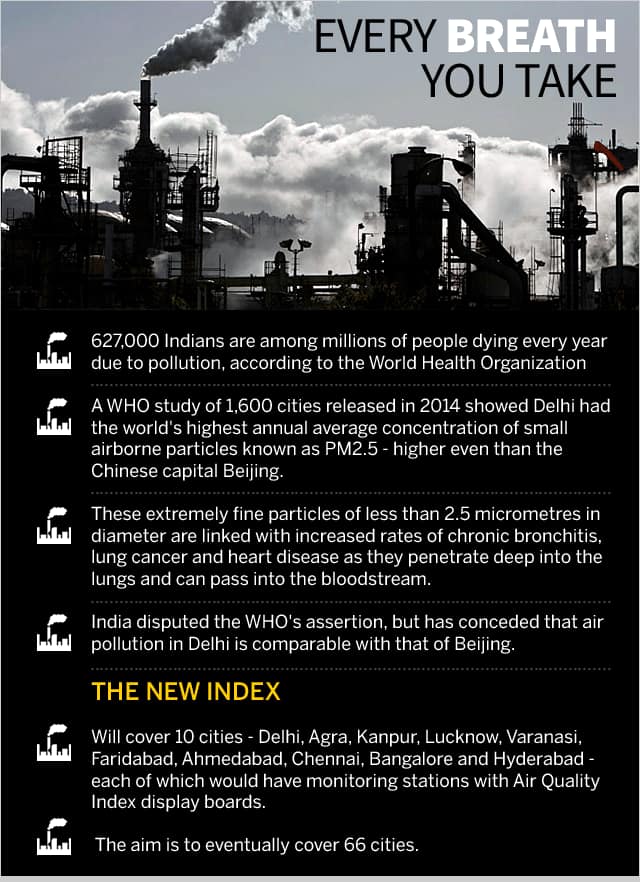
While the Prime Minister is trying to push India as a global manufacturing hub by promoting industry, the quality of air in the country has raised local and international concerns after the WHO last year declared Delhi the world's most polluted city.
"We will rate the industrial clusters only on the basis of water, air and land as they can be measured," said Shashi Shekhar, the environment ministry's special secretary.
Based on the Comprehensive Environmental Assessment of Industrial Clusters (CEPI) ranking system, Ramesh had imposed a ban on allowing new industries in several regions, including Vapi and Ankleshwar in Gujarat.
However, in the revamped CEPI, a ban on new industries will be the exception rather than the rule.
"We are moving away from the moratorium-based approach to taking industries into confidence for reducing emissions," explained Shekhar, adding that the CEPI parameters will be revised to analyse the impact of pollution in a more holistic manner.
In a major relief to industry, the government has decided that the approval to operate will be valid for five years in case of the most-polluting red category units, 10 years for the slightly less-polluting orange category, and the cleaner green category units will require one-time approval.
Under the UPA-era system, industries in 17 critically polluting sectors come under the red category for which most states give annual consent, the orange category ones need approval every five years and the green ones every 10-15 years.
"We are doing away with the annual consent so the industry owners don't have to visit government offices again and again," said environment minister Prakash Javadekar, adding that the categorisation of over 10,000 industries was being re-worked on the basis of overall pollution potential instead of size and effluent discharge.

The ministry has in the last nine months diluted environment rules considered a hurdle by industry to drive economic growth.
Reacting to the relaxations given, Chandra Bhushan, deputy director general of the Centre for Science and Environment said these incremental changes will neither help industry nor ensure pollution abatement.
"The government is not pursuing bigger reforms that can improve the environment and help industry meet green standards," he said.
The ministry also introduced standard terms of reference (ToRs) for conducting scoping studies for projects to reduce time needed for getting environmental approval from over a year to about three months.
Project proponents will not be required to submit their proposals before expert appraisal committees of different sectors for issuing the TORs as this will happen automatically in the new mechanism after a project's registration on the ministry's website.
A similar system will be adopted for proposals cleared by state governments.Watch:


