
 E-Paper



1st week of Paris talks: India fights perception of being ‘blocker’
The first week of negotiations in Paris “encouraged” India to believe that its outstanding issues -- financial roadmap, positioning of the new agreement under the climate convention and faster transfer of cleaner technologies -- could be resolved in the next.


The first week of negotiations in Paris “encouraged” India to believe that its outstanding issues -- financial roadmap, positioning of the new agreement under the climate convention and faster transfer of cleaner technologies -- could be resolved in the next.
The scary part emerging from the negotiations, however, is that although rich nations have not enhanced their climate finance commitment for the period after 2020, they are are asking countries like India to voluntarily be part of the expanded group of donors of climate finance. That Indonesia and Mexico have already announced its climate finance commitment is being used as an argument to put pressure.
But, the optimism of having a fruitful agreement in the city of lights comes from the fact that the draft for the Paris agreement has shrunk from 54 pages on the first day to 38 pages after six days of hectic negotiations that continued till late in the night inside closed rooms of northern suburb Le Bourget.
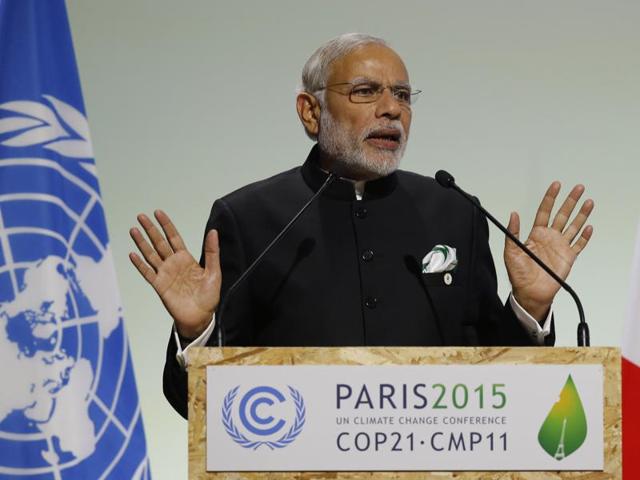
A developing country negotiator said India was “surprised” by the negative perception of being a “blocker” and user of “dirty” coal at the start of the conference. But, that was somewhat negated with Prime Minister Narendra Modi’s series of events on the second day and extensive outreach with other countries and civil society by India’s 28-member climate negotiating team.
Here’s all you need to know about Paris climate change summit
“Finally the tone and tenor of the discussion has changed and it is more constructive towards India. It has helped use to move forward in the negotiations despite the negative perception,” the negotiator said. An observer of the negotiations complimented India for its “diplomatically smart” articulation in the closed door meetings.
This forward momentum has helped India ensure that all its concerns remained in the text submitted by the co-chairs for the Paris agreement to the COP presidency for discussion with the ministers next week.
But the battle for countries like India would be more severe and brutal next week, a civil society member said, adding that there can be “bloodbath” over climate finance by rich nations and differentiation in all elements of the Paris agreement.
Indians cannot differ much as they highlighted five tiers of concern in the draft agreements circulated to all 196 countries participating in the mega environment conference.
The first was ensuring that the agreement is positioned under the UN climate framework and does not run parallel to it as some of the rich countries anchored by United States want.
Second is a clear definition of the process through which Intended Nationally Determined Contributions (INDCs), also called climate action plans, are translated into Nationally Determined Mitigation Contributions (NMDCs). The rich nations want an intrusive review mechanism.
Third is the largely unresolved issue of bringing transparency and accountability in implementation of the proposed agreement. India wants that the present differentiation between the rich and developing countries should be maintained while the US and others are seeking a uniform transparency mechanism for all.
Fourth is the mechanism for global stocktaking of NDMCs every five years. India wants that the stocktaking should not result in enhancement of commitments before 2030 whereas the US is asking for increase in ambition to meet the aspirational 2 degree Celsius temperature rise limit to the pre-industrial levels by turn of the century.
First is the most important one for India to achieve its renewable energy targets of 175GW by 2022. India wants that the Paris agreement should reflect clearly the obligation of the rich countries to provide affordable “storage” technologies -- both for mitigation and adaptation to climate change.
The week gone by also witnessed some realignment in global climate geo-politics. China has been silent and the probable reason is that it has nothing to lose, whereas the Paris agreement would have implications for India’s future economic growth.


