E-Paper



Tiger population rising, India home to more than 2,000 big cats
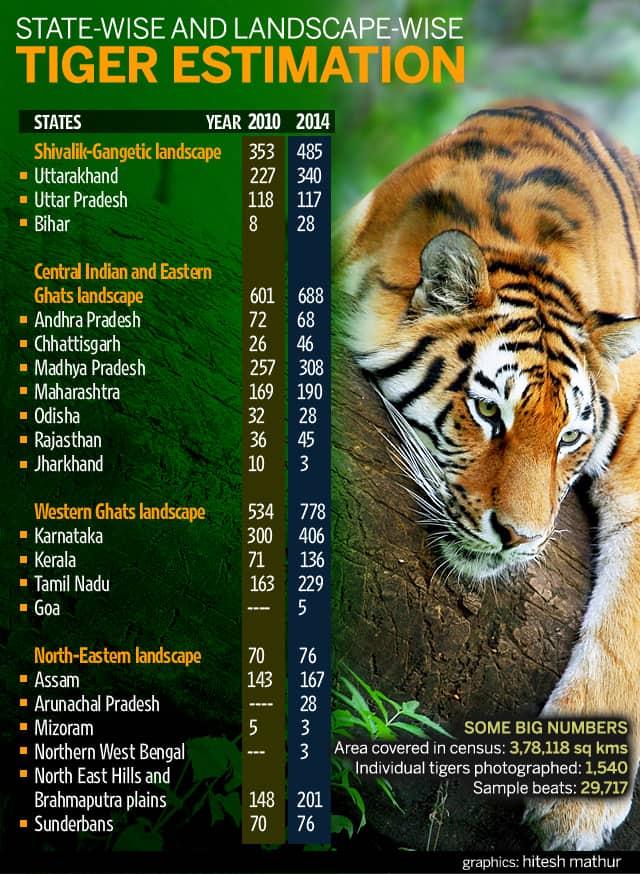
Tiger population in India is estimated to be 2,226 in 2014, according to a new report released on Tuesday. The big cat population in 2010 was an estimated 1,706. The number in the central Indian landscape had gone down four years ago.


India’s tiger population jumped 30% in four years, census figures showed on Tuesday, signalling that government conservation efforts over the past decade to crack down on rampant poaching and dwindling habitats have paid off.
Latest estimates show 2,226 tigers roamed forest reserves in the country in 2014, up sharply from 1,706 in 2010. With this, India has around 70% of the world’s around 3,000 tigers, said environment minister Prakash Javadekar.
"While tiger population is falling in the world, it is rising in India. It is great news," he said.
India’s tiger numbers dwindled to a low of 1,411 in 2006, when the first scientific census was conducted, as widespread poaching, shrinking habitats from deforestation, prey depletion and poor management of India’s 47 tiger reserves took its toll on the big cat.
Since then, concerted efforts to stem the lucrative trade in tiger skin and body parts, and limiting human-animal contact seem to have turned the tide. Tiger organs and bones fetch high prices on the black market because of demand driven by traditional Chinese medicine practitioners.
The latest report -- based on camera traps and DNA testing of tiger scat --- found the tiger population had stabilised in most reserves that have almost reached the maximum number of felines they could sustain. HT was the first to report this on January 10.
The study, details of which will be released in March, – covered five major landscapes – the Shivalik-Gangetic Plains, Central India and the Eastern Ghats, the Western Ghats, North-Eastern India and the Sunderbans.
Ravi Singh, secretary general of the World Wide Fund for Nature (WWF), said the success story demonstrated the impact of political will, science and field effort coming together.
The model should be replicated to protect other wildlife species such as the great indian bustard, the snow leopard and the hangul, experts added.
But former environment minister Jairam Ramesh, who initiated several pro-tiger initiatives, cautioned against complacency. “There are huge man-made and policy-induced threats,” he said, a reference to the NDA government’s dilution of green laws.
Former member of the National Board for Wildlife Prerna Bindra termed the spike “excellent news” but cautioned that, among other things, a strong policy and legal framework had enabled the big cat to survive.
“Diluting the laws or impinging on tiger habitat with development or infrastructure projects will endanger the tigers and our hard-won leadership in tiger conservation,” she added.
Karnataka was home to the maximum number of tigers, the census said, emerging among the biggest gainers in big cat numbers alongside Kerala and Tamil Nadu. The 11,000 sq km of the Mudumalai-Bandipur-Nagarhole complex now has the world’s largest population of a particular species of tiger, 570, the report said.
The roar, however, seemed absent in the traditional home of the tiger, Madhya Pradesh. The state now has 308 tigers as compared to 406 in Karnataka and 340 in Uttarakhand.
“The population has also stabilised in the Sunderbans with 76 tiger estimated,” said Jhala said. He added that the highest tiger density was found in Uttarakhand’S Corbett National Park in and Assam’s Kaziranga National Park.
Bad news also came out of Odisha, Andhra Pradesh and Jharkhand that witnessed a dip in tiger population on account of poor management in habitats, especially in Maoist-affected areas.
The report said the increase in tiger numbers was far outpacing that of lions. “The annual increase in tiger population was about 6%, as compared to about 4-5% for lions in Gujarat’s Gir National Park,” said YV Jhala of the Widlife Institute of India.