
 E-Paper



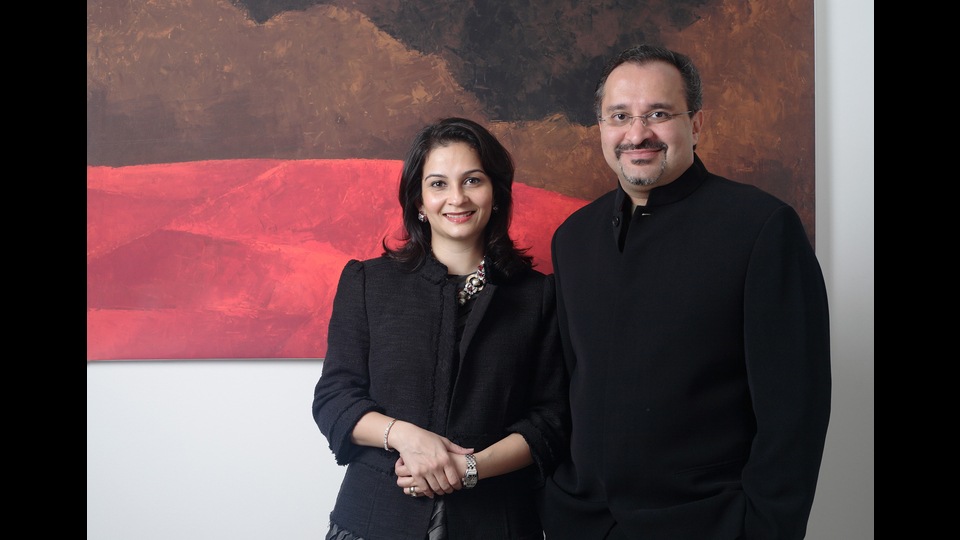
Colouring outside the lines: Minal and Dinesh Vazirani
The co-founders of Saffronart, the leading Indian auction house, have set new records and found new ways forward in the pandemic. There’s even talk of art meeting virtual reality.


The last packed saleroom that Minal and Dinesh Vazirani saw was on March 5, 2020, when the co-founders of auction house Saffronart sold all 40 lots comprising property that once belonged to fugitive businessman Nirav Modi.
The Mumbai auction house was entrusted by the Enforcement Directorate (ED) with the task of auctioning the seized property, ranging from artworks to a Rolls Royce, to recover the money involved in a fraud allegedly perpetrated by the diamond merchant on a state-owned bank.
That was a sultry Thursday evening in Mumbai. The room was filled with interested buyers. Bids came in over the phone and were placed online too, as Dinesh brought the hammer down on each lot. Many sold well above their higher estimates and ED was able to recover a little over ₹51 crore. Over the previous two days, Saffronart had raised a little over ₹2 crore from auctioning 72 other lots of Modi’s property online. In all, the auction raised a little over ₹53 crore.
Three weeks later, the country went into lockdown amid the global pandemic. When it emerged from what was one of the strictest and longest lockdowns in the world, everything was different. Then, as now, large gatherings of any kind had the potential to turn into super-spreader events.
“It was a moment when we said, in this kind of situation how do you traverse this industry, because it’s such an engaged purchase. How will we engage with clients? Is it even appropriate to reach out? Internally too, how do we keep employees motivated? The Nirav Modi sale had a live auction with lots of people in the saleroom. It was packed. That’s why physical engagement became such an issue in our heads,” says Minal Vazirani, president and co-founder of the auction house.
Saffronart began in 2000 as an online auction house; it only began holding physical or live auctions in 2013. It now has teams across four cities: Mumbai, Delhi, London and New York. Shortly after the Modi property auction, the Vaziranis got to work again. Dinesh Vazirani, who is chief executive officer and co-founder, directed all teams to photograph and catalogue consignments.
“Right after the Nirav Modi auction, we knew that some sort of a lockdown would happen. We told the teams that we have about two or three weeks. ‘Photograph every consignment and put it in locations where you can access it remotely’. Pre-planning as a team stood us in good stead,” Dinesh says.
Starting March 24, 2020, Saffronart began holding short-format auctions twice a week: Absolute Tuesdays and Friday Five. In the former, a set of works is put up for auction with no reserve price, and live bids can be placed between 8 am and 8 pm IST. In the latter, five lots of works are put up for sale with no reserve price and the auction is restricted to five hours.
“We had different people on the team responsible for different auctions: everyone was curating an auction. It was a risk we took. But we saw that the number of people bidding, engaging and participating grew,” Dinesh says.
Minal wasn’t initially sold on the idea, but she soon got behind it. “These are more frequent, much smaller auctions where people make impulsive decisions. They may not have to see the work physically, since it isn’t a high-value expenditure. If the person couldn’t get a piece this week, they know that there will be another sale the following week,” she says.
What’s more, these sales allowed consignors to make sales whenever they needed liquidity. “When you create these kinds of liquidity events, that’s when prices start moving up. That hesitation to buy and acquire diminishes because you know that at some point if you need to, you can resell. So as an asset class, it takes on a much more real tradeable value,” Minal says.
Switching back to a purely online format wasn’t quite the same thing as it would have been 20 years ago either. Back then, Dinesh pointed out, it wasn’t the norm to buy things online; now, even high-value art sales occur online. The pandemic deepened people’s engagement with the online world.
Saffronart began to conduct webinars too. Pre-pandemic, auctions were preceded by previews and exhibitions. During the pandemic, the team conducted webinars such as the Dialogues in Art series, which saw hundreds attend. In their regular auction calendar, they used what Minal calls a hybrid format in their auctions: the live sale only had Dinesh in the room, all the bidders were either online or bidding over the phone. This would be streamed online and on the app. As with the Nirav Modi auction, Saffronart coupled a live auction with an online one.
“From the lockdown until now we’ve sold ₹340 crore worth of art,” Dinesh says. This includes two record-breaking sales made earlier this year: in March, an untitled oil-on-canvas by Modernist VS Gaitonde became the most expensive piece of Indian art sold at auction (it fetched ₹39.9 crore), and in July, a 1938 work by Amrita Sher-Gil sold for ₹37.8 crore, becoming the second most expensive piece of Indian art sold at auction.
Globally too online sales became more popular last year. While the pandemic hit the global art market, causing a dip of 22% from financial year 2019 in the sales of art and antiques (even the volume of sales decreased by 23%), online sales doubled in value over the same period. According to the Art Basel and UBS Global Art Market report, of the estimated $50.1 billion of art and antiques sold globally, 25% ($12.4 billion, a record high) came from online sales. Public auction sales of fine and decorative art and antiques (excluding auction house private sales) declined 30% from 2019. Private sales by auction houses however increased by 36% and were “conservatively estimated to have reached over $3.2 billion”, according to the report.
Closer home, the Indian art auction market recorded a jump of 57.3% in turnover in financial year 2020-21, compared to the previous one, according to the Artery State of the Art Market Report 2021.
The hybrid, pandemic-friendly version of a live auction — “to someone who is seeing it online, it may seem like there are bidders in the room. It’s like you’re partaking in a physical auction,” Minal says — has got the Vaziranis thinking about how to improve the immersive experience for the viewer. Dinesh finds his inspiration in video games; Minal in the virtual reality headsets distributed by her daughter’s school.
“What it allowed the kids to do was be in a virtual environment with the glasses on and feel like you’re in a classroom. That is what I foresee happening with our business, where you can view art, view exhibitions, feel as though you are walking around a painting or a sculpture, getting a sense of the dimensions, the density, the volume,” Minal says. “That experience is going to fundamentally transform the art world. But how soon do I see that happening? I’m not sure.”


