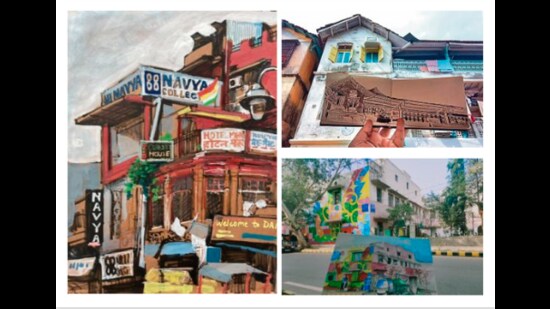
Drawings of Delhi’s Chandni Chowk and Lodhi art district and (above right) the distinctive mill-era chawls of Mumbai.
Advertisement
The groups, which meet on Sunday, draw on hidden heritage in Delhi, fading icons in Mumbai, markets and temples in Pune. We're struggling to keep up, they say.
There are so many aspects of a city’s identity that one doesn’t notice until they are gone, or fading.
The woman in the kashti sari, worn looped like a sort of dhoti, as Kolis have worn it for centuries. The shared balcony running along the length of a chawl — a place for slippers, tricycles, arguments and Diwali lanterns. Wooden eaves and metal girders, now being widely replaced by cold concrete.
{{^htLoading}} {{/htLoading}}
There are so many ways to take in such
(Above left) Sanjeev Joshi, architect and founder of the Pune chapter. (Above right) Members of the Mumbai group pose at the municipal corporation’s headquarters, with their drawings of the heritage structure.
Joshi’s favourite things to sketch are historical monuments.
“If you look at how design has changed with time — buildings, cars, roads, gates — you will see a progressive deterioration of elegance,” he adds. “Given that we can’t turn back the clock, sketching monuments is the most fulfilling experience I can have. I have also sketched in Delhi, Pune, Surat, Nashik, Chennai, Kolkata and Ahmedabad and all have quite a lot on offer to draw.”
{{^htLoading}} {{/htLoading}}
In each city, distinct but fast-fading characteristics are on display.
“Delhi is different from other cities in the sense that it a perfect amalgamation of the modern and the ancient,” says Niraj Gupta, 70, a former electronics engineer who started the Delhi chapter seven years ago. This group seeks out lesser-frequented historic gems such as Jahaz Mahal in Mehrauli, once the summer retreat of the 20th and last Mughal emperor Bahadur Shah Zafar (1775-1862). “Each visit to these remarkable relics reveals new details,” Gupta says.
The Pune chapter, set up eight years ago, often focuses on the ancient Maratha strongholds of the Peth area, and numerous vanishing old wadas or family estates.
“Beyond art and rediscovering the city, these meets foster a unique form of socialisation,” says Sanjeev Joshi, 65, architect and founder of this chapter. “Take, for instance, the Tulshibaug temple and market area. Here, a tapestry of culture unfolds, embellished by gleaming copper and brass treasures waiting to be bought, or documented.”
{{^htLoading}} {{/htLoading}}
The focus is firmly on the past because so much of this past is changing, the sketchers say.
“The importance of sketching and documenting our city hit home when a 3 am fire gutted the fish section of the Chhatrapati Shivaji Market in the Pune cantonment area,” says Farah Irani, 57, artist, chapter head for Urban Sketchers Pune, and regional leader for India. “We are now sketching Pune metro stations. So much is slated for change.”
Back in Mumbai, Aalok Joshi has a small list of icons he wishes he had got to in time. Topping the list is an Udupi restaurant in Mulund that he frequented as a student, which is now a McDonald’s. “Vishwa Mahal was right opposite the railway station. A few metres away was Vishwa Bharati, which is struggling to survive. I always went to Vishwa Mahal. I preferred it,” he says. “I regret that there is no sketch of the restaurant in my sketchbook.”
{{^htLoading}} {{/htLoading}}
His sketches are a quiet record, Joshi adds, of a time when things moved more slowly — a version of Mumbai that he knew and loved.
Sketching is itself a slow-living alternative to photography, Reels and online posts.
“Before photography and videography, sketching was the best way to capture the times — whether it was people, architecture or nature,” says Bharat Gothoskar, founder of the Khaki Heritage Foundation, which conducts walks and conservation initiatives in Mumbai. “It allows you to study history and gain insight in ways that just cannot be achieved through written words alone. We have collaborated with Urban Sketchers on multiple occasions, since we believe that if the sketchers understand the stories related to the subject they are sketching, their work will be more insightful.”
{{^htLoading}} {{/htLoading}}
All Access. One Subscription.
Get 360° coverage—from daily headlines to 100 year archives.
Explore the latest Lifestyle News on health, fashion, travel, relationships, food and festivals. Find useful tips, expert advice, trends and inspiring stories for everyday living.
Explore the latest Lifestyle News on health, fashion, travel, relationships, food and festivals. Find useful tips, expert advice, trends and inspiring stories for everyday living.