E-Paper



Global icons: Check out the world’s most popular emojis, and our favourites at Wknd

 Prefer HTon Google


The classic smiley is both beloved and cringe; the watermelon is a symbol of protest; the purple heart has a BTS connection. Take a look.
The word emoji is a combination of the Japanese terms e, for picture, and moji, for character.
Since 2009, the US-based non-profit Unicode Consortium has standardised them for compatibility across platforms by working out code points or numeric identifiers for each one. These code points act as a sort of universal address, enabling different operating systems and software programs to recognise and render them in ways that are instantly recognisable.
The precursor to the emoji was the emoticon, which is an expressive icon made using keyboard characters (typically punctuation marks, letters and numbers). The first person to enter emoticons into the public record is believed to have been computer scientist Scott Fahlman of Carnegie Mellon University, who proposed the use of :-) and :-( in the university bulletin, in 1982.
Even before the emoticon there was the Japanese kaomoji (literally, face character), made by combining Japanese letters, text symbols and punctuation, in the 1980s. The ^_^ for joy (or arched eyebrows) and ¯\_(ツ)_/¯ for a shrug of indifference are examples.
Take a look at the world’s most popular ones – and our favourites at Wknd.
.
The classic smiley

This one has been around from the start, and for most of its journey, the classic smiley has denoted something happy, friendly and innocent. It is a powerful conveyor of nuance. Add it at the end of “I love you” and the message is now fit for a colleague who helped you out.
Gen Z (those now aged 13 to 28), however, is said to frown upon the classic smiley as creepy, insincere, passive-aggressive, sarcastic and plain cringe. The argument: No one is that happy, nice or innocent.
The smiley face ideogram has its roots in a marketing campaign for the New York-based radio station WMCA. They put the face on a yellow sweatshirt, to boost visibility, in 1962.
The following year, the State Mutual Life Assurance Company in the US was using the full smile with dark oval eyes in a campaign to boost morale during a merger.
Creepy or cute, it has consistently ranked among the top 10 most-used emojis in the world.
.
Melting face

A hit across demographics, melting face was released in 2021.
It can signify childish glee; it can be snarky (“Can you believe she said that!”). It can be used to hint lightly at discomfort, embarrassment or stress.
It is even being used, amid the climate crisis, to convey various kinds of global-warming-related dread.
It was designed to allow the user to express two conflicting emotions. If it does the job exceptionally well, you can thank cognitive scientist, comics theorist and emoji researcher Neil Cohn, who was part of the team that created it.
.
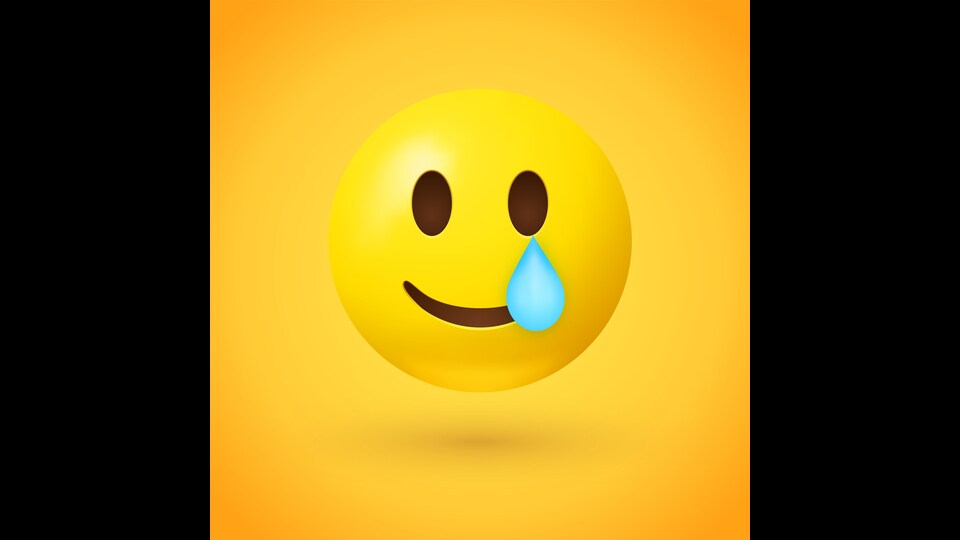
Smiling face with tear
This one works for moments of intense gratitude, relief or embarrassment; it can also convey empathy and shared sadness.
Smiling face with tear was released amid the pandemic, in 2020.
The proposal to Unicode essentially asked: What existing emoji can convey the feeling of a soldier who comes home and is instantly recognised by his dog? Or the mixed emotions of watching a best friend marry?
It can stand in for “bless us everyone”; can be empathetic, triumphant, moved and overcome, all in one.
It was proposed by Jennifer Daniel, an illustrator-designer who heads the Emoji Standard and Research Working Group at the Unicode Consortium.
.
Flexed bicep

This one was added to the Unicode library in 2015, to represent muscle, strength and working-out. It quickly became the symbol for a flex of any kind, or a political stand. It’s the ideal punctuation for statements ranging from “I think I’ll take my new car to the party today” to “Women’s rights are human rights” to “Mask, vaccinate, eliminate”.
.
Pleading face
The puppy-dog eyes are hard to beat, and are used to convey everything from pleading and yearning to shyness, heartfelt apology and flirtatious intent.
Introduced in 2018, it has been among the most-used emojis on X and has seen a spike in use, according to Unicode’s emoji frequency report of 2021. Make of that what you will (insert shrug).
.
OUR FAVOURITES: ICONS THAT CAN MEAN SO MUCH MORE
Slice of watermelon

Standardised in 2015, this emoji of a summer fruit held little relevance online, until Israel began to bombard Gaza in 2023.
The watermelon emoji has since come to represent the flag of Palestine, which is also red, black, white and green. From Gaza to China, it has been used by protestors to sidestep censorship.
Offline, the watermelon has been used as an icon of Palestinian resistance for decades.
By 1980, in fact, the Israeli military had banned any public display of not just the watermelon icon but of anything that put the colours red, green, black and white together. At which point protestors took to waving slices of watermelon, during protests.
As the author Mahdi Sabbagh put it: “When I see a watermelon, I think of the unbreakable spirit of our people.”
.
Sunflower

The cheery yellow bloom is Ukraine’s national flower. The soniashnyk is now also the country’s symbol-of-resistance and call-for-solidarity emoji, as the war waged against the tiny country by Russia looks set to enter its fourth year.
In a video from year one of the war, 2022, a Ukrainian woman is seen handing over a fistful of sunflower seeds to armed Russian soldiers. “Keep these… so sunflowers can grow (over you) when you die,” she says.
.
Purple heart

There are emoji hearts in every colour of the rainbow, presumably for those looking to underscore the fact that they don’t mean the icon in a romantic sense. Purple took on a new meaning, courtesy BTS, about eight years ago.
At the end of a concert in 2016, Kim Taehyung aka V flooded his audience in a purple light and called out: “Borahae (I purple you)… Do you know what purple means? Purple is the last colour of the rainbow. Purple means I will trust and love you for a long time.”
“I just made it up,” he would later say.
Nevertheless, it has since become a symbol of borahae for the BTS Army, and abiding platonic love of any kind.
.
Face with bags under the eyes

This emoji was pitched with an eye on new parents, heavy drinkers battling a hangover, shift workers, students, people pulling all-nighters and insomniacs.
But it can just as well stand in for anyone trying to just get by, in a time when everyone is so perennially tired (or anxious or otherwise harried) that The New York Times is writing articles about the feeling. Watch out for the release this year.
.
Shovel

Gardening? Clearing away snow? Digging a hole? Digging yourself into a hole? The shovel, due for release this year, will seek to convey them all.
It will underscore sentiments ranging from “I’m such an idiot. I just want to bury myself” to “Is he as cool as he seems? Can you do some digging for me?” and “I wonder how you’re going to dig your way out of this one.”
.
Fingerprint

This one indicates clues, crime, forensics work, a sense of mystery, a personal touch, and authenticity. In a world where nearly everything can be cloned, it can be used to ask: How secure is that? Or: How authentic? Watch out for its release this year.
.
Broken chain

This is a 2024 addition, and has been used to indicate feelings or a wish for freedom, liberty or emancipation. It arrived just in time to signal a full return to normalcy, about a year after the pandemic (which officially ended in May 2023).
.
New-format families

In 2022, Unicode introduced four new emojis as a sort of rebranding of the family cluster. There’s a single adult with a child, two gender-neutral adults with two children, and a single adult with two kids. The step is a part of Unicode’s annual interventions to make the existing emoji library more diverse with respect to gender, race and culture.
Icons for the djembe drum, sari and mango were also finally added, in recent years. One we’d really like to see: The dosa!