
 E-Paper



Grand deft auto: Kunal Pradhan on insanity and obsession on the F1 track

 Prefer HTon Google


What does rivalry look like at 300 kmph? In the world of Formula 1, the battle is not merely for points, lap times or a chequered flag; it is also for survival.
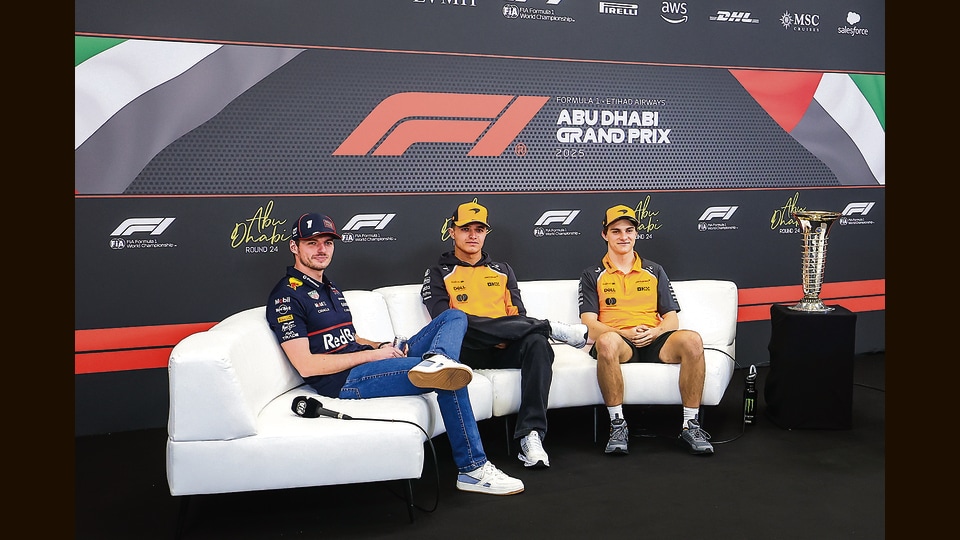
A long, white sectional sofa lay in the middle of the room, in a setting so surreal it could have been a scene from the sci-fi show Severance.
Max Verstappen, a 28-year-old Dutchman who was Formula 1 world champion for 1,457 consecutive days, entered and sat in the middle. Oscar Piastri, a 24-year-old Melbournian widely tipped to be a future champion, joined him moments later. The man of the hour, Lando Norris, 26, from Glastonbury, was the last to enter.
Aware that the cameras were rolling, they smiled at each other awkwardly between sips of sparkling water. Until 10 minutes earlier, Verstappen, Piastri and Norris had been hurtling around the Yas Marina Circuit in Abu Dhabi at 220 miles an hour, in the race of their lives. Now they were sitting together in what seemed like comfortable, almost companionable, silence.
In the course of 12 months, across 1,262 laps over 7,377 km at 24 Grands Prix, these three men had thought of little other than beating each other. It was an almost unhealthy obsession — the kind that sport in general can fuel, and Formula 1 in particular can harness.
For out on the track, when you’re bobbing around in a metal carcass, trying to squeeze an extra tenth of a second from a 1,000-horsepower engine, the first battle is not for points or lap times or the chequered flag; it is for survival. A mistake is not a volley in the net on the tennis court, or a dropped catch in the deep on the cricket field, or a penalty shot in football that comically sails into the stands. Here, an error could be well your last. This is life, quite literally, on the edge. And so, it pushes you over the edge.
In 2025, this three-way battle for survival, excellence and sanity took Norris, Verstappen and Piastri to dark places none of them had encountered before. They feuded in the team paddock, on the track, before race arbitrators and in the press. There were moments when it seemed each of them was unassailable, and moments when it seemed each of them was done. Until the rollercoaster brought them to the final race at Abu Dhabi, for a title fight in which any of the three could have been crowned champion.
RAGE AGAINST THE MACHINE
The 2025 season was a throwback to a nostalgic age of danger and daring that marked F1 through its classical and early modern eras. Of Niki Lauda vs James Hunt (1976) as cross-team rivals in the manner that Verstappen and Norris were towards the end of this season; of Alain Prost vs Ayrton Senna (1988 and 1989) as bitter foes on the same team in the way Norris and Piastri were through the year; and of the Kimi Raikkonen vs Lewis Hamilton vs Fernando Alonso (2007) triple-header that it eventually boiled down to.
But how does one even process rivalries, machinations of team dynamics and track positions with your life in your hands at over 300 km per hour?
Over the course of his multiple autobiographies, 1992 Formula 1 world champion Nigel Mansell broke down the concept of how his brain would react to being in the cockpit. He called it his “miracle moment”.
“Out on the track, and instantaneously the 220mph I was doing slowed down to 40mph,” Mansell wrote. “Suddenly, I could see the trees and the flag marshals, anything I was looking at. Then I was waiting for the corner to come. When I got to the corner, there was plenty of time to brake, plenty of time to change gears, plenty of time to pick the apex, plenty of time to go around. I was pushing down on the throttle thinking, ‘yeah, I’m flat out’… The first time it happened, I started going six seconds a lap faster. Bingo; I’d arrived in Formula 1!”
But a sport that demands such tremendous training of the mind and such a fine balance between speed and safety is often wrongly judged as mechanical. Though a staggering 52 F1 drivers have been killed on the track, from Cameron Earl at Warwickshire in 1952 and the great Senna at Imola in 1994 to Jules Bianchi after a crash in Japan in 2014, not everyone understands what is on the line.
In the film F1, starring Brad Pitt, endorsed by FIA and released this year, for instance, the plot line is comically bizarre. Pitt, a veteran driver making a comeback, chooses to cause chaos on the track to help a hotshot teammate register points in a car that’s slower than the competition. It’s a farcical and callous misinterpretation of a sport where bravado may be essential but can never be foolhardy.
So, to return to the title fight in Abu Dhabi last week: Verstappen needed to win to give himself a shot — so he did; Piastri wanted to stay in the hunt by finishing ahead of his teammate Norris — he delivered; and Norris needed to get on the podium to become the 35th driver to be crowned F1 world champion in 75 years — he did that, and nothing more.
One was triumphant, two lived to fight another day. Not exactly a Hollywood ending, but a great day in the dangerous and exciting world of Formula 1. The drama will resume in 2026.
(The views expressed are personal)


