E-Paper



How does the brain do it all? Dr Masud Husain chats with Wknd about his new book

 Prefer HTon Google


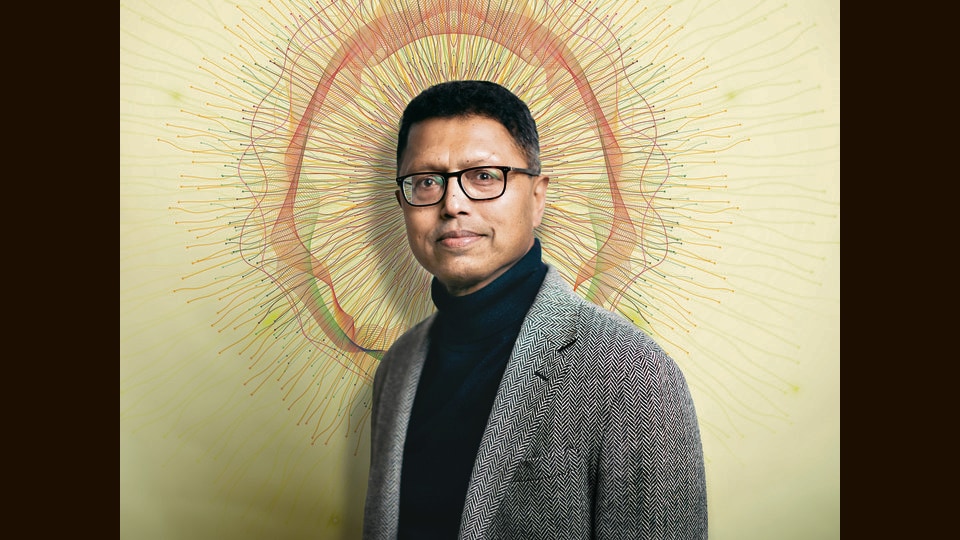
How do we hum a tune ‘without thinking’, choose the right footwear, make a joke? Through people stories, see how intricately the brain tether us to our reality.
A man is slowly running out of words. A woman thinks she’s having an affair, with the man who is really her partner. Another appears to have lost all control over one arm and leg; they have begun to do exactly as they please, when she isn’t watching.
How changes in the brain slowly alter who we are, and then creep into social circles to tamper with our closest bonds, is the subject of a new book by neuroscientist and neurologist Dr Masud Husain, 63.
Earlier this month, Our Brains, Our Selves: What a Neurologist’s Patients Taught Him About the Brain, his debut, won the Royal Society Trivedi Science Book Prize. “I’m thrilled and very surprised. I wasn’t expecting the prize at all,” he says.
What stands out in the book is the human element; something that is often missing or minimised in books that seek to explain what we know about the human brain. Dr Husain puts the person, their distress and the fallout on their lives at the heart of things.
Also woven into the narrative are threads from Dr Husain’s own struggles with belonging. His family moved to the UK from what was then East Pakistan (and is now Bangladesh) when he was five. He speaks in the book of the intense efforts he made, as a child, to sound less different and to fit in better.
As an adult, he became fascinated by what makes each of us who we are, and what works to bring people together, or divide them.
For 30 years, Dr Husain has researched the role played in this by the giant, bewildering jigsaw puzzle that is the brain. A professor of neurology and cognitive neuroscience at University of Oxford and professorial fellow at New College, Oxford, his focus has primarily been behaviour, memory, attention and motivation.
“The book was initially called Outsiders, because in it I also consider the idea of belonging, and how a change in the brain can lead to someone not feeling like they belong. Or, as in my case, feeling like they finally belong,” he says. “How does that happen? It has to be the brain. It is what assimilates information, defining how we connect with one another.” Excerpts from an interview.
.
* The story of Michael Buckley was like a poetic reminder to value the little miracles that hold up our everyday life. His semantic dementia makes it hard for him to accurately connect words with objects and their meaning. Asked to draw a rake, he sketches, in great detail, a toothbrush. What, to you, is most amazing about how our brains work?
What is probably most amazing is how little we think about all the things we do so effortlessly every day. Let’s look at concepts, which is what Michael was slowly losing.
Say I’m thinking of a table. I can look at different types of tables from around the world and identify them as such. I can tell them apart from a stool, a footstool or a stepladder.
When one loses concepts, due to damage to the brain, one not only loses the idea, but also the link to the word that encapsulates that idea.
It’s amazing, isn’t it, all the connections the brain has been building about the world around us, ever since our childhood; assimilating and organising information, creating links, and yet simplifying?
.
* There is so much to learn that neuroscience as a field is constantly evolving. What does it feel like to study and treat what is arguably the most complex and uncertain organ of the body?
I don’t think it requires anything special, except curiosity and motivation.
Studying behaviour, and how it changes with disorders or damage, is endlessly fascinating to me because it is a challenge to even find methods to measure behaviour and isolate components of behaviour.
It’s hard to imagine anyone solving the entire puzzle. Each of us is just trying to understand one part of it.
.
* In your book, certain patients suffer damage to the brain and start to behave in ways that are interpreted as aggression. Some are considered drunk, others lascivious. Given how much of who we are is a factor of how the brain operates, is it possible that we might someday reach the point where we can “treat” at least certain crimes out of the system?
If you look at prisons, at least in many Western countries, you will find that there is a large percentage of people who have had a head injury in the past, or a history of drug or alcohol abuse.
What we are essentially saying is that a significant percentage of the prison population has something wrong with their brain. If we could have detected there was a problem, then the question arises: Would they have ended up in prison? But detection that early is a big “if”.
Meanwhile, what will it take to stop drug abuse? Because that is one big factor that leads to brain disorders.
.
* As you continue your work, research and clinical, what would you say is the larger mission?
In my clinical practice, I am a keen advocate of the old-fashioned skill of listening.
Many of our patients with chronic problems do not expect a cure, or all the answers. What they need is to feel that they are able to tell their story, and that someone — not just an expert who writes a prescription, but a fellow human — is really listening. That is such a big part of medicine.
I tell my students that the patient has to leave feeling better than when they came in, and that can just be because of the human contact they’ve had with their doctor. Of course, prescriptions, tests and cures matter, but feeling that your doctor cares matters too.
In terms of my research, I want to trace how we can unravel the mechanisms that allow the brain to perform all its seemingly effortless tasks. When it goes wrong, what kind of treatment can we offer?
The pharmaceuticals industry is always looking for the magic bullet: the medication that can solve our big problems. I think it’s unlikely we will cure major brain disorders such as Alzheimer’s in my lifetime, though we can make small increments towards it.
We can and are already developing treatments that can make a significant difference to the quality of life of a patient who is slowly losing some small but essential part of who they used to be.