
 E-Paper



India@76: Meet seven Indians fighting brave new fights, this side of freedom

 Prefer HTon Google


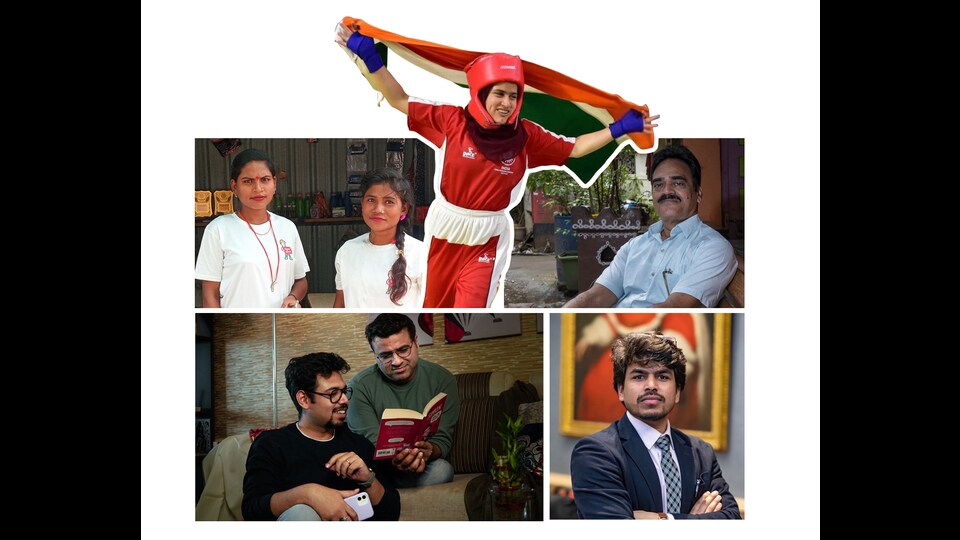
As Wknd celebrates Independence Day, meet Indians who bucked trends to say: This is who I am. This is what I care for. This is what I want my India to look like
A country is always evolving. Its struggles for freedom may narrow, alter and change, but they continue.
Seventy-six years after the last of the British ships finally left our shores, we are asking (as we must): What’s holding us down? What’s keeping us back?
What do we mean when we use the term ‘’we’’ and how can we widen that circle? It’s essential that we do.
For this is how every generation gains new freedoms (and new freedom fighters) -- from people forging brave paths in new causes.
There are those navigating identities made more complex by laws that change, or refuse to.
There are others fighting to protect ancient ways of life, in cities forever in flux.
And there are still others facing up to systems and hierarchies that, whether by accident or design, render them invisible.
As modern India celebrates 76 years of freedom, here are the stories of five Indians who stood up to say: This is who I am. This is what I care for. This is what I want my India to look like.
There’s the story of the two tribal women from rural Madhya Pradesh, both in their early 20s, who have set up a motorcycle repair shop and are earning in a way that bucks the trend for tribal employment in India. They’re entrepreneurs, working close to home, in a business they founded. Their lives are no longer buffeted by the vagaries of seasonal jobs and unemployment. When she realised this, even my mother had to agree that it was a good idea, says one of the two, Gayatri Kasde, 23.
There’s the story of a young Dalit whose grandmother couldn’t wear slippers in their village; he is now studying at the School of Oriental and African Studies in London, shattering barriers that continue to hold back millions of young Indians. “This is for our grandparents who gave up everything,” says Sushant Singh, 30, “and for our parents, who never let us forget the words of (BR) Ambedkar.”
There’s the story of the Muslim teenager from Kashmir who went on a fast — avoiding food and smiles around her father, until he relented and let her take on kickboxing. Tajamul Islam, 15, has since won two world championships. “I always wanted equal rights for my daughters,” says Ghulam Mohammad Lone. But he wanted Tajamul to focus on further study, and a stable career. Now, he says, he couldn’t be prouder.
“That I am a Muslim girl from Kashmir is not lost on me,” says Islam. “I realise I have broken stereotypes, but there are many more barriers to break.” She is taking on boxing next, and living in Haryana.
There’s the story from Hyderabad, of two men who lived together, in love but secretly so, for five years, until a door opened for them when the Supreme Court decriminalised same-sex relationships. Then, determined to never go back, Supriyo Chakraborty and Abhay Dang launched a fight of their own. They held a lavish wedding ceremony, which was step one. Their union isn’t recognised by existing Indian laws, so they petitioned the Supreme Court to reconsider the country’s stand on queer love, in matters of civil law such as marriage. (The petition has since been joined by dozens of others).
They fight on behalf of the LGBTQIA+ community, they say, and on behalf of India. Because we are still a country finding our way on this -- a way we once knew so well.
And finally, there’s the story from Mumbai, of a member of the indigenous Koli community who saw his city change in a way he could not reconcile with. So, 15 years ago, he began to fight for the megalopolis’s endangered mangroves and wetlands. He has filed petitions, cleared away rubble, worked to restore literal oxygen to these marine nurseries and ecological hotspots.
“There are good laws in place, but they are not implemented. Few people care about the environment.” But he will not give up, and he will not be demoralised, says Nandkumar Pawar, 62.
These people, their families and communities, now stand united by courage, and by their belief in a greater cause.
This Independence Day, we celebrate a country in which such battles are seen, acknowledged, supported. And, most importantly, and only because we are free, possible.
Jai Hind.
.
In Madhya Pradesh, two tribal women turn auto-repair entrepreneurs
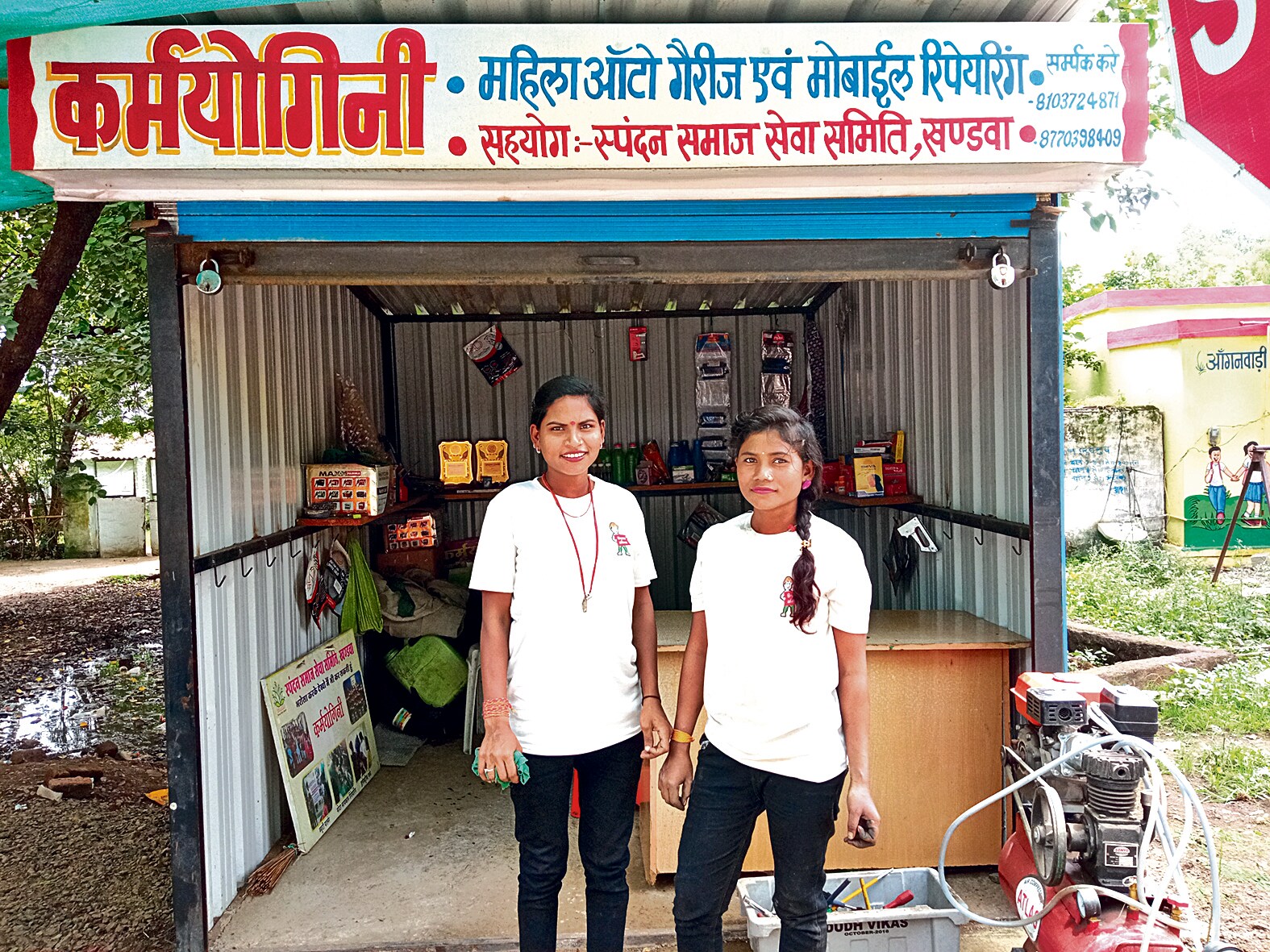
A spanner in hand, 23-year-old Gayatri Kasde squats beside a stalled motorcycle. “There’s a problem with the clutch. It’ll cost ₹100 to fix,” she says.
The rider is surprised. He asks if Kasde intends to carry out the repairs herself. She’s used to the question, and the expression of surprise mixed with extreme doubt. Sometimes there is aggression too, anger, or contempt. Some riders shake their heads in disbelief and leave.
She carries on. She is proud to be the first woman from the Korku tribe to run an auto repair shop. “Whenever you have a problem, this is the shop you should come to,” she tells her current client, smiling.
In interior Madhya Pradesh’s Khandwa district, Gayatri Kasde and 22-year-old Mantu Kasde set up this outfit together, a year ago. Their community is proud of them, Gayatri says. They are proud that two women have set up a profitable, independent business right where they were born and grew up.
This is unusual for the community, whose members tend to migrate to cities in search of work. In addition, the literacy rate for tribal women in the state is 50.6%. According to data from the state’s tribal development ministry, tribal women work an average of 155 days a year. This is typically gruelling, low-paid, temporary farm labour.
Gayatri Kasde, in fact, has vivid memories of the first lockdown. Many of her fellow tribe members were stranded in Mumbai, where they had worked as daily-wage labourers. Members of her family were among thousands who walked back to Khalwa, a distance of about 550 km.
Back home, there was no income, little money; food became a struggle, Kasde says. “I needed to do something.”
She reached out to Seema Prakash, convenor of a local non-governmental organisation called Spandan (Hindi for Heartbeat). “It was a bad time and several women like me had contacted her for work.” There were options in areas such as tailoring and pickle-making, but they would only pay sporadically. “We needed work that would pay us every day,” Kasde says.
As she and Prakash discussed the options, they began to talk about how nearly everyone in the area had a motorcycle, but there were very few repair shops. Why not start one?
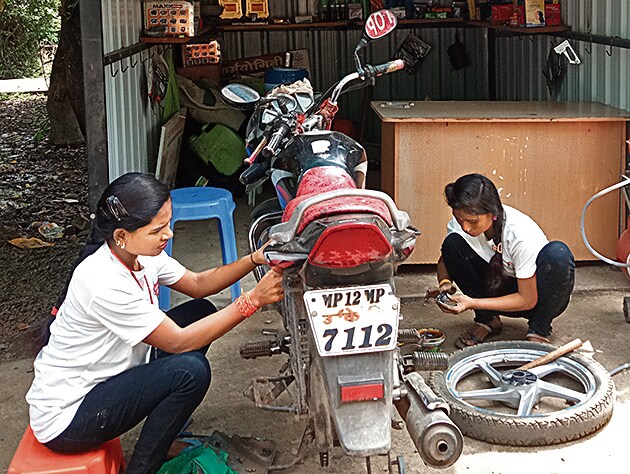
Spandan provided 21 days of training to a large group of women, including Gayatri and Mantu. They helped them find auto repair shops where they could cut their teeth, before striking out on their own.
Both women faced objections from their families but with the only real alternative being seasonal farm work, even Gayatri’s mother eventually came around.
The two women launched their auto-repair service in a thatched structure on the side of the road. “People laughed at us,” Gayatri says. “They said we would never be able to compete with the men. They told us to go home and cook, or get married. We paid no attention.”
Their persistence paid off. In October, the Khalwa panchayat allotted the two women a small plot of land, on which they have erected a more permanent outfit “with a tin roof”. There is more respect, with this legitimacy. But more than anything Kasde values the financial independence. “I earn ₹500 a day, and that allows me to live my life the way I want,” she says.
.
In Hyderabad, fighting for new laws around love
Husband. That seemingly innocuous word exchanged between Supriyo Chakraborty, 33, and Abhay Dang, 36, on a December evening in 2021, contained a lifetime of struggle, self-discovery and courage.
In many ways, their meet-cute was commonplace. Chakraborty is a hotel management executive; Dang, a software developer. They met on a dating app in 2012, had a first date at a café, spent hours talking in the days that followed. Yet, when they decided to move into a small flat together the following year, that was anything but commonplace. The Supreme Court had just overturned a 2009 judgment by the Delhi high court that decriminalised homosexuality. In doing so, it upheld the validity of Section 377 of the Indian Penal Code, which makes “unnatural” sex “against the order of nature” a punishable offence. This is a section that is often wielded as a threat, by families and the police, to force same-sex couples apart; as a means of coercion and blackmail by others.
“It was tough. We were criminals overnight. We would wonder, what if the homeowner got to know who we really are? He could throw us out,” Chakraborty says.
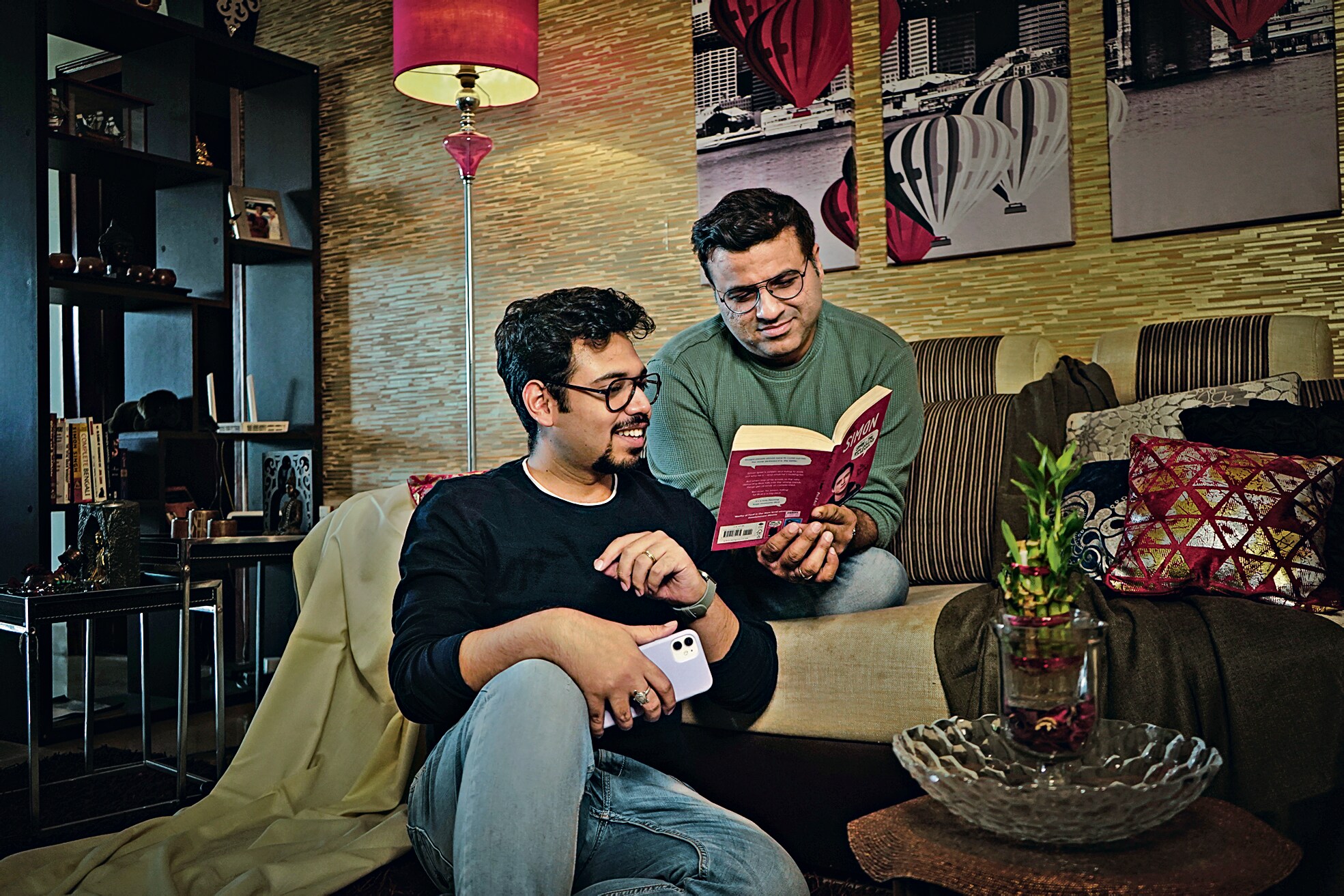
In that period of despair for the millions that make up India’s Lesbian, Gay, Bisexual, Transgender, Queer, Intersex and Asexual (LGBTQIA+) community, Chakraborty and Dang returned to hiding who they were to each other. They lived their lives in palatable nuggets. They learnt to never hold hands in public. “If someone asked us if we were brothers, we’d say yes. If someone asked if we were colleagues, we’d say yes. We learnt to accept whatever came our way,” Chakraborty says.
Then, in 2018, the Supreme Court ruled on a fresh petition and read down Section 377. The same constitutional right to equality that applies to all Indians, must be seen to apply to same-sex couples, it noted. To not recognise such rights amounted to indirect discrimination.
The court was explicit about not extending this equality to civil rights (such as the right to marry). But still, for Dang and Chakraborty, a window had opened. The two had been living together for almost five years at this point. They could hold hands in public again. They could correct people who thought they were brothers, colleagues, friends.
By 2021, having lived through the pandemic together, with all its losses and scars, they decided to take another step forward. In 2021, they threw a lavish two-day wedding party in Hyderabad. Chakraborty planned the dream wedding for seven months.
The two men now live deliciously ordinary lives: they wake up and go to work, get home and watch TV, have dinner and go to bed. Their initial struggle has made other differences fade into the background. Dang, for instance, is Punjabi; Chakraborty, Bengali. The former is vegetarian, the latter is not. Dang is a big fan of sci-fi and Hollywood productions; Chakraborty is a sucker for Bollywood. One loves T-shirts, the other, sharp suits.
It still hurts that their marriage is not recognised by existing Indian laws. The two men are working to change that. They were the first of 10 couples to file the marriage equality petitions now being heard in the Supreme Court.
The frenzy of the hearings and the glare from the media has ebbed for now, but they’re in this fight for the long haul. It’s not a choice, Dang says. In a country where so many queer people grow up in hiding, afraid or brutalised, stigmatised for who they are and who they love, if those in positions of privilege don’t fight, who will, he asks?
Chakraborty and Dang recognise that they are still outliers. Their country is still finding its way on this. And they’re driven by the idea that they can help it in this struggle.
.
From a hut on the edge of a UP village to studying at SOAS
Growing up, Sushant Singh remembers his grandmother always being barefoot. It’s an image that would haunt him in later years.
In rural Bulandshahr, Uttar Pradesh, their mud-caked hutment stood on the fringes of Madhogarh village, as dictated by caste-based rules of habitation. They were Dalits, which meant that, to the upper-caste settlements, their homes were impure.
He can still see Dallo Devi, hunched with age, plodding about with the help of a stick, dragging her hookah along. Having grown up in Delhi, “I would wonder why one would hold on to such an inconvenient habit as being barefoot, especially on village roads strewn with stones,” he says.
It was only years later that he found out why: in her youth, Dalits were expected to remain barefoot. Footwear was seen as presumptuous, and could attract attention, questions, violence: By wearing shoes, were these Dalits attempting parity with the rest of the village?
“For almost a century, she never thought she could have the simplest of luxuries – slippers – because of what caste did to our village,” says Singh, 30.

Hewn into the fabric of social life of India, caste is a reality for tens of millions in India. Its harshest effects are reserved for the 220-million-odd Dalits, who face material discrimination in access, education and employment, but also everyday bias in people-to-people interactions.
Typically landless in rural India, Dalits are still disproportionately poor on average, earning less, and owning less. Singh’s family moved to Delhi hoping to blend in and do better. They did better than they would have in their village; but they were in for a rude shock.
“The caste discrimination was less intense, but it was pervasive – starting with whether we’d get a house on rent or what kind of jobs were available to my father,” Singh says.
Inderjeet Singh had little formal education, and worked in a range of jobs: bus attendant, petrol-pump operator, security guard. Through it all, he was determined that life would be different for his children; he carefully put away half of every small salary, for their education.
In school, Singh and his sister tried to hide their caste. “There was a lot of humiliation…we felt we’d lose every opportunity if someone knew we felt they’d start hating us,” he says.
When their fees were once unpaid, they were singled out and made to stand outside their classrooms for hours. It’s a memory that has stayed with him. “We were quite famous,” he says.
What kept the family going were the words of BR Ambedkar, the framer of India’s Constitution, whose three-point agenda for emancipation of his communities focussed on education. After a degree from National Law University, Delhi, Singh is now at the School of Oriental and African Studies in London, one of a tiny share of Dalits to have broken through caste barriers, finished school, graduated, secured a professional degree, and then gone on to study overseas.
“This is for our grandparents who gave up everything,” he says, “and for our parents, who never let us forget the words of Ambedkar.”
.
In Jammu & Kashmir, a kick-boxing champion twice over, who got her start by refusing to eat or smile
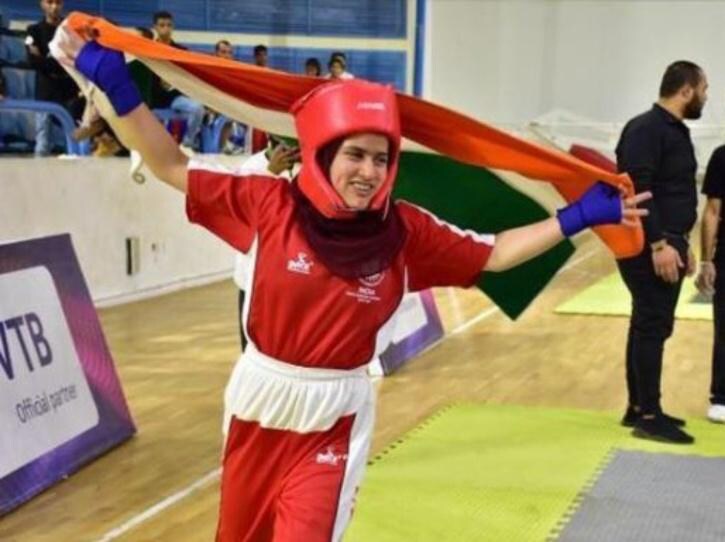
She’s 15 years old, and a two-time world kick-boxing champion. The first of these medals came when she was eight, in Italy. The second, in 2021, in Cairo.
Tajamul Islam has had to fight to arrive at these moments. She has fought competitors, her family’s lack of resources, notions of propriety for her gender, and very often she has had to fight the implications of where she lives: Bandipora in Jammu and Kashmir.
Islam was five when she was part of a group taken to watch a live Bandipora’s Got Talent event, part of a local talent hunt organised by the Indian Army. A new world opened up to her. “There was boxing, kick-boxing, Muay Thai…I liked the idea of beating up people,” she says, giggling over the phone from Gohana in Haryana, where she now lives and trains.
Islam returned home that day determined to try kick-boxing, but ran into resistance from her father, Ghulam Mohammad Lone, an apple and dry fruits merchant. “He was afraid I would end up badly injured. Everyone in our society told him that a young girl should not get into boxing,” Islam says.
There were sportswomen in the family. Islam’s elder sister Razia Islam is a national-level gold medallist in the martial art of wushu. Their two brothers Athar Islam and Mohsin Islam are athletes. The fifth sibling, Sabia Islam, intends to pursue a career in law.
“I always wanted equal rights for my daughters,” Lone says. But he wanted Tajamul to focus on further study, and a stable career.
She, however, was determined, and decided to protest. She stopped eating, stopped smiling, and pestered her mother, a homemaker, to convince her father to let her try the sport. “My mother was a constant support. She is my biggest hero, the woman that taught me to learn to fight for myself,” Islam says. “And my father now goes around town proudly telling everyone his daughter is a kick-boxer.”
It helped that Islam grew up in a household obsessed with sport. Lone had participated in 10 national-level kick-boxing tournaments, and was her first coach. An army officer helped.
“I coached her at home, but it was Major Raghubir Singh of the 14 Rashtriya Rifles who nurtured her talent and encouraged her to participate in big events,” says Lone. “He saw the immense potential in her, and played a crucial role.”
The family began to back Islam with, literally, everything they had. Her father sold some land to pay her way. “But I am happy that she has achieved so much at such a young age and done something for the country,” he says. “Today everyone knows my family, including Lieutenant-Governor Manoj Sinha, home minister Amit Shah and prime minister Narendra Modi. What else do I need?”
Islam, meanwhile, is acutely aware of her Kashmiri identity. “That I am a Muslim girl from Kashmir is not lost on me. I realise I have broken stereotypes, but there are many more barriers to break,” she says.
In Haryana, Islam now also trains to box, and wants to try out in the sport competitively. “Kick-boxing competitions are few and far between, so it makes sense to learn a new sport. I am waiting for kick-boxing to be included in the Olympic programme. When that happens, I will go all out to win an Olympic medal for India.”
.
Working to protect an ancient way of life, and crucial wetlands, in Mumbai
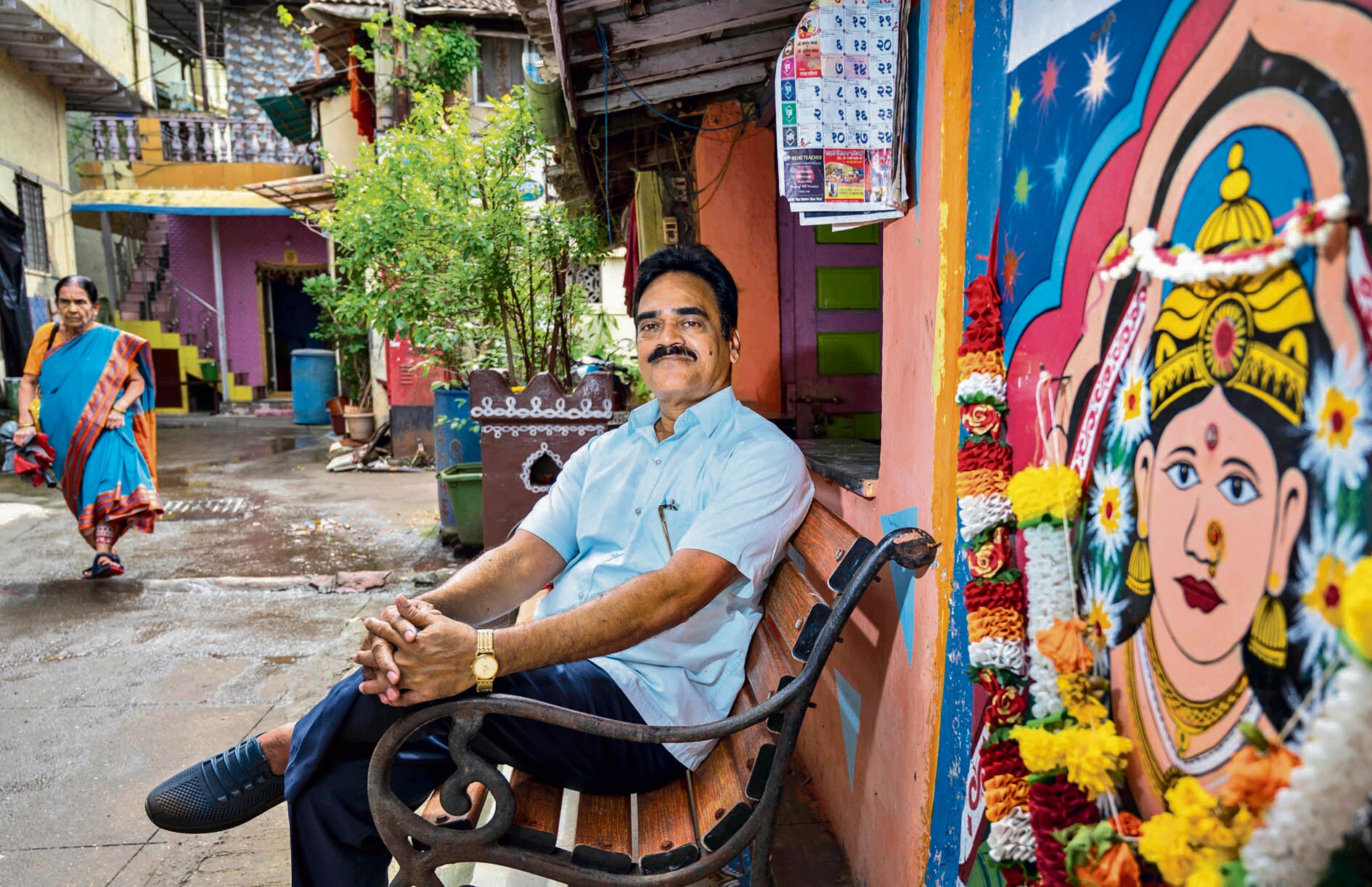
Nandkumar Pawar was seven years old when his mother began taking him into the mangroves near their home, to show him how to fish. By 10, he knew where the crabs lay, where to find the tilapia. He could guess how the catch would be, he says, based on the colour of the water.
He needed no equipment; he caught the fish with his hands. His mother was continuing an ancient tradition. The Pawars are members of the indigenous Koli community, which has fished for a living for centuries.
Pawar would eventually enrol in college, and graduate. But through it all, he kept fishing. It was part of him, he says. And there was never a shortage of fish in Bhandup.
“All we needed to do was walk into the mangroves, and then decide how much we wanted to carry back.”
He is now 62. Things have changed.
By the late 1990s, as he entered his 30s, he noticed a crisis brewing. “The Thane Creek once supported 12 coastal Koli villages. But there was increasing pollution from dumping grounds that released their toxic waste into the water,” he says. As the pollution intensified, the mouth of the creek narrowed.
By 2005, Pawar had framed his mission: preserving the mangroves, the “maternity wards” for fish.
Thus began his path towards environmentalism. He is now founder and head of the non-governmental organisation Shree Ekvira Aai Pratishthan, named for the Koli deity Ekvira.
In 2008, he began taking his causes to court. Pawar began by filing a petition in the Bombay high court against the Kanjurmarg dumping ground, located amid the mangroves. That petition did not bear fruit, but there were others that were more successful, like the declaration of eco-sensitive zones in the coastal district of Sindhudurg as Environmentally Sensitive Areas (ESA).
A big success, he says, was the restoration of the 34-acre Dahisar mangroves that had been used as a dumping ground for construction debris. In 2015, the high court ordered that the debris be removed. This mangrove forest is currently thriving.
Pawar has made headlines for his work to protect the Panje wetlands, which support an estimated 500,000 migratory birds across 118 species, including the lesser flamingo, painted stork, and the Indian skimmer (a vulnerable species).
“It floods due to the continuous dumping of debris and blocking of tidal water,” Pawar says. He has approached the Bombay high court, the National Green Tribunal and the Maharashtra Coastal Zone Management Authority. The matter is being heard.
In his heart, Pawar says, he is simply a lover of nature, and it is deeply distressing to be witness to the ecological damage around him. He knows he is fighting a powerful tide. Much of the change he manages to effect is reversed, or at risk of being reversed.
“There are good laws in place, but they are not implemented or enforced. Few people care about the environment.” But he will not give up, nor will he get demoralised, he says.
(With reporting by Dhrubo Jyoti, Shruti Tomar, Shantanu Srivastava, Mir Ehsan and Sabah Virani)


