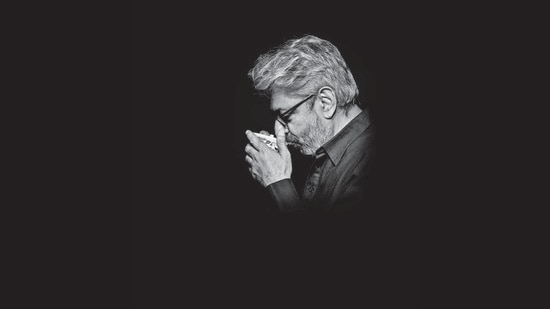
He’s probably the last of the old-style Bollywood movie moguls. As screens get smaller, stories more complex, and theatre audiences sparser and harder to please, it is possible that India will never have another movie-maker in the vein of Sanjay Leela Bhansali, 58.
Already, by the time Bhansali made his big splash with his second film, Hum Dil De Chuke Sanam, in 1999, it had been a while since Bollywood had seen his kind of extravagance and opulence. As he completes 25 years in the Hindi film industry, history remains his muse. Bhansali’s tenth film, Gangubai Kathiawadi, set for release this year, is the story of a powerful woman brothel owner with links to the underworld in 1960s Mumbai. The filmmaker is also working on first web series, Heeramandi, on Netflix, which is the story of three generations of courtesans in pre-Independence Lahore.
Both Gangubai Kathiawadi and Heeramandi could have been steps in a gritty new direction. But that wouldn’t be Bhansali. And this is what makes him such an outlier in the Hindi film industry: Bhansali makes the films he wants to make. His reference points are not what Gen Z wants, what millennials crave, or current filmmaking trends; his inspiration comes from directors like K Asif and Guru Dutt, films like Pakeezah, and actresses such as Meena Kumari.
Khamoshi: The Musical (1996), Bhansali’s first film, was an exception to most of his rules and did not work for the audience, but in most of his other works he has checked off the same boxes: major stars, operatic grandeur, obsessive detailing in the costume and art departments, memorable music and dazzling dance sequences.
His sensibility is old-world, so his films must almost necessarily be set in the past: Devdas (Shah Rukh Khan, Aishwarya Rai Bachchan; 2002) is based on Sarat Chandra Chattopadhyay’s 1917 classic novel of the same name; Bajirao Mastani (Deepika Padukone, Ranveer Singh; 2015) is about an 18th-century Peshwa and the woman he loves; Padmaavat (Deepika Padukone, Ranveer Singh; 2018) is a 13th-century story about a Rajput queen.
Even the legends that have built up around Bhansali are reminiscent of a world long gone. He’s supposed to have used over 1 lakh pieces of stained glass in the set for Paro’s home in Devdas, at a cost of ₹3 crore. The Aaina Mahal in Bajirao Mastani was supposedly made up of 20,000 mirrors sourced from Jaipur. If this is reminiscent of anything, it is the great K Asif and Mughal-e-Azam; legend has it that the set for the sheesh mahal in that film took two years to construct and was made up of thousands of pieces of glass imported from Belgium.
Checking off the same boxes from before, Gangubai Kathiawadi looks plain luscious. The trailer is lit up by lamps used once again to great effect, lots of white saris, impeccable make-up and pretty faces (Alia Bhatt plays the lead). Heeramandi looks set to have an opulent budget too; there’s already talk of exorbitant sets that will recreate pre-Independence Lahore in Mumbai.
But is there much of an audience for his kind of thing today? Is he pushing it with Baiju Bawra, a film in the works that is yet another tragi-romance in a royal setting? Ranbir Kapoor is said to have turned down the lead role saying the project will have restricted appeal.
The truth is, no one in the industry would probably have the nerve, or the inclination, to try and remake the 1952 Bharat Bhushan-Meena Kumari hit, set during the reign of the Mughal emperor Akbar. Or to attempt Heeramandi as “an ambitious, grand, all-encompassing” work.
Could this very steadfastness be the deftest evolution? If Game of Thrones has proved anything, it is that the spectacle is no longer the domain of the big screen. If Bhansali can make his brand of opulence work on a streaming platform, who knows? Perhaps the movie mogul will become the sultan of streaming.

 E-Paper