
 E-Paper



Rann Utsav: Art & culture comes alive in a salt desert

 Prefer HTon Google


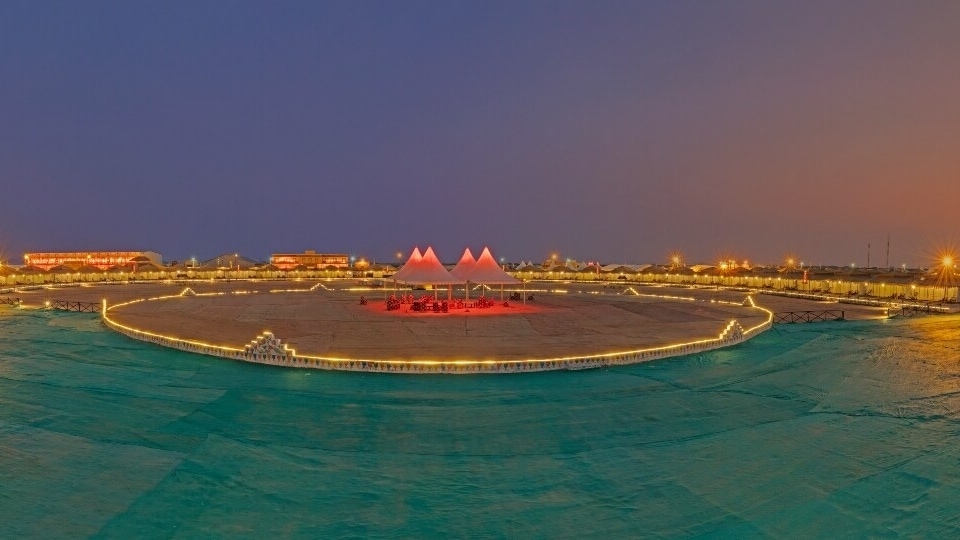
On until March 15, 2025, Rann Utsav is an unforgettable celebration of traditional art, craft & culture of Kachchh.
And who would have thought that a cancelled flight from Ahmedabad to Bhuj would turn into a 12-hour storytelling sesh. Of Rann of Kutch, the world’s second largest salt marsh (7,500 square kilometres) and coarse salt that drapes the arid desert in a white veil. Of Rann Utsav, the festival that started out as a two-day festival and grew into the famed 100-day celebration of local art and culture. Of Ahmedabad-headquartered Lallooji & Sons, the firm that first set up its tents in the 1921 Kumbh Mela and now every year pitches the country’s largest temporary tent accommodation during the Rann Utsav. And the fact that the word Rann translates into desert in Gujarati while the word Kutch derives from a local fable that the region’s map, if turned upside down, resembles kachchh, the Sanskrit word for tortoise. So many captivating tales on that long, knobbly road to Rann Utsav in Dhordo (Gujarat).
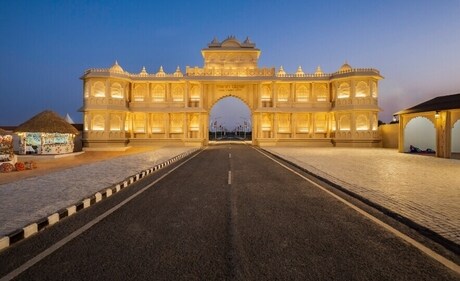
And who would have thought that the journey would end in a drive through a symmetrically-lit gigantic facade into the well-appointed Rann Utsav - The Tent City where the ground beneath the feet is sturdy, brown tarp; women in blue welcome guests with a tilak; the lavish buffet is laid in brass/copper utensils; and the dinner plates are handcrafted ceramic. In the ink-dark night, the glittery number plates of the tents add the luminescence of the stars. Inside the tent, there’s bespoke luxury. A four-poster bed with white curtains, red rugs on the floor, wooden chairs, a full-length mirror and pretty prints on the tent fabric. And no plastic. Not an ounce of it. The toiletries are made of bamboo and water is thoughtfully kept in clean glass bottles. In that quiet night, it is impossible to believe that the 100+acre Tent City sits in a desert that lies desolate and windswept before and after the Rann Utsav.
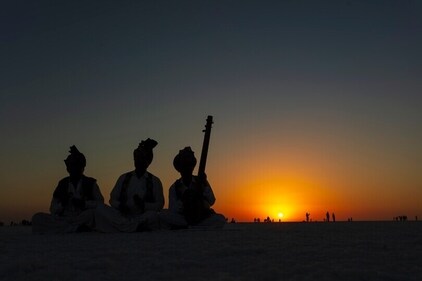
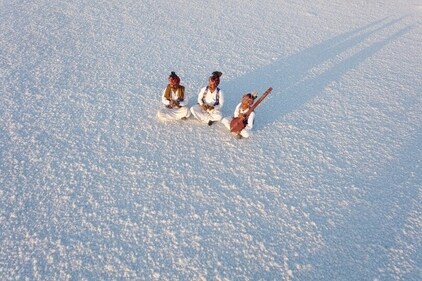
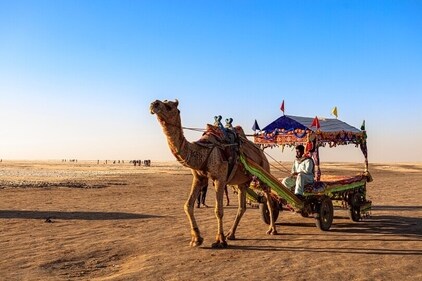
In the unending expanse of the salt marsh, during the Rann Utsav, there is nothing prettier than watching the sunrise and sunset- the burnished orange sun hurriedly waking out of its slumber in the morning and then lazily dipping into the white horizon every evening. The stark contrast of white and orange is surreal, I stood there mesmerised by this geographical munificence. The marsh is crowded with humans, a few spinning around in small all-terrain vehicles ( ₹300 for a few spins), a few others gyrating to loud music that shatter the quiet of a sleepy morning, and everyone else busy posing for selfies. In the milling crowd, I was perhaps the only un-photographed human. As the sun climbs up the sky, the land simmers with desert heat that can go up to 50 degrees Celsius during summer months.
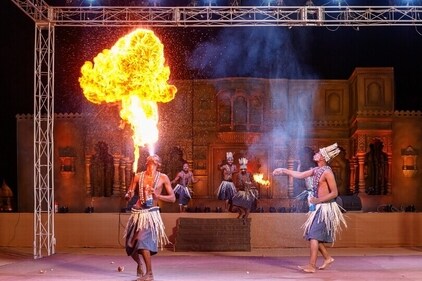
The Rann Utsav is at its glorious best after dusk but the day has an artistic excuse to head to Nirona village where the 400-year old Rogan art has been resuscitated by Padma Shri Abdul Gafur Khatri, the only family still practising the oil-based art-on-cloth. The sexagenarian with his sons still use the traditional method of rogan art (‘rogan’ in Persian means oil-based) and the demand has grown exponentially - during his visit to the United States, Prime Minister Narendra Modi had gifted a Tree of Life rogan art wall hanging to the then President Barack Obama.
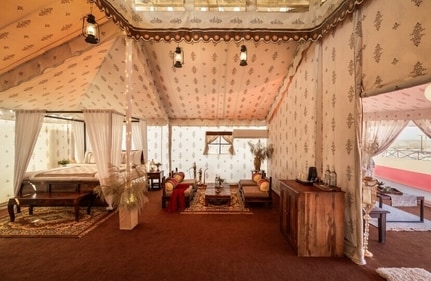
As night takes over the arid desert, the cultural activity area reverberates with the sound of traditional musical instruments and songs. There’s Sundari, a double reed wind instrument with 7 to 9 holes; Jodia Pawa, a pair of two flutes played simultaneously; Surando, an ancient stringed instrument; Ghado or Ghaghar, a clay arrhythmic instrument; and the unusual Nagphani shaped like a cobra. In the large shopping area, potters, block printers, sculptors, lippan artists demonstrate their skills and in the pretty kiosks temptations galore - from Ajrakh and Batik prints to famed Kucchhi embroidery, metal figurines, beaded earrings and necklaces, mojris, shawls, readymade outfits. To add more mirth and playfulness are men on tall stilts and men/women walking around dressed in fat doll suits.
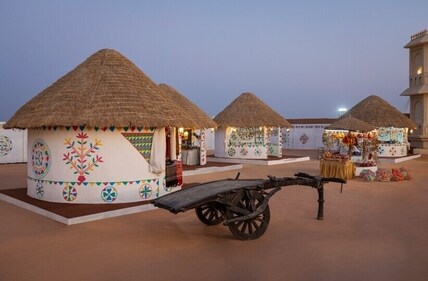
The night was chill but music was my refuge, between the notes there was a certain warmth. The night at Rann Utsav, however, wasn’t over yet. Not until one gazes at the stars in the utterly dark landscape. I returned to the Rann Utsav Tent City, lay on the four-poster bed and thought what Vincent van Gogh once said: “Be clearly aware of the stars and infinity on high. Then life seems almost enchanted after all.” In the salt desert, I was certainly enchanted by the inexhaustible salt marsh and the unending celebration of traditional art and culture.
Good to know:
Where: Rann Utsav is held in Dhordo, roughly 86 kilometres from Bhuj.
Best time to go: On a full moon night.
Getting there: There are very few direct flights to Bhuj. You can fly into Ahmedabad & take the flight to Bhuj (there is only one flight per day).
Nearest railway station: Bhuj.
Online Permit to visit the salt desert: Apply online at https://rannpermit.gujarat.gov.in/. Fee: ₹100.
Stay at Rann Utsav-The Tent City in Dhordo: Tariff starts from ₹10,000 per night (inclusive of all meals).
Early mornings & nights get cold, carry a jacket/shawl.
In the Rann Utsav Tent city shopping area, prices, in general, are fixed but you can try your bargaining skills.
Try local delicacies like Dabeli, Sev Tamatar sabzi, Baingan bharta and Gulab Pak.
Accommodation for Full moon nights get sold out quickly, book early.
All meals in the Tent City are vegetarian & buffet. Gujarat is a dry state, hence, sale/consumption of alcohol is strictly prohibited.
Visit Dholavira (2-hour drive from Dhordo) to see the excavation site of the Indus Valley Civilisation.


