
 E-Paper



The future of money: Kashyap Kompella on what’s next for this pivotal invention

 Prefer HTon Google


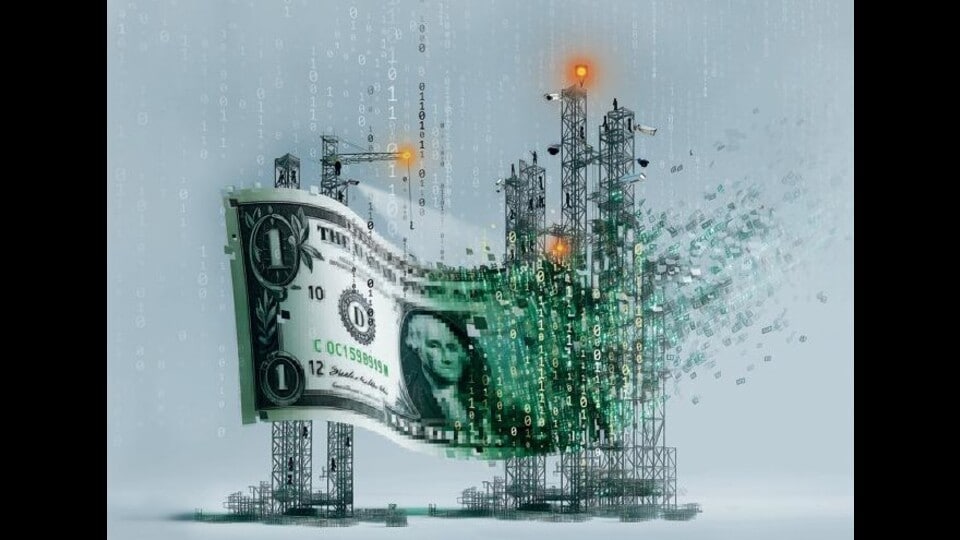
Expect its nature and role to change. As money becomes embedded with code, a core issue will be who decides where it goes, when it stops, and why.
What is money? Economists begin with function.
Money, they say, does three things: it lets us exchange goods and services, acts as a standard measure of value, and it lets us store value. A kind of economic Swiss Army knife, remarkably adaptable and endlessly circulated.
John Maynard Keynes saw money as a bridge between present and future. Milton Friedman warned that it could be a weapon in the wrong hands; that too much of it, too fast, would corrode a system. Hyman Minsky went deeper still: all money is a promise, he said, but not all promises are equal. Some come wrapped in the authority of the state, others in the credibility of a bank, still others in the brute fact of power.
Today, a hundred-rupee note doesn’t in fact represent a hundred rupees. It asks to be believed as such. What we call currency is a fiction wrapped in design: Microtext and hologram, watermark and thread, security and ceremony. We dress our illusions well.
Where coins offered a kind of weight and direct value, and the early notes were backed by metal (often gold), stored somewhere, safe and tangible, most currency is now backed by the heft of its respective state. By inertia as well, in a sense.
But really, in a world where money is mostly numbers drifting across invisible networks, what holds it up is our collective agreement. Consensus as collateral. Money is the most powerful fiction humans ever agreed to believe.
(Scroll to the bottom for more on how this works, and how we got here.)
The death of cash
Is it accident that most money now doesn’t even exist as paper? What does it mean that so much of the ritual and choreography around this asset is fading?
There was a time when one went to the bank to update a passbook, and to an ATM to withdraw the notes. Money still had a place, a shape, a texture.
More and more, today, it doesn’t.
Cash, we are told, is the past. It is eulogised in policy memos and start-up decks. Replaced by cleaner, smarter tools; contactless, compliant, optimistically frictionless.
It persists, in temple donation boxes, in wedding envelopes, in the shadowy portions of real-estate payments. It lives in private safes, in the seams of sari blouses and under mattresses. It survives in the folds between trust and traceability.
It neither asks its user’s name nor logs their location. It holds no record of where it has been. But for how long?
Secret gardens
In the mythology of Silicon Valley, every system is just a feature waiting to be rebuilt: as faster, more frictionless, more easily monetisable. Money is no different.
Here, the goal has become focused on erecting walled gardens to enclose wealth and spending.
Capture the interface, own the flow. Build platforms that draw money in, and then design ways to keep it there.
It’s the Starbucks Rewards scheme, on a global scale. Already, expanding ecosystems of this kind have been built by Google, Apple, Amazon and others. For the user, the promise is a smooth, unified experience (and small benefits for staying with the walled garden).
For the tech company, the potential is massive. If a salary is eventually disbursed onto a platform and spent within that platform, in tokens or credits or points, does it matter (to the owner of the platform) whose name is on each token as it changes hands?
The real revolution, however, will be driven by those who have been carefully watching.
Early experiments in these walled gardens have shown governments — ie, the powers that create, regulate and oversee the money actually driving it all — what is possible and what will be embraced. Which brings us to…
Money with a mind
Imagine a coin that knows what it’s for. A welfare payment that refuses to be spent on alcohol. A currency that reports to headquarters, quietly, after every transaction.
This isn’t science-fiction. These are the traits or potential traits of central bank digital currencies. These are being rolled out as test cases around the world, in countries ranging from China and Nigeria to Jamaica and India.
This is programmable money; essentially, money with a mind.
If it becomes widespread, for the first time in history, standardised promissory notes will no longer be silent, disinterested participants in a transaction.
Governments could target subsidies more precisely and monitor corruption in real time.
They could also automate compliance. Economic policy could be deployed like code: live, granular, conditional.
The implications, of course, are enormous. This kind of currency could serve as a direct tool of control. The lines between incentive and instruction, governance and surveillance, public and private, could blur.
Programmable money would turn spending into a performance that is constantly logged and evaluated. Unlike cash, this money could also be remotely controlled.
In one possible scenario, a dissident isn’t placed under house arrest; their credits are simply erased. And compliance becomes a hushed imperative.
Parallel tracks
In a strange twist, cryptocurrency — born of rebellion against the absurdities of hyper-capitalist definitions of money, and the excessive control wielded by governments through it — laid the groundwork for money with a mind.
Bitcoin, the world’s first such currency, was born in 2008, in the wake of the global financial crisis. If so much of the world’s money was fiction to begin with, and could simply evaporate because it had no true inherent value, then why could a new kind of currency not improve on this with ideas of its own (such as limited supply and far greater transparency), it argued.
Bitcoin began to be “mined” in 2009, generated as a fee or reward for using powerful computers to solve complex math problems.
But hyper-capitalism claimed this revolution too. As it gained in value, it lost its claim to rebellion. Hype made it speculative and volatility made it impractical. What had been pitched as the people’s money became one more asset class.
As more cryptocurrencies emerged, creating, securing, and transferring value without state intervention or control, the empire took note.
Governments began planning centralised digital currencies.
(In a final signal that this particular revolution has been co-opted, American government agencies are now considering using Bitcoin-backed instruments to shore up and diversify pension-fund portfolios.)
The future of us
For years, the future of money has been framed as a contest of forms. Would cash survive? Would the dollar be dethroned? Would we eventually pay via thumbprints, retinal scans, barcodes embedded in skin?
These are interesting questions, but not the most important ones. Because the deeper shift isn’t about form. It is about access.
In a world where money is programmable, traceable, and conditional, the critical questions will be: Who decides how it is used? And: Who will be watching, each time you swipe?
Now, the old order had problems. It leaked, it excluded, it corroded and enabled hoarding, laundering and loopholes. The new order seeks to fix some of this. But what it fixes, it also redefines.
We began by asking what money is. We end with something harder: How will it change us this time?
Because money is never just money. It is infrastructure for belief. It is how a society encodes obligation. How it decides what counts, who counts, and on what terms value can be held, moved, withheld and erased.
When code replaces the coin, when your account becomes your identity, we are no longer redesigning currency. We are redesigning control, compliance and consequence.
Yes, cash may survive in the cracks. The dollar may hold its seat a while longer. Cryptocurrencies may mature. But these are surface questions. The deeper shift is this: money is fusing with code, and code is never a silent participant.
What we are building is not just a new financial system. It is a new moral architecture. One where every choice — by government, by company and by user — carries the weight of a rule once debated in public.
The future of money is not a question of coins vs notes vs ledgers. It is the future of trust. The future of access. The future of power. Which is to say: the future of us.
(Kashyap Kompella is an industry analyst and author of two books on AI)
.
A TIMELINE: How our money came to be
Coins have a long history that overlaps with ideas of barter, soft power and annexation. So, the story of money for money’s sake really dates to the earliest forms of non-metal currency: standardised promissory notes.
* 118 BCE: The Chinese empire takes its first steps towards lighter, more representative money by issuing tokens or promissory notes on leather.
* 1000 CE: In Sichuan, as trade booms, strings of coins are becoming too bulky to haul around, so black-and-red mulberry-paper receipts begin to be used instead. Sixteen merchants are awarded the right to issue these, and the government ultimately takes over, issuing the world’s first fixed-denomination banknotes.
They are essentially backed by bullion; a trader needed to hand over strings of coins and take an equivalent note in return. These notes could then circulate until someone returned to the merchant-banker to claim the corresponding coins. Of course, soon enough the notes are doing the rounds without the coins themselves being moved at all — and money was born.
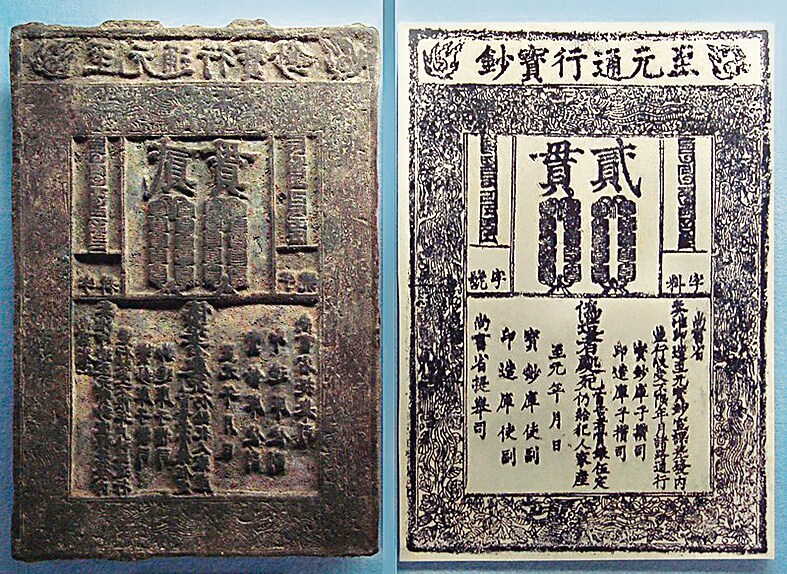
* 1200s: Central and western Asia took to the concept readily. Fast-forward 200 years and the Mongol emperor Kublai Khan has helped spread paper money all the way to Persia. But the concept baffles Europe. Those reading about paper money in Marco Polo’s travels think it so preposterous, they wonder if he’s making it up.
* 1294: The Persian city of Tabriz experiments with paper money of its own but issues too much of it, sending the trading port of Basra into financial ruin.
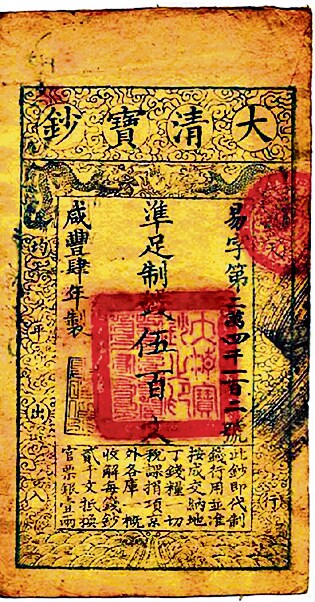
* 1455: The Chinese goof up too. Their over-production of paper notes devalues their money. Paper money is eliminated at this point, and will not return for centuries. Currency reverts to metal.
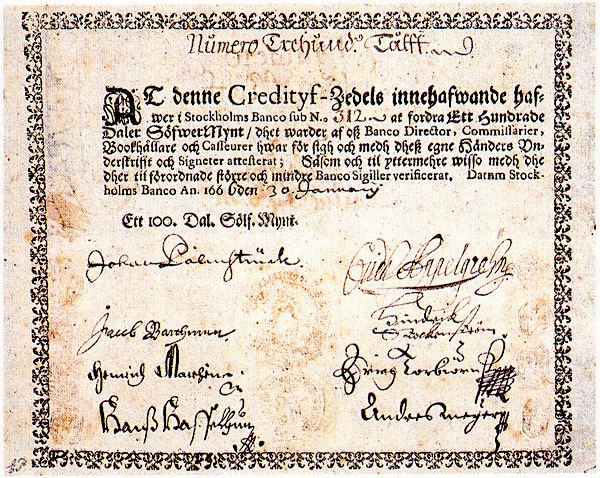
* 1661: Dutch entrepreneur Johan Palmstruch, who founded the Stockholms Banco in collaboration with the Swedish government, introduces kreditivsedlar or credit notes. They come in set denominations, are watermarked, bear a date of issue, bank seal and eight banker signatures. They are a hit. But they issue too many too and the bank is liquidated.
* 1694: England learns from Sweden and sets up the Bank of England to issue Pound Sterling notes to help fund a war with France.
* 1700s: Banks are appearing across the colonies. Currency notes are circulated within banking regions. For the public, it is a convenient and safe way to move money around. For the banks, it creates wealth from thin air – banks are permitted to print as much as 1/3rd more notes than they have coins in reserve.
* 1792: Following the end of the American War of Independence in 1783, the US dollar is declared the country’s official currency.
* 1700s to 1900s: Given how much of the world Great Britain controls, it is no surprise that the Pound Sterling is the default global currency.
* 1944: World War 2 is devastating Britain. Its empire is shrinking at the same time. The US, meanwhile, is now the world’s most stable economy. Amid acknowledgement that the Pound Sterling will need to be replaced as the world’s reserve currency, 44 allied countries come together to sign the Bretton Woods agreement.
It fixes a rate of exchange for all foreign currencies against the US dollar, with the US promising, in theory, to back every dollar transaction using its vast reserves of gold. (Interestingly, it has shored up much of this gold as a result of trade surpluses during the two world wars.) The gold-backed dollar remains relatively stable, allowing other countries to back their currencies with dollars rather than gold.
In order to back a currency with dollars, of course, one must have dollars. This creates an entirely separate revenue stream for the United States, turning US treasury bonds into one of the most powerful debt instruments in the world. Governments buy the bonds on the promise that the US can swap them for dollars at any time. They then use the bonds (plus actual dollar reserves) to keep their economies stable.
* 1971: US President Richard Nixon delinks the US dollar’s representative value from the country’s gold reserves. This is essentially a tacit admission that the economy has grown so large that there isn’t enough gold in the world to back it with. Money as a social construct has entered a new phase.
What does back the dollar now? Trust and goodwill, partly. As well as the understanding that US economy can generate enough revenue (through the direct sale of goods and services, and through taxes and debt) to keep the still-growing system from imploding.
But perhaps the most powerful thing keeping currencies today from crumbling is the quiet social contract by which we all agree not to look directly at the numbers, so as not to see them for the mirage that they, sort of, are. Instead, our system is backed by the idea that as long as the wheel keeps turning, the wheel will keep turning.
.
WHEELS WITHIN WHEELS: How much of our money is ‘real’?
What does it really mean that most currency is no longer backed by gold? That isn’t even really the question. The real question is: How much of our money is “real”?
And the answer is: It is impossible to say.
For instance, let’s say that you put ₹1 lakh in the bank. The bank uses it to issue a loan to a customer. That money is now in two places at once.
The customer who took the loan uses it to buy things; the person he pays uses it again. The money is now in multiple places at once. And that’s not even accounting for how much of the original ₹1 lakh was “yours” to begin with.
Anti-capitalists view this system as absurd, and it was partly as a mark of protest against this absurdity that Bitcoin was born. It was marketed as a fresh slate; anyone could get rich; there was no legacy wealth. Could it become the money of the future?
It turned out, of course, to be simply another social construct, entangled with those that came before it: money, legislation, security, adoption, legitimacy.
The idea of cryptocurrency has since become woven into the idea of centralised money.
There has been periodic talk of post-money economies replacing the tangles of today. It is wholly unclear what they would look like, or what kind of world we would need to build in order for them to work.
For the moment, then, money remains the most stable means of exchange, if not the most just or logical. Just as elections remain the most stable means of governing large populations.
Could a change be coming? It almost certainly is. The story of money, of societies, of people, after all, is just an endless unfolding of old to new.


