
 E-Paper



Tick talk: Rachel Lopez takes a trip through time, as IST turns 120

 Prefer HTon Google


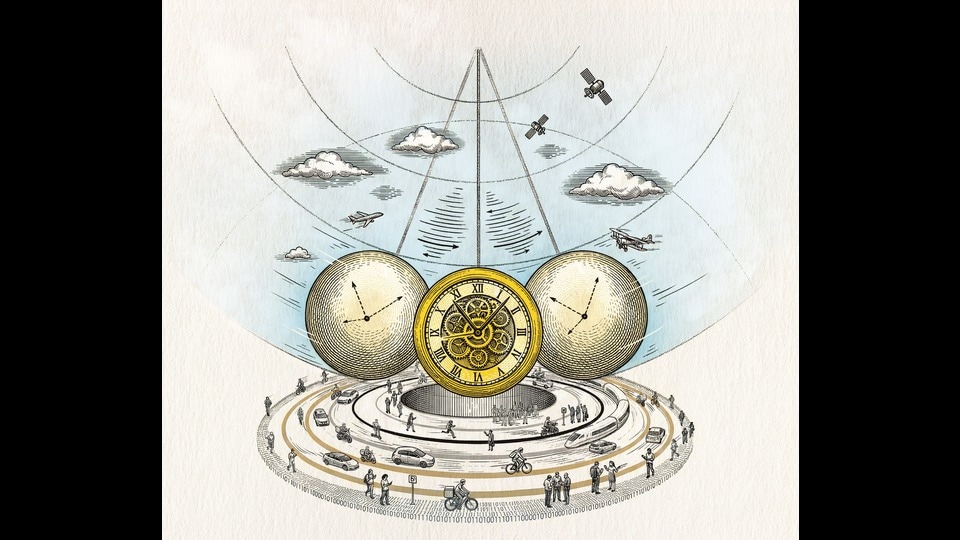
For much of history, we lived happily without clocks. From there to atomic timers and zeptoseonds, see where things stand – and how they look set to change.
Milestone alert! January 1 marked 120 years of the adoption of Indian Standard Time.
For anyone whose eyes quickly darted to their watch, it means that our national clock — five-and-a-half hours ahead of London, three-and-a-half hours behind Tokyo, and a full fourteen-and-a-half hours ahead of Alaska — has been in use since 1906. Midnight at 01-01-1906, to be precise.
And being precise is exactly the point. Because what is time, really? We wake up when the alarm rings; not when the sun rises. In much of the world, it’s noon when the clock says it is; not necessarily when the sun is overhead. The sun is still at the centre of the solar system. But modern life revolves around the clock.
It might look elegant: hours, minutes, seconds, and time zones falling neatly into place. But it is an artificial imposition of order on the natural day. It’s why timekeeping involves so much manipulation: Daylight savings; Eastern Standard and Mountain Standard; microseconds and nanoseconds (as you’ll soon see).
It is a concept shaped as much by math as by science, religion, colonialism and power.
We believe in overtime, ETAs, New Year’s Eve countdowns and that our Zomato order is 11 minutes away. We fight over the right to such belief too. We did it in 1906, when colonial India adopted IST. Today, 120 years on, the fight has changed.
SECOND OPINIONS
“We’ve always lived with time, we just utilised and measured it differently,” says historian Shekhar Krishnan.
For much of our history, India did fine without clocks. A new day began at sunrise. The positions of the stars pointed to auspicious days in the year. All time was local time. If one took a long journey (and very few did), one simply followed whatever the hour was at one’s destination.
For a village, a town or a princely state, this was enough. But for a foreign power whose colony stretched from present-day Pakistan in the west to Burma in the east, it just wouldn’t do. British India’s vast rail network, for instance, could only function if trains left and arrived on a schedule everyone understood. By 1884, after London’s Greenwich became the internationally agreed-upon zero-degree longitude, two zones were established for India: Bombay Time (BT) and Calcutta Time. The trains followed Madras Time, a convenient intermediate.
For a while, this worked. But in a world of growing financial and trade complexities, where time was money, the calculations constituted needless risk (and involved far too much math).
“Colonisation was built on the idea of order: transport, measurement, records,” Krishnan points out. Synchrony was vital. It meant control. Control meant power.
The British decided that India needed to set all its clocks to the exact 82.5° E longitude that aligned with the +5.30 mark. It turned out to run through Mirzapur, east of Allahabad. And so, in 1906, the British ushered in the change: a new central meridian for the colony, a unified time to rule them all.
Or at least, they tried.
UNDER WATCH
The adoption of Indian Standard Time came at a fraught moment. George Curzon, viceroy of India, had partitioned Bengal the previous year, creating a Muslim-majority East Bengal and Hindu-majority West Bengal. It was described as an administrative exercise. Indians saw it for what it was: A way to weaken India’s growing sense of nationalism.
Opposing centralised British timekeeping became part of the resistance.
Centralised institutions ran on IST, but a number of private institutes and business in Calcutta kept to old Calcutta Time. In Bombay Presidency, a full 39 minutes behind, there was even greater reluctance to shift. It was as much about patriotism as prestige.
“Bombay already dominated, with money, with business and real-estate. It understandably wanted to be in charge of its own time,” Krishnan says.
When mill owners adjusted the clocks from BT to IST, workers rose up in protest. About 4,500 mill workers went on strike. No one wanted to toil by electric light. The protest turned violent; a mill clock was smashed. But they got their way. Mills across the city ran on BT.
Dual time-keeping became a measure of one’s politics.
“The clock at Bombay’s Victoria Terminus would show IST, the one across the road at the Municipal Corporation headquarters would show BT,” Krishnan says. Invitations to official events cited one or the other, leaving guests to work out whether they were early or late.
This went on for 44 years. While Calcutta adopted IST in 1947, Bombay held out until 1950.
STRETCHING TIME
All of India follows IST today, which makes the nation’s timekeeping both uniform and uneven.
India’s borders stretch nearly 3,000 km from east to west. This means that when Indians in Dong Valley, Arunachal Pradesh, see sunrise, the clock shows 5.25 am, and the sun sets there just after 4 pm. This is a whole two hours earlier than the average sunrise and sunset times in the country’s westernmost point: Guhar Moti in Gujarat.
Across the country, millions either wake up when it’s too dark or go to bed out of sync with daylight because everyone follows the same clock.
There have been attempts, since the 1980s, to introduce either regional time zones or US-style daylight-savings calendars. Neither has met with much success. India remains a time-zone rebel, along with China, Argentina and Brazil, all large countries under a single clock. Russia, in contrast, has 11 time zones.
Maulik Jagnani, assistant professor of economics at Tufts University in the US, has conducted studies on how living out of sync with daylight can affect sleep cycles and productivity. It might be complicated to introduce different clocks across the country, this many years in, he admits. “Perhaps a more realistic policy response would be flexible work and school schedules so people can adjust their sleep and wake times,” he says.
Assam tried. In 2014 the state government set its clocks an hour ahead of IST, in a bid to boost productivity. But last year, the government made IST mandatory across financial markets, power grids, telecommunications, transportation and commerce, to ensure fairness, accuracy and national security.
LEAP FORWARD
On the ground, timekeeping remains political. But zoom out enough and all timekeeping becomes tricky. Gears wind down and batteries run out. Even Earth’s rotation has slowed, and days have got quite a bit longer. (About 600 million years ago, for instance, a day was 21 hours long.)
Since 1972, leap seconds have occasionally been added to Coordinated Universal Time (UTC), so atomic clocks can stay aligned with the planet’s spin. We’ve added 37 already; the last was in 2016.
More-precise timekeeping, using atomic clocks (turn to the story alongside for more on how these work), reveals what else is askew. “Yes, our planet’s rotation has been slowing over the long term, but we’re finding that it has also sped up in the short term,” says Poonam Arora, senior principal scientist and head of the Indian Standard Time Metrology Division of the National Physical Laboratories (NPL) in Delhi. This means having to drop a second, every once in a while, a move that rattles computer systems and multinational businesses alike.
The practice is set to be stopped after 2035. How might we figure out the time then? It’s complicated enough that no one entity can call the shots anymore.
Arora says we’ll move from control to consensus. We’re halfway there already. Atomic clocks worldwide — there are about 450 of them — contribute time data to create a weighted average that makes up International Atomic Time (or TAI, from the French Temps Atomique International). “It’s a joint effort by every country with an atomic clock to contribute to our recognition of time,” Arora says.
We’ll draw on that consensus even more soon. Optical clocks, far more accurate that the atomic ones, have already shaken up timekeeping records. “Scientists are working towards redefining what makes up a second – a standard that was set in 1967,” says Arora.
They expect to work it out by 2030. You’d best set your alarm and wait.


