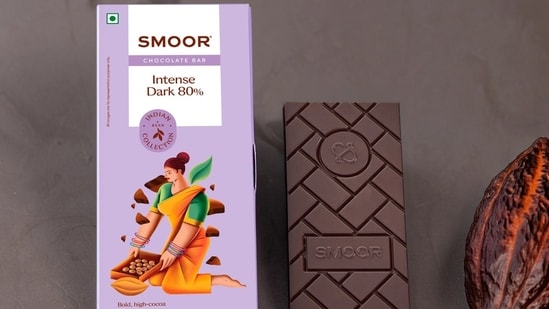
Dark chocolate is making waves in the health and wellness space, especially as more people turn to it as a way to satisfy their sweet cravings. However, what often confuses consumers is the cocoa percentage listed on the label. What do 70%, 85% or 90% actually mean, and does a higher cocoa percentage necessarily make the chocolate a better choice? Understanding these numbers can help you make a more informed pick the next time you reach for a bar. In an interview with HT Lifestyle, Vimal Sharma, founder and CEO of SMOOR, explained the difference between varying cocoa percentages.
Also read | The internet says dark chocolate is healthy, but is every bar actually good for you? Dietitian explains
Difference between 70%, 85% or 90% dark chocolate
A 90% bar sounds more sophisticated than an 85% one, which sounds more serious than 70%. Vimal Sharma highlighted that cocoa percentage is not a quality score. It is a measure of composition, and understanding that distinction is essential to understanding chocolate. Broadly, the percentage represents the proportion of cocoa-derived ingredients in the chocolate, with the balance typically coming from sugar and other ingredients.
“As the number rises, sweetness generally decreases, and the inherent character of the cacao becomes more pronounced. But that is where the simple hierarchy ends. A beautifully made 70% chocolate can be far more expressive and balanced than a poorly formulated 90%,” explained Vimal Sharma.
How does cocoa percentage matter?
{{/usCountry}}“As the number rises, sweetness generally decreases, and the inherent character of the cacao becomes more pronounced. But that is where the simple hierarchy ends. A beautifully made 70% chocolate can be far more expressive and balanced than a poorly formulated 90%,” explained Vimal Sharma.
How does cocoa percentage matter?
{{/usCountry}}“What matters beyond the number is what has gone into creating that percentage,” said Vimal Sharma. Cacao is not a uniform raw material. Its flavour is influenced by origin, variety, fermentation, drying and roasting, before the chocolatier even begins formulation. Then comes the balance between cocoa solids and cocoa butter. Cocoa solids bring much of the flavour, aroma, acidity and bitterness; cocoa butter contributes to texture, melt and mouthfeel.
Vimal Sharma highlighted that couverture chocolate, where a higher proportion of cocoa butter enables the fluidity, shine and precise melting behaviour required for tempering, moulding and confectionery. A serious chocolate conversation therefore cannot stop at asking whether a bar is 70%, 80% or 90%. We should also be asking: what cacao is being used, how has it been treated, and what has the maker done to preserve and express its character?
How does the taste change with the cocoa percentage?
“For consumers, I would think of percentages as different points on a flavour spectrum rather than a ladder of superiority,” said Vimal Sharma.
Around 70%, there is often enough sweetness to make the cacao approachable while allowing its personality to come through. Move towards 80% and beyond, and the chocolate becomes increasingly dependent on the quality of the cacao and the precision of the formulation. At the higher end, there is nowhere for excessive bitterness, acidity or astringency to hide.