
 E-Paper



From 71kg to 63kg: Switching from a regular plate to a section plate helped me control portions and lose weight
After years of workouts with little change, a simple section plate method helped me to control portions, reduce cravings, and lose 8kg. Here's my journey.

 Prefer HTon Google


Our Picks
FAQs
Our Picks
| Product | Rating | Price |
|---|---|---|
JEE ALTO 20 Gauge Heavy Duty 4 in 1 Stainless Steel Kitchen and Dining Rectangle Compartment Divided Plate/Thali/Mess Tray Set, 29 x 25.5 x 2.5 cm, Silver_Set of 1View Details  | ₹690 | |
 | ||
URBAN KRAFT 8in1 Stainless Steel Plates with Compartments Pack of 6 / Big Bhojan Thal | Partition Plates Set of 6 for Lunch & Dinner - Extra Deep Mess TrayView Details | ₹2,399 | |
| ||
MARU Stainless Steel Dinner Partition Plate Set of 4 - Durable & Large 3-in-1 Section Compartment Plates, Ideal for Pav Bhaji, Breakfast, Lunch & Dinner – Heavy Duty & Easy to CleanView Details | ₹839 | |
| ||
Sharda Metals Stainless Steel Rectangular Compartment Thali Plates | 5 in 1 Divided Partition Bhojan Mess Tray | Durable Lunch and Dinner Serving Plates for Indian Kitchen | 13 x 10 Inches - Set of 6View Details | ₹1,199 | |
| ||
MESHIV Stainless Steel Plates with Compartments for Lunch/Dinner/Kids Plate Set of 1 (Small for Kids)View Details | ₹199 | |
| ||

Research-Backed Choices
Every product we recommend is chosen through a combination of Primary Research and Secondary Research.

At 71kg, I often felt sluggish and very uncomfortable in my own body. The strange part is that I was not someone who avoided exercise. For the past five years, I had been fairly consistent with movement. Four of those years were spent practising Hatha yoga. The last year involved regular gym sessions with a personal trainer, and somehow, the change was never visible The scale barely moved, and I would occasionally lose an inch or two, feel encouraged for a few weeks, and then the bloating would return. The cycle kept repeating. And the frustration with my own body led to a lot of attempts at crash dieting and failing.
My meals looked structured on paper. Three proper meals a day, mostly home-cooked. But the real issue sat quietly in the background. What I had been severely ignoring was portion sizes and proportions. Then, a very simple idea came up during a late-night conversation with “Chat GPT” about my food habits. Portion control using a section plate.
The funny part is that these plates were already in my kitchen. My kids used them every day because they were easier than juggling a plate and several bowls.
Four months later, I am at 63kg. The biggest shift came from one simple realisation that the transformation does not come from eating less food. It comes from eating the right proportions.
The problem with eyeballing portions on your plate
For years, I trusted my instincts when serving food. If the meal was homemade and reasonably balanced, I assumed the quantity would sort itself out. But reality works differently.
Large plates and open bowls make it very easy to keep adding just a little more. A scoop of rice becomes two. Pasta quietly multiplies in the bowl. I even tried calorie-tracking apps for a while. They worked for a few days, and then the constant logging in and snapping photos before very meal became tiring. A section plate removed that entire mental load. The boundaries were already there in front of me. No counting. No measuring. Just a clear visual reminder at every meal. This has made my daily lunch a very easy meal. Effortless portion control, thanks to the section plate, has just made it a no-brainer and ensured I eat smarter.
Breaking down the plate
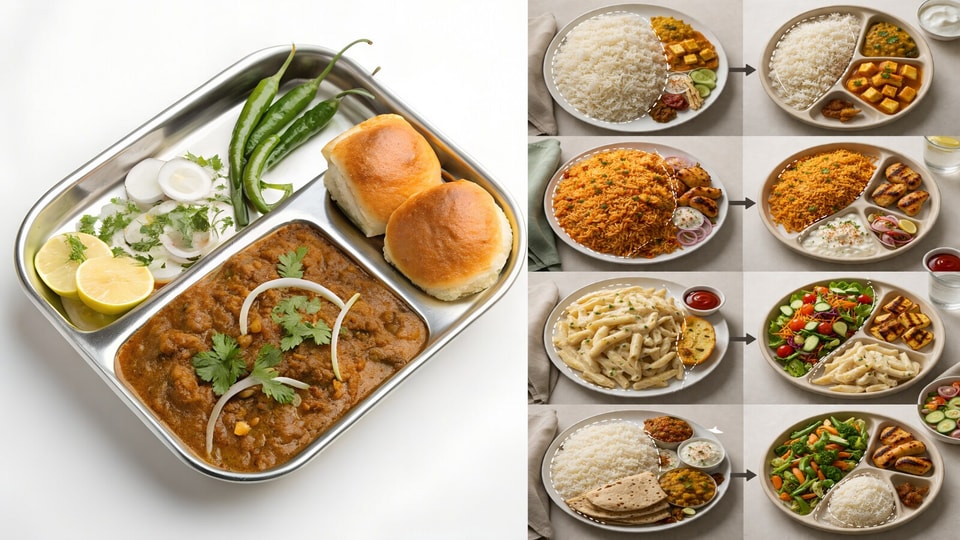
My section plate system did not begin perfectly. In the early days, the largest section was still filled with rice. Old habits take time to adjust. Gradually, after far too many late-night doom scrolling through portion control content, I started shifting the proportions. Today, the plate looks very different.
• Half the plate for fibrous vegetables
This is now the largest section. Think sautéed beans, broccoli, cabbage, carrots, cucumber salads or any vegetable that adds volume and fibre.
• The second largest section for carbohydrates
Rice still appears on my plate regularly. I never removed it. The difference is that it now sits in a defined space instead of quietly taking over the entire meal.
• Smaller sections for dal, protein and extras
These sections usually hold dal, condiments and sometimes protein such as paneer, chicken, eggs or lentils.
• An unexpected side effect
My cook noticed the shift before anyone else. She joked that our household rice consumption dropped by half once I stopped serving it generously.
Without any complicated calculations, the plate has naturally created a better balance between fibre, protein and carbs.
My four-month timeline
| Phase | What changed |
| Month 1: The adjustment | The first few weeks were about retraining my eye. Portions that once looked normal suddenly seemed excessive. There was also the usual early drop in water weight once carb-heavy plates were reduced slightly. |
| Months 2 and 3: The rhythm | This phase felt surprisingly smooth. Clothes began fitting better, and my energy during the day felt far more stable. The biggest surprise was cravings. As fibre and protein increased and carb-heavy portions reduced, the constant urge for junk food faded, and meals felt far more satisfying. |
| Month 4: The goal | By the fourth month, the scale showed 63kg. More importantly, the plate had quietly become a habit. I no longer thought of it as a diet trick. It simply became the way I served food every day. |
Practical tips that helped me stay consistent
Respect the plate boundaries
A section plate works only if you avoid piling food vertically. The sections exist for a reason.
Start with vegetables
Many meals begin with the vegetable portion. That fibre signals fullness earlier and slows down the rest of the meal.
Apply the idea outside the home
Restaurants obviously do not serve section plates, so I follow a simple routine. I start with a large plate of salad. That part is non-negotiable. After that, I pick either a starter or a main course instead of both and focus on protein options like paneer or chicken.
Stay hydrated
Water plays a quiet but important role. Proper hydration makes meals more satisfying, and random snacking drops.
The psychological shift
The most surprising change has been mental. Carbs still have a designated space on my plate, so there is no anxiety around eating rice. Food now feels balanced instead of restrictive. I look at the plate and see vegetables, protein and carbs sitting together in sensible portions. Once that balance became routine, cravings dropped naturally and eating felt easier and less about taste in quantity and more about enjoying the little bites.
The 8kg weight loss happened over four steady months through consistency and simple structure. I cannot subtract the contribution of a regular workout plan from just eating right. You cannot remove one part of the equation and help the other to work, which, in my case, over the last five years, has shown that simply working out was clearly “not working out”. A section plate created boundaries that my habits clearly needed. If you feel curious, try this for just one meal a day and see how it feels.
Sometimes, the simplest changes create the biggest shifts.
Similar articles for you
Ramen bowls that are cute and perfect for slurping your noodles from; 8 picks I absolutely love
Cushion covers to brighten up your rooms this summer; My top 8 picks
Office chairs with lumbar support: Understanding why this is important for your back
Switched my armchair to an ergonomic office chair: Changed how I work from home
Disclaimer: At Hindustan Times, we help you stay up-to-date with the latest trends and products. Hindustan Times has an affiliate partnership, so we may get a part of the revenue when you make a purchase. We shall not be liable for any claim under applicable laws, including but not limited to the Consumer Protection Act, 2019, concerning the products. The products listed in this article are in no particular order of priority.
Catch your daily dose of Fashion, Taylor Swift, Health, Festivals, Travel, Relationship, Recipe and all the other Latest Lifestyle News on Hindustan Times Website and APPs.


