
 E-Paper



Japan’s Yoga connect

 Prefer HTon Google


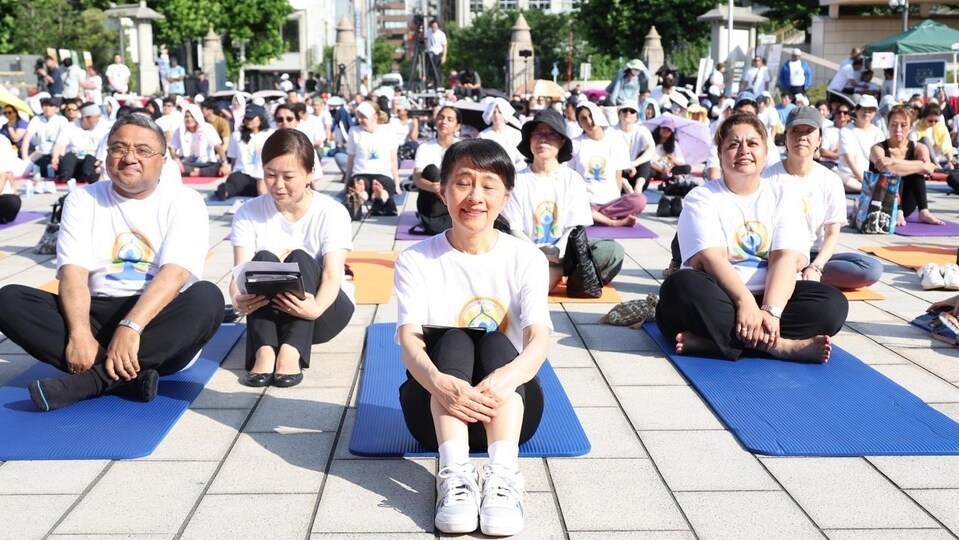
Like India, yoga in Japan is also not just a physical exercise, but one of participation in a spiritual culture that has a long tradition and history.
The Japanese way of life has had the wonderful gift of assimilating new ideas in its own way and making it distinctively Japanese. The Meiji restoration of 1871 inaugurated the epoch of Japanese modernisation. But Japan never borrowed wholesale from the west. It preserved its own essence or kakutai even while following the path of Fukoku Kyohei (‘rich country strong army’). The Japanese zaibatsus powered rapid industrialisation and technological innovation without adopting the western ideas of management. Japanese have always been conscious of their eastern inheritance and valued the ties that they have shared with India. The passion Japanese have developed for yoga and the way they have added unique Japanese elements to this method has turned Japanese yoga into a national phenomenon that has become an essential routine for many Japanese men and women.
While Kipling spoke of ‘East is East and West is West’, it is within Asiatic cultures that we see ideas and practices moving in such a way that they create a cultural bridge connecting them for all times to come. Swami Vivekananda and Rabindranath Tagore were great admirers of the Japanese way. Okakura Tenshin, the great Japanese artist had met both and spent much time in Tagore’s Shantiniketan bringing Japanese aesthetic principles into Indian art and architecture. Okakura’s vision for a unified Asia, based on shared spiritual values and art aimed to counter Western materialism. Today this vision finds its realisation in yoga that has become a way of life in Japan.
The history of yoga in Japan is also linked with the influence of Buddhism on the Japanese way of life. At different times, a variety of schools of Buddhism made their way into Japan, some through China, some via Korea and some directly from India. Among these schools the one which became most influential has been Zen Buddhism which entered Japan through China. Such quintessential Japanese cultural pursuits like the tea ceremony, gardening, and calligraphy owe their significance to Zen Buddhism which has deeply influenced the Japanese outlook. Zen masters placed great emphasis in harmony with nature and harmony within mind that has greatly facilitated the assimilation of yoga in Japanese society. Shintoism with its love for nature has also been very helpful in bringing yoga into the hearts and minds of the Japanese people.
The yoga that has become highly popular in Japan draws a lot of inspiration from nature. It follows the rhythm of nature. Yoga in summer is different from yoga in winter. Different body parts become the focus of yoga in a slow paced and meditative exercise that is deeply rejuvenating. There are four core principles of Japanese yoga: (a) positively use the mind, (b) use the mind with full concentration, (c) use the body naturally and (d) train the body systematically. Like in India, yoga in Japan is also not just a physical exercise, but one of participation in a spiritual culture that has a long tradition and history.
It was in the early 19th century that Japanese martial artist Nakamura Tempo developed the modern form of Japanese Yoga, which he named Shinshin-toitsu-do or the unification of mind and body. Harnessing the flow of energy through the different meridians of the body to achieve mastery over the mind is the central aim of this form of Yoga. Positive affirmations, self-healing and meditation are of key significance for the yoga practitioners in Japan. Deep and controlled breathing, self-awareness, stillness and keeping a pose for longer duration while utilising earth’s gravity are some of the key techniques in this form of Yoga. However, over the time different trends in yoga have caught different minds hankering for a quality time with themselves. In the 1950s Oki-do formulated by Masahiro-Oki was very popular. Younger practitioners are much attracted by power yoga that combines brisk exercise with meditative yoga.
The International Association of Yoga Therapists estimate that approximately 1 per cent of the Japanese population (between 500,000 to one million people) are yoga practitioners. There is a booming business of Yoga studios and clubs in Japan that offer conducive settings for the yoga enthusiasts. There are over 20 yoga organisations in Japan that are active in promoting the culture of Yoga. While Japan has a large ageing population its younger demographic segment is known for its fast-paced life and a zeal for incessant work. For both these groups yoga offers multiple benefits that explains why it has become such an important part of Japanese society.
Prime Minister Narendra Modi has visualised a new era of cooperation between India and Japan with metaphoric and visionary appeal for bringing Kyoto and Varanasi closer, the centres of spiritual cultures in both countries. His recent visit to Japan has forged deeper ties between the two Asiatic cultures making Shinshin-toitsu-do an apt symbol of unification of Indian and Japanese genius in a world that is faced with immense challenges of conflicts and instability.


