The 2019 Odisha outcome will be remembered in Indian political history. This is not just because Naveen Patnaik has scored his fifth successive win. This is also not because the Bharatiya Janata Party (BJP) has jumped from winning merely one seat to eight in a matter of five years.
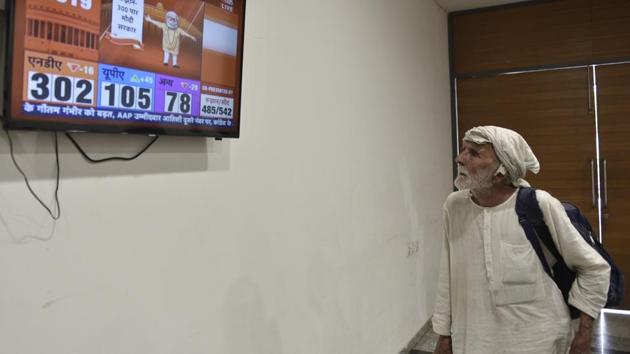
It is because in the same state -- one of the most marginalised in the country on social and economic indicators -- voters have displayed a remarkable degree of political understanding. They voted differently in Lok Sabha elections and the state assembly polls.
Back in January, in Bhubaneshwar, or Kendrapara, a seat the BJP eventually lost, many voters praised the CM for his welfare schemes, but the same voters suggested that while Patnaik was needed in the state, Narendra Modi was the man for Delhi. The results indicate precisely this divergence. The Biju Janata Dal (BJD) has swept the assembly elections, winning over two-thirds of the seats. But in the Lok Sabha, many have opted for the BJP.
There are enough instances in recent history to suggest voters are clear about what an election for the Centre and what one for the state is. In 2013, a big chunk of Delhi’s voters opted for Arvind Kejriwal in the state assembly polls; many of the same voters elected BJP in the 2014 Lok Sabha seats. And then, in the 2015 state assembly polls, a segment of the voters shifted and backed Kejriwal yet again. In those months, it was common to hear citizens say, “Modi Kendra mein, Kejriwal Dilli mein” (Modi at the centre, Kejriwal in Delhi).
Similarly, in the 2014 Lok Sabha polls, many voters in Bihar who admired Nitish Kumar’s governance in the state said that he was not in the reckoning for PM. At the end of 2015, when Nitish and RJD’s Lalu Prasad joined hands for the state assembly polls, many voters who had opted for Modi in 2014, returned Nitish Kumar to the state government.
{{/usCountry}}Similarly, in the 2014 Lok Sabha polls, many voters in Bihar who admired Nitish Kumar’s governance in the state said that he was not in the reckoning for PM. At the end of 2015, when Nitish and RJD’s Lalu Prasad joined hands for the state assembly polls, many voters who had opted for Modi in 2014, returned Nitish Kumar to the state government.
{{/usCountry}}Also read | In 45-min victory speech, PM Modi hails power of nation, democracy
More evidence of this emerged from the outcome in states that went to polls last year -- Madhya Pradesh, Rajasthan and Chhattisgarh.
In Rajasthan, the BJP got a respectable tally but the Congress formed a government, ousting the Vasundhara Raje administration. Five months later, the BJP has won 24 of the 25 Lok Sabha seats in the state.
In the Madhya Pradesh assembly polls, the Congress won more seats, but owing to Modi’s popularity and the perceived failures of the state government, the BJP has won 28 of the 29 Lok Sabha seats. In Chhattisgarh too, the Congress had decisively defeated the BJP in assembly elections but the BJP has won nine of the 11 Lok Sabha seats this time around.
One could argue that a lot has changed since then -- Balakot happened and the Centre reached out to farmers. But it is remarkable that when BJP came to power in states, it translated it into electoral strength at the national level (BJP won in three states in 2013 and swept Lok Sabha polls the following year), and the Congress failed to do so.
While that is for Congress to ponder over, a pattern is getting established -- of voters distinguishing between central and state polls, national and local issues, a prime ministerial race and one for the chief minister. This reflects both the maturing of the voter and has implications for the federal structure.
Also read | PM Modi tweets ‘India wins yet again’ after BJP’s big victory